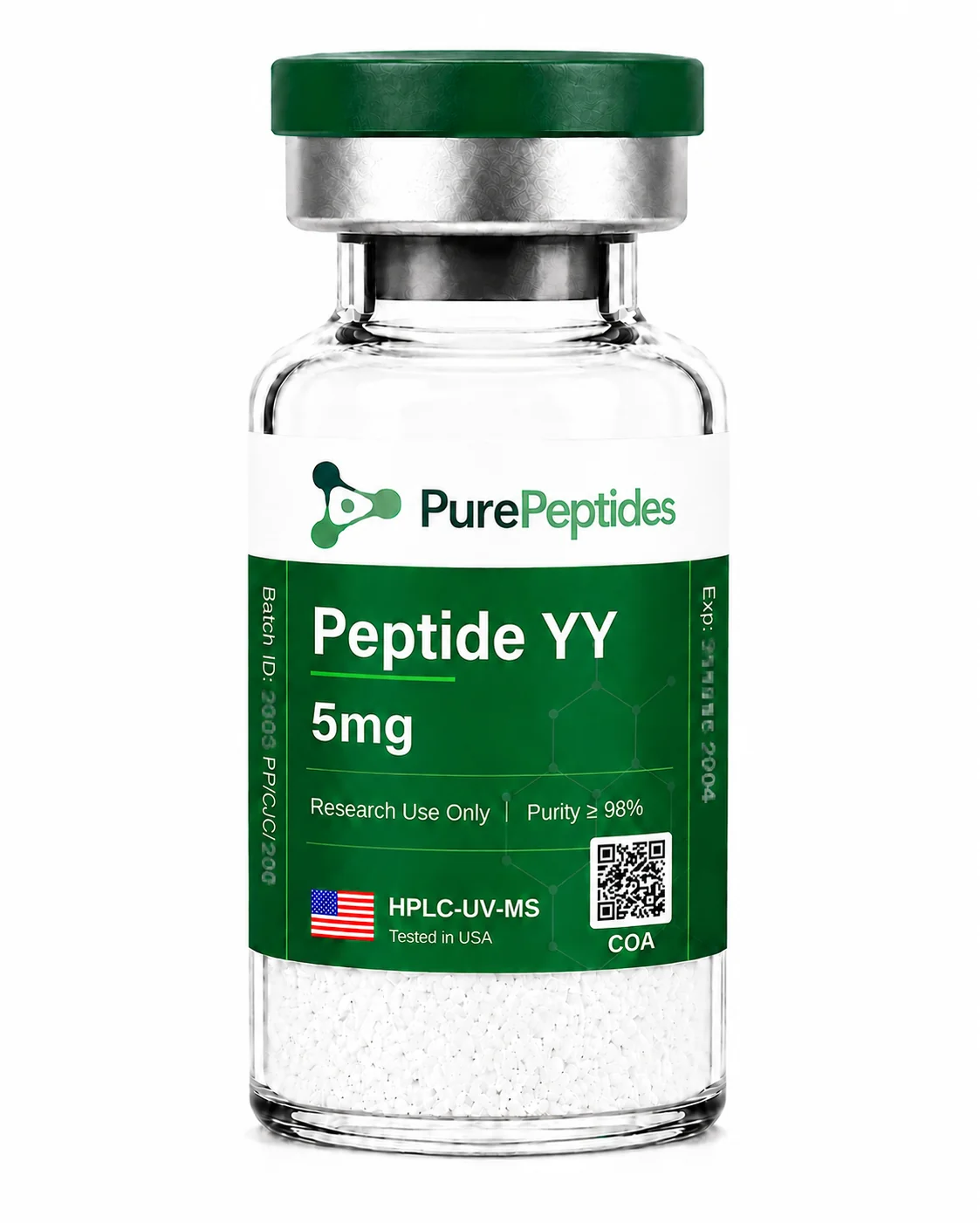
Peptide YY (PYY 3-36)
$47.00
Supplied as a lyophilised powder and independently verified to ≥98% purity by HPLC and MS-UPLC analysis.
1000 in stock
🔥 Exclusive Crypto Offer
Get an INSTANT 15% DISCOUNT when you pay with Bitcoin, Ethereum, Dogecoin, Bitcoin Cash, XRP, Solana, or USDT.
⚡ Don't have crypto? Buy it here in 5 minutes with easy guidance.
💡 Pro Tip: You can also pay with cryptocurrency using your verified Cash App or PayPal account for a fast and secure checkout!
What is Peptide YY (PYY 3-36)?
Peptide YY 3-36 is a natural gut peptide released after eating that travels to the brain to signal fullness and slow stomach emptying. It is used in research as a reference compound for studying appetite and gut-brain signaling.
- A natural gut peptide released by the intestine after eating
- Studied in published research for its effects on fullness (satiety) signaling via the NPY Y2 receptor
- Investigated in animal research for its effects on stomach emptying and how long fullness lasts
- Studied in metabolism research on gut-brain signaling
For research use only. Not approved for human therapeutic use.
Peptide YY 3-36 (CAS 123583-37-9), also known as PYY(3-36), is a synthetic 34-amino acid polypeptide with an approximate molecular weight of 4049 g/mol. PYY 3-36 corresponds to the endogenous truncated form of the full-length 36-amino acid Peptide YY, generated by dipeptidyl peptidase-IV (DPP-IV) cleavage of the N-terminal Tyr-Pro dipeptide. It belongs to the neuropeptide Y (NPY) family of peptides and shares the characteristic PP-fold tertiary structure consisting of an extended polyproline helix and an alpha-helix connected by beta-turns. Produced via solid-phase peptide synthesis, PYY 3-36 acts as a selective agonist at the neuropeptide Y2 receptor (Y2R) and is one of the most extensively studied gut-derived satiety peptides.
PYY 3-36 is the principal circulating form of Peptide YY. The DPP-IV-mediated N-terminal truncation that generates PYY 3-36 from PYY 1-36 fundamentally alters the peptide’s receptor selectivity profile, converting a non-selective NPY receptor agonist into a Y2R-selective ligand. Published research has documented that PYY 3-36 acts on the hypothalamic arcuate nucleus through the Y2 receptor, establishing Y2R as the receptor mediating PYY 3-36 modulation of the arcuate NPY/orexigenic circuitry [1]. In vivo rodent studies documented that peripheral administration of PYY 3-36 reduced food intake in rodents in a manner dependent on the Y2 receptor, and that PYY 3-36 and glucagon-like peptide-1 (GLP-1) inhibit food intake additively when co-administered, consistent with an interplay between these two gut-derived hormones in the control of feeding [1][2], making PYY 3-36 a key reference compound in preclinical metabolic and neuroendocrine research examining Y2-receptor-mediated, arcuate-nucleus-directed regulation of food intake by gut-derived satiety peptides.
Peptide YY (PYY 3-36) is produced to research-grade standards and independently verified by third-party HPLC and MS-UPLC analysis before dispatch. Vials are vacuum sealed and stored in a temperature controlled, monitored cold storage system. Certificates of Analysis are available on request.
Sold strictly for in vitro research purposes only. Not for human consumption. Intended for use by qualified researchers in laboratory settings only.
References
1Batterham RL, Cowley MA, Small CJ, Herzog H, Cohen MA, Dakin CL, et al. Gut hormone PYY(3-36) physiologically inhibits food intake. Nature. 2002 Aug 8;418(6898):650–4. .PubMed PMID: 121678642Neary NM, Small CJ, Druce MR, Park AJ, Ellis SM, Semjonous NM, et al. Peptide YY3-36 and glucagon-like peptide-17-36 inhibit food intake additively. Endocrinology. 2005 Dec;146(12):5120–7. .PubMed PMID: 16150917
Scientific Review

Dr. Martina Rossi, PhD
Scientific Contributor and Reviewer
Reviewed for scientific accuracy, 14 June 2026
View credentials →
Peptide YY 3-36 (CAS 123583-37-9), also known as PYY(3-36), is a synthetic 34-amino acid polypeptide with an approximate molecular weight of 4049 g/mol. PYY 3-36 corresponds to the endogenous truncated form of the full-length 36-amino acid Peptide YY, generated by dipeptidyl peptidase-IV (DPP-IV) cleavage of the N-terminal Tyr-Pro dipeptide. It belongs to the neuropeptide Y (NPY) family of peptides and shares the characteristic PP-fold tertiary structure consisting of an extended polyproline helix and an alpha-helix connected by beta-turns. Produced via solid-phase peptide synthesis, PYY 3-36 acts as a selective agonist at the neuropeptide Y2 receptor (Y2R) and is one of the most extensively studied gut-derived satiety peptides.
PYY 3-36 is the principal circulating form of Peptide YY. The DPP-IV-mediated N-terminal truncation that generates PYY 3-36 from PYY 1-36 fundamentally alters the peptide’s receptor selectivity profile, converting a non-selective NPY receptor agonist into a Y2R-selective ligand. Published research has documented that PYY 3-36 acts on the hypothalamic arcuate nucleus through the Y2 receptor, establishing Y2R as the receptor mediating PYY 3-36 modulation of the arcuate NPY/orexigenic circuitry [1]. In vivo rodent studies documented that peripheral administration of PYY 3-36 reduced food intake in rodents in a manner dependent on the Y2 receptor, and that PYY 3-36 and glucagon-like peptide-1 (GLP-1) inhibit food intake additively when co-administered, consistent with an interplay between these two gut-derived hormones in the control of feeding [1][2], making PYY 3-36 a key reference compound in preclinical metabolic and neuroendocrine research examining Y2-receptor-mediated, arcuate-nucleus-directed regulation of food intake by gut-derived satiety peptides.
Peptide YY (PYY 3-36) is produced to research-grade standards and independently verified by third-party HPLC and MS-UPLC analysis before dispatch. Vials are vacuum sealed and stored in a temperature controlled, monitored cold storage system. Certificates of Analysis are available on request.
Sold strictly for in vitro research purposes only. Not for human consumption. Intended for use by qualified researchers in laboratory settings only.
References
1Batterham RL, Cowley MA, Small CJ, Herzog H, Cohen MA, Dakin CL, et al. Gut hormone PYY(3-36) physiologically inhibits food intake. Nature. 2002 Aug 8;418(6898):650–4. .PubMed PMID: 121678642Neary NM, Small CJ, Druce MR, Park AJ, Ellis SM, Semjonous NM, et al. Peptide YY3-36 and glucagon-like peptide-17-36 inhibit food intake additively. Endocrinology. 2005 Dec;146(12):5120–7. .PubMed PMID: 16150917
Scientific Review
Dr. Martina Rossi, PhD
Scientific Contributor and Reviewer
Reviewed for scientific accuracy, 14 June 2026
View credentials →CAS Number123583-37-9Molecular Weight4,049.52 g/molPurity≥98%Physical FormLyophilised PowderManufacturingManufactured in an ISO9001 Certified LaboratoryTestingHPLC + MS-UPLCSKUPYY336
Lyophilised powder: store at -20 °C or below, away from light and moisture. Once reconstituted in an appropriate laboratory diluent (e.g. sterile water, PBS, or assay buffer), store at 2–8 °C and use within the validated period for your protocol. Do not refreeze.
Peptide YY 3-36 (CAS 123583-37-9), also known as PYY(3-36), is a synthetic 34-amino acid polypeptide with an approximate molecular weight of 4049 g/mol. PYY 3-36 corresponds to the endogenous truncated form of the full-length 36-amino acid Peptide YY, generated by dipeptidyl peptidase-IV (DPP-IV) cleavage of the N-terminal Tyr-Pro dipeptide. It belongs to the neuropeptide Y (NPY) family of peptides and shares the characteristic PP-fold tertiary structure consisting of an extended polyproline helix and an alpha-helix connected by beta-turns. Produced via solid-phase peptide synthesis, PYY 3-36 acts as a selective agonist at the neuropeptide Y2 receptor (Y2R) and is one of the most extensively studied gut-derived satiety peptides.
PYY 3-36 is the principal circulating form of Peptide YY. The DPP-IV-mediated N-terminal truncation that generates PYY 3-36 from PYY 1-36 fundamentally alters the peptide’s receptor selectivity profile, converting a non-selective NPY receptor agonist into a Y2R-selective ligand. Published research has documented that PYY 3-36 acts on the hypothalamic arcuate nucleus through the Y2 receptor, establishing Y2R as the receptor mediating PYY 3-36 modulation of the arcuate NPY/orexigenic circuitry [1]. In vivo rodent studies documented that peripheral administration of PYY 3-36 reduced food intake in rodents in a manner dependent on the Y2 receptor, and that PYY 3-36 and glucagon-like peptide-1 (GLP-1) inhibit food intake additively when co-administered, consistent with an interplay between these two gut-derived hormones in the control of feeding [1][2], making PYY 3-36 a key reference compound in preclinical metabolic and neuroendocrine research examining Y2-receptor-mediated, arcuate-nucleus-directed regulation of food intake by gut-derived satiety peptides.
Peptide YY (PYY 3-36) is produced to research-grade standards and independently verified by third-party HPLC and MS-UPLC analysis before dispatch. Vials are vacuum sealed and stored in a temperature controlled, monitored cold storage system. Certificates of Analysis are available on request.
Sold strictly for in vitro research purposes only. Not for human consumption. Intended for use by qualified researchers in laboratory settings only.
References
1Batterham RL, Cowley MA, Small CJ, Herzog H, Cohen MA, Dakin CL, et al. Gut hormone PYY(3-36) physiologically inhibits food intake. Nature. 2002 Aug 8;418(6898):650–4. .PubMed PMID: 121678642Neary NM, Small CJ, Druce MR, Park AJ, Ellis SM, Semjonous NM, et al. Peptide YY3-36 and glucagon-like peptide-17-36 inhibit food intake additively. Endocrinology. 2005 Dec;146(12):5120–7. .PubMed PMID: 16150917
Scientific Review
Dr. Martina Rossi, PhD
Scientific Contributor and Reviewer
Reviewed for scientific accuracy, 14 June 2026
View credentials →CAS Number123583-37-9Molecular Weight4,049.52 g/molPurity≥98%Physical FormLyophilised PowderManufacturingManufactured in an ISO9001 Certified LaboratoryTestingHPLC + MS-UPLCSKUPYY336
Lyophilised powder: store at -20 °C or below, away from light and moisture. Once reconstituted in an appropriate laboratory diluent (e.g. sterile water, PBS, or assay buffer), store at 2–8 °C and use within the validated period for your protocol. Do not refreeze.
Related products

GH Axis Research

GH Axis Research
GH Axis Research

GH Axis Research

GH Axis Research

GH Axis Research

GH Axis Research
GH Axis Research