
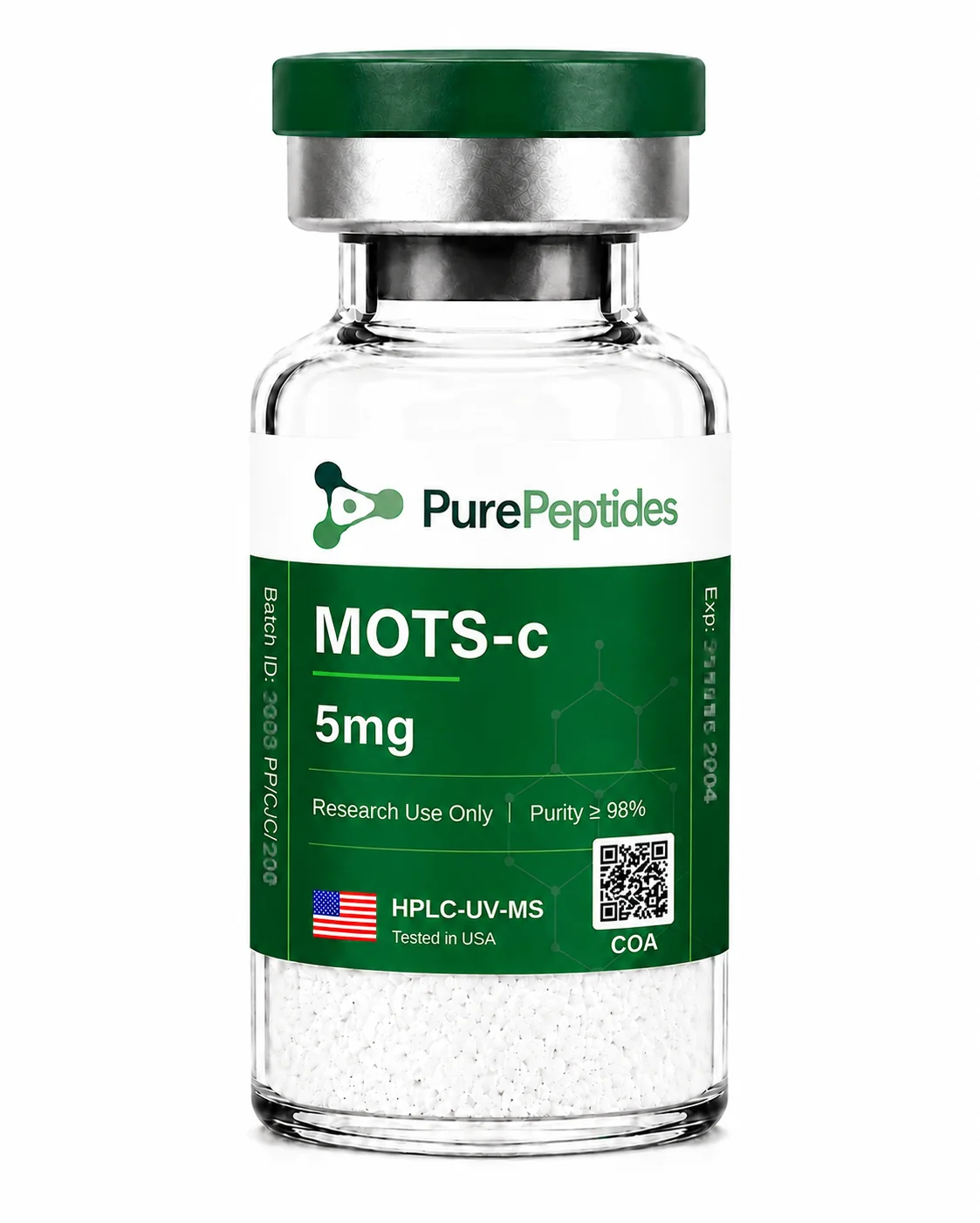
MOTS-c
$47.00
Supplied as a lyophilised powder and independently verified to ≥98% purity by HPLC and MS-UPLC analysis.
1000 in stock
🔥 Exclusive Crypto Offer
Get an INSTANT 15% DISCOUNT when you pay with Bitcoin, Ethereum, Dogecoin, Bitcoin Cash, XRP, Solana, or USDT.
⚡ Don't have crypto? Buy it here in 5 minutes with easy guidance.
💡 Pro Tip: You can also pay with cryptocurrency using your verified Cash App or PayPal account for a fast and secure checkout!
What is MOTS-c?
MOTS-c is a peptide encoded inside mitochondrial DNA, which surprised researchers when reported in 2015. Made inside mitochondria, it acts as a metabolic regulator and is studied in animal research for its effects on how cells handle sugar and energy.
- Encoded in mitochondrial DNA rather than the cell nucleus, a rare class of peptide
- Studied in metabolism research including the AMPK energy pathway
- Animal studies looked at insulin-sensitivity and glucose-uptake markers
- Investigated for its effects on exercise-related metabolism and aging
For research use only. Not approved for human therapeutic use.
MOTS-c (CAS 1627580-64-6), an abbreviation for Mitochondrial Open Reading Frame of the 12S rRNA Type-c, is a synthetic 16-amino acid peptide with the molecular formula C101H152N28O22S2 and a molecular weight of 2174.64 g/mol. Defined by the amino acid sequence Met-Arg-Trp-Gln-Glu-Met-Gly-Tyr-Ile-Phe-Tyr-Pro-Arg-Lys-Leu-Arg, MOTS-c is encoded within the 12S rRNA gene of mitochondrial DNA, a region not previously recognised as protein-coding. First characterised in 2015, it belongs to the mitochondrial-derived peptide (MDP) class. Produced via solid-phase peptide synthesis, MOTS-c is associated with AMP-activated protein kinase (AMPK) signalling and cellular metabolic regulation in preclinical research.
MOTS-c has been extensively investigated in preclinical metabolic research as the first mitochondrial-encoded peptide characterised in published studies as translocating to the cell nucleus and participating in transcriptional regulation. Its first 11 amino acid residues are highly conserved across mammalian species, a feature noted in the published literature as consistent with a preserved biological role within the mitochondrial signalling repertoire. In vitro studies in L6 skeletal muscle cell line preparations have investigated MOTS-c’s interaction with AMPK-dependent metabolic pathways, documenting effects on glucose metabolism, folate-methionine cycling, and de novo purine biosynthesis as downstream readouts of MOTS-c-mediated metabolic signalling engagement [1]. In vivo rodent studies have examined MOTS-c’s relationship with exercise-responsive physiology and age-related metabolic changes, documenting circulating MOTS-c concentrations, skeletal muscle metabolomic profiles, and physiological adaptations following exogenous administration, and characterising MOTS-c as an exercise-induced mitochondrial-encoded regulator of age-dependent physical decline and muscle homeostasis under controlled preclinical conditions [2], making MOTS-c a key reference compound in mitochondrial-derived peptide research.
MOTS-c is produced to research-grade standards and independently verified by third-party HPLC and MS-UPLC analysis before dispatch. Vials are vacuum sealed and stored in a temperature controlled, monitored cold storage system. Certificates of Analysis are available on request.
Sold strictly for in vitro research purposes only. Not for human consumption. Intended for use by qualified researchers in laboratory settings only.
References
1Lee C, Zeng J, Drew BG, Sallam T, Martin-Montalvo A, Wan J, et al. The mitochondrial-derived peptide MOTS-c promotes metabolic homeostasis and reduces obesity and insulin resistance. Cell Metab. 2015 Mar 3;21(3):443–54. ; PubMed Central PMCID: PMC4350682.PubMed PMID: 257384592Reynolds JC, Lai RW, Woodhead JST, Joly JH, Mitchell CJ, Cameron-Smith D, et al. MOTS-c is an exercise-induced mitochondrial-encoded regulator of age-dependent physical decline and muscle homeostasis. Nat Commun. 2021 Jan 20;12(1):470. ; PubMed Central PMCID: PMC7817689.PubMed PMID: 33473109
Scientific Review

Dr. Martina Rossi, PhD
Scientific Contributor and Reviewer
Reviewed for scientific accuracy, 14 June 2026
View credentials →
MOTS-c (CAS 1627580-64-6), an abbreviation for Mitochondrial Open Reading Frame of the 12S rRNA Type-c, is a synthetic 16-amino acid peptide with the molecular formula C101H152N28O22S2 and a molecular weight of 2174.64 g/mol. Defined by the amino acid sequence Met-Arg-Trp-Gln-Glu-Met-Gly-Tyr-Ile-Phe-Tyr-Pro-Arg-Lys-Leu-Arg, MOTS-c is encoded within the 12S rRNA gene of mitochondrial DNA, a region not previously recognised as protein-coding. First characterised in 2015, it belongs to the mitochondrial-derived peptide (MDP) class. Produced via solid-phase peptide synthesis, MOTS-c is associated with AMP-activated protein kinase (AMPK) signalling and cellular metabolic regulation in preclinical research.
MOTS-c has been extensively investigated in preclinical metabolic research as the first mitochondrial-encoded peptide characterised in published studies as translocating to the cell nucleus and participating in transcriptional regulation. Its first 11 amino acid residues are highly conserved across mammalian species, a feature noted in the published literature as consistent with a preserved biological role within the mitochondrial signalling repertoire. In vitro studies in L6 skeletal muscle cell line preparations have investigated MOTS-c’s interaction with AMPK-dependent metabolic pathways, documenting effects on glucose metabolism, folate-methionine cycling, and de novo purine biosynthesis as downstream readouts of MOTS-c-mediated metabolic signalling engagement [1]. In vivo rodent studies have examined MOTS-c’s relationship with exercise-responsive physiology and age-related metabolic changes, documenting circulating MOTS-c concentrations, skeletal muscle metabolomic profiles, and physiological adaptations following exogenous administration, and characterising MOTS-c as an exercise-induced mitochondrial-encoded regulator of age-dependent physical decline and muscle homeostasis under controlled preclinical conditions [2], making MOTS-c a key reference compound in mitochondrial-derived peptide research.
MOTS-c is produced to research-grade standards and independently verified by third-party HPLC and MS-UPLC analysis before dispatch. Vials are vacuum sealed and stored in a temperature controlled, monitored cold storage system. Certificates of Analysis are available on request.
Sold strictly for in vitro research purposes only. Not for human consumption. Intended for use by qualified researchers in laboratory settings only.
References
1Lee C, Zeng J, Drew BG, Sallam T, Martin-Montalvo A, Wan J, et al. The mitochondrial-derived peptide MOTS-c promotes metabolic homeostasis and reduces obesity and insulin resistance. Cell Metab. 2015 Mar 3;21(3):443–54. ; PubMed Central PMCID: PMC4350682.PubMed PMID: 257384592Reynolds JC, Lai RW, Woodhead JST, Joly JH, Mitchell CJ, Cameron-Smith D, et al. MOTS-c is an exercise-induced mitochondrial-encoded regulator of age-dependent physical decline and muscle homeostasis. Nat Commun. 2021 Jan 20;12(1):470. ; PubMed Central PMCID: PMC7817689.PubMed PMID: 33473109
Scientific Review
Dr. Martina Rossi, PhD
Scientific Contributor and Reviewer
Reviewed for scientific accuracy, 14 June 2026
View credentials →CAS Number1627580-64-6Molecular Weight2,174.62 g/molPurity≥98%Physical FormLyophilised PowderManufacturingManufactured in an ISO9001 Certified LaboratoryTestingHPLC + MS-UPLCSKUMOTSC
Lyophilised powder: store at -20 °C or below, away from light and moisture. Once reconstituted in an appropriate laboratory diluent (e.g. sterile water, PBS, or assay buffer), store at 2–8 °C and use within the validated period for your protocol. Do not refreeze.
MOTS-c (CAS 1627580-64-6), an abbreviation for Mitochondrial Open Reading Frame of the 12S rRNA Type-c, is a synthetic 16-amino acid peptide with the molecular formula C101H152N28O22S2 and a molecular weight of 2174.64 g/mol. Defined by the amino acid sequence Met-Arg-Trp-Gln-Glu-Met-Gly-Tyr-Ile-Phe-Tyr-Pro-Arg-Lys-Leu-Arg, MOTS-c is encoded within the 12S rRNA gene of mitochondrial DNA, a region not previously recognised as protein-coding. First characterised in 2015, it belongs to the mitochondrial-derived peptide (MDP) class. Produced via solid-phase peptide synthesis, MOTS-c is associated with AMP-activated protein kinase (AMPK) signalling and cellular metabolic regulation in preclinical research.
MOTS-c has been extensively investigated in preclinical metabolic research as the first mitochondrial-encoded peptide characterised in published studies as translocating to the cell nucleus and participating in transcriptional regulation. Its first 11 amino acid residues are highly conserved across mammalian species, a feature noted in the published literature as consistent with a preserved biological role within the mitochondrial signalling repertoire. In vitro studies in L6 skeletal muscle cell line preparations have investigated MOTS-c’s interaction with AMPK-dependent metabolic pathways, documenting effects on glucose metabolism, folate-methionine cycling, and de novo purine biosynthesis as downstream readouts of MOTS-c-mediated metabolic signalling engagement [1]. In vivo rodent studies have examined MOTS-c’s relationship with exercise-responsive physiology and age-related metabolic changes, documenting circulating MOTS-c concentrations, skeletal muscle metabolomic profiles, and physiological adaptations following exogenous administration, and characterising MOTS-c as an exercise-induced mitochondrial-encoded regulator of age-dependent physical decline and muscle homeostasis under controlled preclinical conditions [2], making MOTS-c a key reference compound in mitochondrial-derived peptide research.
MOTS-c is produced to research-grade standards and independently verified by third-party HPLC and MS-UPLC analysis before dispatch. Vials are vacuum sealed and stored in a temperature controlled, monitored cold storage system. Certificates of Analysis are available on request.
Sold strictly for in vitro research purposes only. Not for human consumption. Intended for use by qualified researchers in laboratory settings only.
References
1Lee C, Zeng J, Drew BG, Sallam T, Martin-Montalvo A, Wan J, et al. The mitochondrial-derived peptide MOTS-c promotes metabolic homeostasis and reduces obesity and insulin resistance. Cell Metab. 2015 Mar 3;21(3):443–54. ; PubMed Central PMCID: PMC4350682.PubMed PMID: 257384592Reynolds JC, Lai RW, Woodhead JST, Joly JH, Mitchell CJ, Cameron-Smith D, et al. MOTS-c is an exercise-induced mitochondrial-encoded regulator of age-dependent physical decline and muscle homeostasis. Nat Commun. 2021 Jan 20;12(1):470. ; PubMed Central PMCID: PMC7817689.PubMed PMID: 33473109
Scientific Review
Dr. Martina Rossi, PhD
Scientific Contributor and Reviewer
Reviewed for scientific accuracy, 14 June 2026
View credentials →CAS Number1627580-64-6Molecular Weight2,174.62 g/molPurity≥98%Physical FormLyophilised PowderManufacturingManufactured in an ISO9001 Certified LaboratoryTestingHPLC + MS-UPLCSKUMOTSC
Lyophilised powder: store at -20 °C or below, away from light and moisture. Once reconstituted in an appropriate laboratory diluent (e.g. sterile water, PBS, or assay buffer), store at 2–8 °C and use within the validated period for your protocol. Do not refreeze.
Related products

Regeneration Research

Regeneration Research

Regeneration Research

Regeneration Research
Regeneration Research

Regeneration Research
Regeneration Research

Regeneration Research