
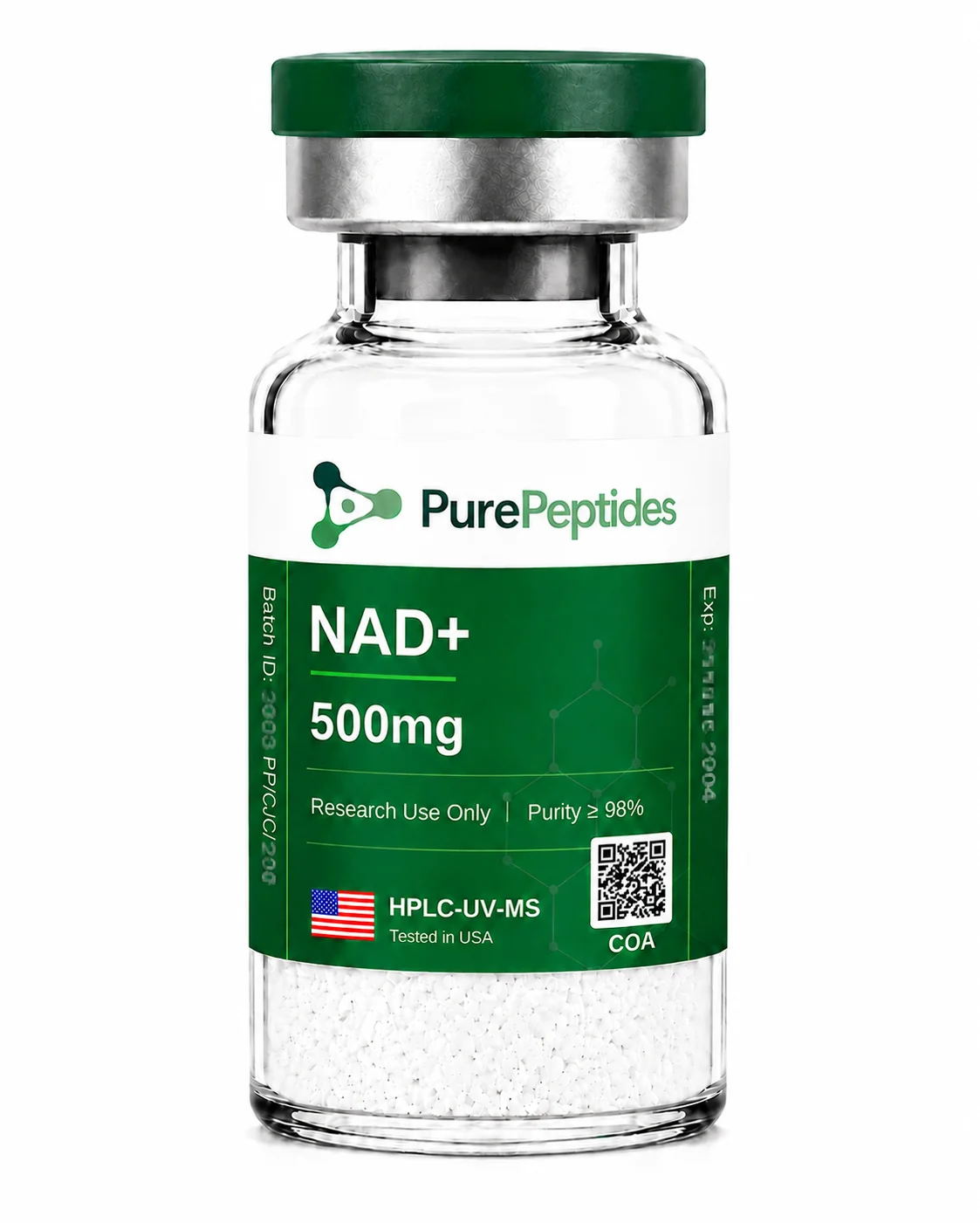
NAD+ Research Nucleotide
$164.00
Supplied as a lyophilised powder and independently verified to ≥98% purity by HPLC and MS-UPLC analysis.
1000 in stock
🔥 Exclusive Crypto Offer
Get an INSTANT 15% DISCOUNT when you pay with Bitcoin, Ethereum, Dogecoin, Bitcoin Cash, XRP, Solana, or USDT.
⚡ Don't have crypto? Buy it here in 5 minutes with easy guidance.
💡 Pro Tip: You can also pay with cryptocurrency using your verified Cash App or PayPal account for a fast and secure checkout!
What is NAD+?
NAD+ is a coenzyme found in every living cell, essential for turning nutrients into energy and for the activity of repair and signaling enzymes such as sirtuins and PARPs. It is studied in laboratory and animal research for its effects on metabolism, brain and heart-cell signaling. NAD+ is a nucleotide, not a peptide.
- A core energy coenzyme involved in turning nutrients into cellular energy
- Required by sirtuin enzymes that regulate DNA repair and gene activity
- Also required by PARP repair enzymes and CD38 signaling
- Studied in animal research on metabolism, brain and heart-cell signaling (a nucleotide, not a peptide)
For research use only. Not approved for human therapeutic use.
NAD+ (CAS 53-84-9), formally designated Nicotinamide Adenine Dinucleotide (oxidised form), is a dinucleotide coenzyme with the molecular formula C21H27N7O14P2 and a molecular weight of 663.43 g/mol. Unlike the peptide compounds in this catalogue, NAD+ is a pyridine nucleotide consisting of two nucleotides, nicotinamide mononucleotide (NMN) and adenosine monophosphate (AMP), joined by a pyrophosphate bond. Its structure features a nicotinamide ring capable of accepting a hydride ion (H-) to form the reduced form NADH, a redox transition central to its role as an electron carrier. NAD+ is produced via chemical synthesis and is one of the most extensively studied coenzymes in preclinical metabolic and ageing research.
NAD+ is a coenzyme required by over 500 enzymatic reactions and acting as a co-substrate for three major classes of signalling enzymes: sirtuins (SIRT1-7), poly(ADP-ribose) polymerases (PARPs), and cyclic ADP-ribose synthases (CD38/CD157). Published in vitro studies have shown that the silencing and longevity protein Sir2 deacetylates histone H3 at lysines 9 and 14 in a strictly NAD+-dependent reaction, thereby directly linking the cellular NAD+ pool to protein-deacetylation activity [1]. In vivo rodent studies have shown that age-related declines in tissue NAD+ disrupt nuclear–mitochondrial communication, while restoring NAD+ levels can restore mitochondrial function in aged mice [2], and that restoring NAD+ salvage pathway flux can alter metabolic outcomes, with nicotinamide mononucleotide ameliorating glucose intolerance and increasing insulin sensitivity in diet- and age-induced diabetic mice [3], making NAD+ a reference coenzyme in preclinical metabolic and ageing research examining sirtuin- and PARP-mediated NAD+ consumption and age-dependent NAD+ decline in rodent models.
NAD+ is produced to research-grade standards and independently verified by third-party HPLC and MS-UPLC analysis before dispatch. Vials are vacuum sealed and stored in a temperature controlled, monitored cold storage system. Certificates of Analysis are available on request.
Sold strictly for in vitro research purposes only. Not for human consumption. Intended for use by qualified researchers in laboratory settings only.
References
1Imai S, Armstrong CM, Kaeberlein M, Guarente L. Transcriptional silencing and longevity protein Sir2 is an NAD-dependent histone deacetylase. Nature. 2000 Feb 17;403(6771):795–800. .PubMed PMID: 106938112Gomes AP, Price NL, Ling AJY, Moslehi JJ, Montgomery MK, Rajman L, et al. Declining NAD(+) induces a pseudohypoxic state disrupting nuclear-mitochondrial communication during aging. Cell. 2013 Dec 19;155(7):1624–38. ; PubMed Central PMCID: PMC4076149.PubMed PMID: 243602823Yoshino J, Mills KF, Yoon MJ, Imai S ichiro. Nicotinamide mononucleotide, a key NAD+ intermediate, treats the pathophysiology of diet- and age-induced diabetes in mice. Cell Metab. 2011 Oct 5;14(4):528–36. ; PubMed Central PMCID: PMC3204926.PubMed PMID: 21982712
Scientific Review

Dr. Martina Rossi, PhD
Scientific Contributor and Reviewer
Reviewed for scientific accuracy, 14 June 2026
View credentials →
NAD+ (CAS 53-84-9), formally designated Nicotinamide Adenine Dinucleotide (oxidised form), is a dinucleotide coenzyme with the molecular formula C21H27N7O14P2 and a molecular weight of 663.43 g/mol. Unlike the peptide compounds in this catalogue, NAD+ is a pyridine nucleotide consisting of two nucleotides, nicotinamide mononucleotide (NMN) and adenosine monophosphate (AMP), joined by a pyrophosphate bond. Its structure features a nicotinamide ring capable of accepting a hydride ion (H-) to form the reduced form NADH, a redox transition central to its role as an electron carrier. NAD+ is produced via chemical synthesis and is one of the most extensively studied coenzymes in preclinical metabolic and ageing research.
NAD+ is a coenzyme required by over 500 enzymatic reactions and acting as a co-substrate for three major classes of signalling enzymes: sirtuins (SIRT1-7), poly(ADP-ribose) polymerases (PARPs), and cyclic ADP-ribose synthases (CD38/CD157). Published in vitro studies have shown that the silencing and longevity protein Sir2 deacetylates histone H3 at lysines 9 and 14 in a strictly NAD+-dependent reaction, thereby directly linking the cellular NAD+ pool to protein-deacetylation activity [1]. In vivo rodent studies have shown that age-related declines in tissue NAD+ disrupt nuclear–mitochondrial communication, while restoring NAD+ levels can restore mitochondrial function in aged mice [2], and that restoring NAD+ salvage pathway flux can alter metabolic outcomes, with nicotinamide mononucleotide ameliorating glucose intolerance and increasing insulin sensitivity in diet- and age-induced diabetic mice [3], making NAD+ a reference coenzyme in preclinical metabolic and ageing research examining sirtuin- and PARP-mediated NAD+ consumption and age-dependent NAD+ decline in rodent models.
NAD+ is produced to research-grade standards and independently verified by third-party HPLC and MS-UPLC analysis before dispatch. Vials are vacuum sealed and stored in a temperature controlled, monitored cold storage system. Certificates of Analysis are available on request.
Sold strictly for in vitro research purposes only. Not for human consumption. Intended for use by qualified researchers in laboratory settings only.
References
1Imai S, Armstrong CM, Kaeberlein M, Guarente L. Transcriptional silencing and longevity protein Sir2 is an NAD-dependent histone deacetylase. Nature. 2000 Feb 17;403(6771):795–800. .PubMed PMID: 106938112Gomes AP, Price NL, Ling AJY, Moslehi JJ, Montgomery MK, Rajman L, et al. Declining NAD(+) induces a pseudohypoxic state disrupting nuclear-mitochondrial communication during aging. Cell. 2013 Dec 19;155(7):1624–38. ; PubMed Central PMCID: PMC4076149.PubMed PMID: 243602823Yoshino J, Mills KF, Yoon MJ, Imai S ichiro. Nicotinamide mononucleotide, a key NAD+ intermediate, treats the pathophysiology of diet- and age-induced diabetes in mice. Cell Metab. 2011 Oct 5;14(4):528–36. ; PubMed Central PMCID: PMC3204926.PubMed PMID: 21982712
Scientific Review
Dr. Martina Rossi, PhD
Scientific Contributor and Reviewer
Reviewed for scientific accuracy, 14 June 2026
View credentials →CAS Number53-84-9Molecular Weight663.43 g/molPurity≥98%Physical FormLyophilised PowderManufacturingManufactured in an ISO9001 Certified LaboratoryTestingHPLC + MS-UPLCSKURSC-NAD-7525
Lyophilised powder: store at -20 °C or below, away from light and moisture. Once reconstituted in an appropriate laboratory diluent (e.g. sterile water, PBS, or assay buffer), store at 2–8 °C and use within the validated period for your protocol. Do not refreeze.
NAD+ (CAS 53-84-9), formally designated Nicotinamide Adenine Dinucleotide (oxidised form), is a dinucleotide coenzyme with the molecular formula C21H27N7O14P2 and a molecular weight of 663.43 g/mol. Unlike the peptide compounds in this catalogue, NAD+ is a pyridine nucleotide consisting of two nucleotides, nicotinamide mononucleotide (NMN) and adenosine monophosphate (AMP), joined by a pyrophosphate bond. Its structure features a nicotinamide ring capable of accepting a hydride ion (H-) to form the reduced form NADH, a redox transition central to its role as an electron carrier. NAD+ is produced via chemical synthesis and is one of the most extensively studied coenzymes in preclinical metabolic and ageing research.
NAD+ is a coenzyme required by over 500 enzymatic reactions and acting as a co-substrate for three major classes of signalling enzymes: sirtuins (SIRT1-7), poly(ADP-ribose) polymerases (PARPs), and cyclic ADP-ribose synthases (CD38/CD157). Published in vitro studies have shown that the silencing and longevity protein Sir2 deacetylates histone H3 at lysines 9 and 14 in a strictly NAD+-dependent reaction, thereby directly linking the cellular NAD+ pool to protein-deacetylation activity [1]. In vivo rodent studies have shown that age-related declines in tissue NAD+ disrupt nuclear–mitochondrial communication, while restoring NAD+ levels can restore mitochondrial function in aged mice [2], and that restoring NAD+ salvage pathway flux can alter metabolic outcomes, with nicotinamide mononucleotide ameliorating glucose intolerance and increasing insulin sensitivity in diet- and age-induced diabetic mice [3], making NAD+ a reference coenzyme in preclinical metabolic and ageing research examining sirtuin- and PARP-mediated NAD+ consumption and age-dependent NAD+ decline in rodent models.
NAD+ is produced to research-grade standards and independently verified by third-party HPLC and MS-UPLC analysis before dispatch. Vials are vacuum sealed and stored in a temperature controlled, monitored cold storage system. Certificates of Analysis are available on request.
Sold strictly for in vitro research purposes only. Not for human consumption. Intended for use by qualified researchers in laboratory settings only.
References
1Imai S, Armstrong CM, Kaeberlein M, Guarente L. Transcriptional silencing and longevity protein Sir2 is an NAD-dependent histone deacetylase. Nature. 2000 Feb 17;403(6771):795–800. .PubMed PMID: 106938112Gomes AP, Price NL, Ling AJY, Moslehi JJ, Montgomery MK, Rajman L, et al. Declining NAD(+) induces a pseudohypoxic state disrupting nuclear-mitochondrial communication during aging. Cell. 2013 Dec 19;155(7):1624–38. ; PubMed Central PMCID: PMC4076149.PubMed PMID: 243602823Yoshino J, Mills KF, Yoon MJ, Imai S ichiro. Nicotinamide mononucleotide, a key NAD+ intermediate, treats the pathophysiology of diet- and age-induced diabetes in mice. Cell Metab. 2011 Oct 5;14(4):528–36. ; PubMed Central PMCID: PMC3204926.PubMed PMID: 21982712
Scientific Review
Dr. Martina Rossi, PhD
Scientific Contributor and Reviewer
Reviewed for scientific accuracy, 14 June 2026
View credentials →CAS Number53-84-9Molecular Weight663.43 g/molPurity≥98%Physical FormLyophilised PowderManufacturingManufactured in an ISO9001 Certified LaboratoryTestingHPLC + MS-UPLCSKURSC-NAD-7525
Lyophilised powder: store at -20 °C or below, away from light and moisture. Once reconstituted in an appropriate laboratory diluent (e.g. sterile water, PBS, or assay buffer), store at 2–8 °C and use within the validated period for your protocol. Do not refreeze.
Related products
Regeneration Research
Regeneration Research
Regeneration Research
Regeneration Research

Regeneration Research
Regeneration Research
Regeneration Research
Regeneration Research