
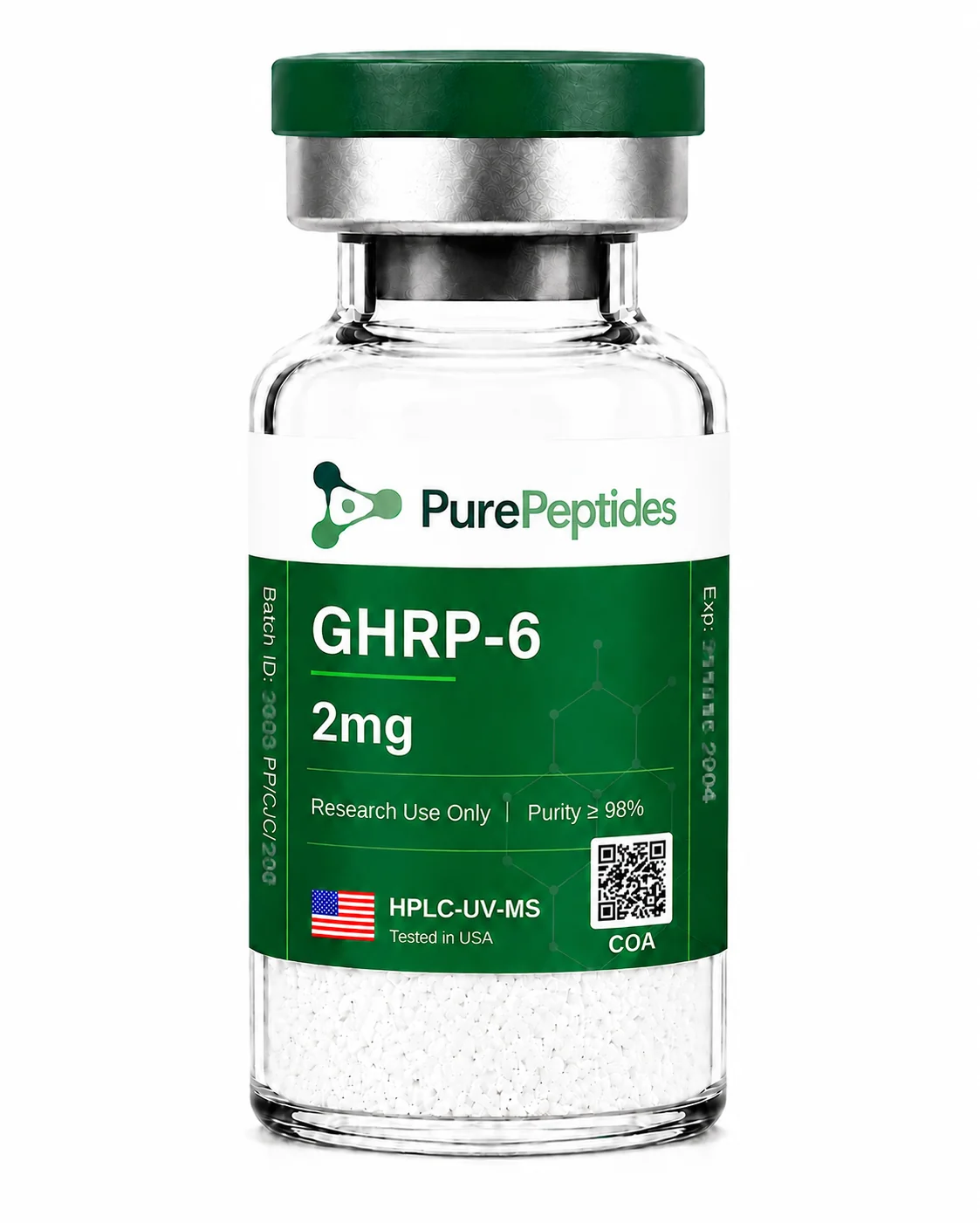
GHRP-6
$21.00
Supplied as a lyophilised powder and independently verified to ≥98% purity by HPLC and MS-UPLC analysis.
1000 in stock
🔥 Exclusive Crypto Offer
Get an INSTANT 15% DISCOUNT when you pay with Bitcoin, Ethereum, Dogecoin, Bitcoin Cash, XRP, Solana, or USDT.
⚡ Don't have crypto? Buy it here in 5 minutes with easy guidance.
💡 Pro Tip: You can also pay with cryptocurrency using your verified Cash App or PayPal account for a fast and secure checkout!
What is GHRP-6?
GHRP-6 is one of the earliest growth-hormone-releasing peptides and remains a common research tool for studying the ghrelin receptor. Like GHRP-2 it prompts the pituitary to release growth hormone, and it is also studied for its effect on appetite signaling in animal research.
- A six-amino-acid peptide widely used as a foundational growth-hormone research tool
- Studied in published research for ghrelin-receptor and growth-hormone signaling
- Investigated in animal research for its effects on appetite signaling
- Used in receptor research to map ghrelin signaling and its downstream pathways
For research use only. Not approved for human therapeutic use.
GHRP-6 (Growth Hormone-Releasing Peptide-6) is a synthetic hexapeptide and one of the earliest characterised growth hormone secretagogues in preclinical research. Defined by the amino acid sequence His-D-Trp-Ala-Trp-D-Phe-Lys-NH2, GHRP-6 has a molecular formula of C46H56N12O6 and a molecular weight of 873.01 g/mol. The incorporation of a D-tryptophan residue at position 2 is considered central to its binding affinity and selectivity at the ghrelin receptor (GHS-R1a). Produced via solid-phase peptide synthesis, GHRP-6 (CAS 87616-84-0) remains a foundational reference compound in the laboratory investigation of the growth hormone axis.
GHRP-6 features extensively in preclinical endocrinology and receptor pharmacology research. Published in vitro studies in primary cultured ovine and rat pituitary somatotroph cell lines have examined GHS-R1a receptor activation and downstream intracellular signalling cascades, characterising intracellular cAMP accumulation, voltage-gated calcium channel dependency, and differential PKC versus PKA pathway contributions to GH secretion [1]. In vivo rodent model studies have investigated the compound’s role in modulating GH pulse amplitude and frequency, with particular attention to its synergistic interaction with endogenous GHRH within the hypothalamic-pituitary axis and the broader somatotropic regulatory network [2]. Its well-characterised receptor profile and consistent use as a benchmark secretagogue have made GHRP-6 a key reference compound when evaluating second and third generation analogues across the secretagogue class.
GHRP-6 is produced to research-grade standards and independently verified by third-party HPLC and MS-UPLC analysis before dispatch. Vials are vacuum sealed and stored in a temperature controlled, monitored cold storage system. Certificates of Analysis are available on request.
Sold strictly for in vitro research purposes only. Not for human consumption. Intended for use by qualified researchers in laboratory settings only.
References
1Wu D, Chen C, Zhang J, Bowers CY, Clarke IJ. The effects of GH-releasing peptide-6 (GHRP-6) and GHRP-2 on intracellular adenosine 3’,5’-monophosphate (cAMP) levels and GH secretion in ovine and rat somatotrophs. J Endocrinol. 1996 Feb;148(2):197–205. .PubMed PMID: 86991332Bowers CY, Momany FA, Reynolds GA, Hong A. On the in vitro and in vivo activity of a new synthetic hexapeptide that acts on the pituitary to specifically release growth hormone. Endocrinology. 1984 May;114(5):1537–45. .PubMed PMID: 6714155
Scientific Review

Dr. Martina Rossi, PhD
Scientific Contributor and Reviewer
Reviewed for scientific accuracy, 14 June 2026
View credentials →
GHRP-6 (Growth Hormone-Releasing Peptide-6) is a synthetic hexapeptide and one of the earliest characterised growth hormone secretagogues in preclinical research. Defined by the amino acid sequence His-D-Trp-Ala-Trp-D-Phe-Lys-NH2, GHRP-6 has a molecular formula of C46H56N12O6 and a molecular weight of 873.01 g/mol. The incorporation of a D-tryptophan residue at position 2 is considered central to its binding affinity and selectivity at the ghrelin receptor (GHS-R1a). Produced via solid-phase peptide synthesis, GHRP-6 (CAS 87616-84-0) remains a foundational reference compound in the laboratory investigation of the growth hormone axis.
GHRP-6 features extensively in preclinical endocrinology and receptor pharmacology research. Published in vitro studies in primary cultured ovine and rat pituitary somatotroph cell lines have examined GHS-R1a receptor activation and downstream intracellular signalling cascades, characterising intracellular cAMP accumulation, voltage-gated calcium channel dependency, and differential PKC versus PKA pathway contributions to GH secretion [1]. In vivo rodent model studies have investigated the compound’s role in modulating GH pulse amplitude and frequency, with particular attention to its synergistic interaction with endogenous GHRH within the hypothalamic-pituitary axis and the broader somatotropic regulatory network [2]. Its well-characterised receptor profile and consistent use as a benchmark secretagogue have made GHRP-6 a key reference compound when evaluating second and third generation analogues across the secretagogue class.
GHRP-6 is produced to research-grade standards and independently verified by third-party HPLC and MS-UPLC analysis before dispatch. Vials are vacuum sealed and stored in a temperature controlled, monitored cold storage system. Certificates of Analysis are available on request.
Sold strictly for in vitro research purposes only. Not for human consumption. Intended for use by qualified researchers in laboratory settings only.
References
1Wu D, Chen C, Zhang J, Bowers CY, Clarke IJ. The effects of GH-releasing peptide-6 (GHRP-6) and GHRP-2 on intracellular adenosine 3’,5’-monophosphate (cAMP) levels and GH secretion in ovine and rat somatotrophs. J Endocrinol. 1996 Feb;148(2):197–205. .PubMed PMID: 86991332Bowers CY, Momany FA, Reynolds GA, Hong A. On the in vitro and in vivo activity of a new synthetic hexapeptide that acts on the pituitary to specifically release growth hormone. Endocrinology. 1984 May;114(5):1537–45. .PubMed PMID: 6714155
Scientific Review
Dr. Martina Rossi, PhD
Scientific Contributor and Reviewer
Reviewed for scientific accuracy, 14 June 2026
View credentials →CAS Number87616-84-0Molecular Weight873.01 g/molPurity≥98%Physical FormLyophilised PowderManufacturingManufactured in an ISO9001 Certified LaboratoryTestingHPLC + MS-UPLCSKUGHRP6
Lyophilised powder: store at -20 °C or below, away from light and moisture. Once reconstituted in an appropriate laboratory diluent (e.g. sterile water, PBS, or assay buffer), store at 2–8 °C and use within the validated period for your protocol. Do not refreeze.
GHRP-6 (Growth Hormone-Releasing Peptide-6) is a synthetic hexapeptide and one of the earliest characterised growth hormone secretagogues in preclinical research. Defined by the amino acid sequence His-D-Trp-Ala-Trp-D-Phe-Lys-NH2, GHRP-6 has a molecular formula of C46H56N12O6 and a molecular weight of 873.01 g/mol. The incorporation of a D-tryptophan residue at position 2 is considered central to its binding affinity and selectivity at the ghrelin receptor (GHS-R1a). Produced via solid-phase peptide synthesis, GHRP-6 (CAS 87616-84-0) remains a foundational reference compound in the laboratory investigation of the growth hormone axis.
GHRP-6 features extensively in preclinical endocrinology and receptor pharmacology research. Published in vitro studies in primary cultured ovine and rat pituitary somatotroph cell lines have examined GHS-R1a receptor activation and downstream intracellular signalling cascades, characterising intracellular cAMP accumulation, voltage-gated calcium channel dependency, and differential PKC versus PKA pathway contributions to GH secretion [1]. In vivo rodent model studies have investigated the compound’s role in modulating GH pulse amplitude and frequency, with particular attention to its synergistic interaction with endogenous GHRH within the hypothalamic-pituitary axis and the broader somatotropic regulatory network [2]. Its well-characterised receptor profile and consistent use as a benchmark secretagogue have made GHRP-6 a key reference compound when evaluating second and third generation analogues across the secretagogue class.
GHRP-6 is produced to research-grade standards and independently verified by third-party HPLC and MS-UPLC analysis before dispatch. Vials are vacuum sealed and stored in a temperature controlled, monitored cold storage system. Certificates of Analysis are available on request.
Sold strictly for in vitro research purposes only. Not for human consumption. Intended for use by qualified researchers in laboratory settings only.
References
1Wu D, Chen C, Zhang J, Bowers CY, Clarke IJ. The effects of GH-releasing peptide-6 (GHRP-6) and GHRP-2 on intracellular adenosine 3’,5’-monophosphate (cAMP) levels and GH secretion in ovine and rat somatotrophs. J Endocrinol. 1996 Feb;148(2):197–205. .PubMed PMID: 86991332Bowers CY, Momany FA, Reynolds GA, Hong A. On the in vitro and in vivo activity of a new synthetic hexapeptide that acts on the pituitary to specifically release growth hormone. Endocrinology. 1984 May;114(5):1537–45. .PubMed PMID: 6714155
Scientific Review
Dr. Martina Rossi, PhD
Scientific Contributor and Reviewer
Reviewed for scientific accuracy, 14 June 2026
View credentials →CAS Number87616-84-0Molecular Weight873.01 g/molPurity≥98%Physical FormLyophilised PowderManufacturingManufactured in an ISO9001 Certified LaboratoryTestingHPLC + MS-UPLCSKUGHRP6
Lyophilised powder: store at -20 °C or below, away from light and moisture. Once reconstituted in an appropriate laboratory diluent (e.g. sterile water, PBS, or assay buffer), store at 2–8 °C and use within the validated period for your protocol. Do not refreeze.
Related products
GH Axis Research

GH Axis Research

GH Axis Research

GH Axis Research

GH Axis Research
GH Axis Research

GH Axis Research

GH Axis Research