
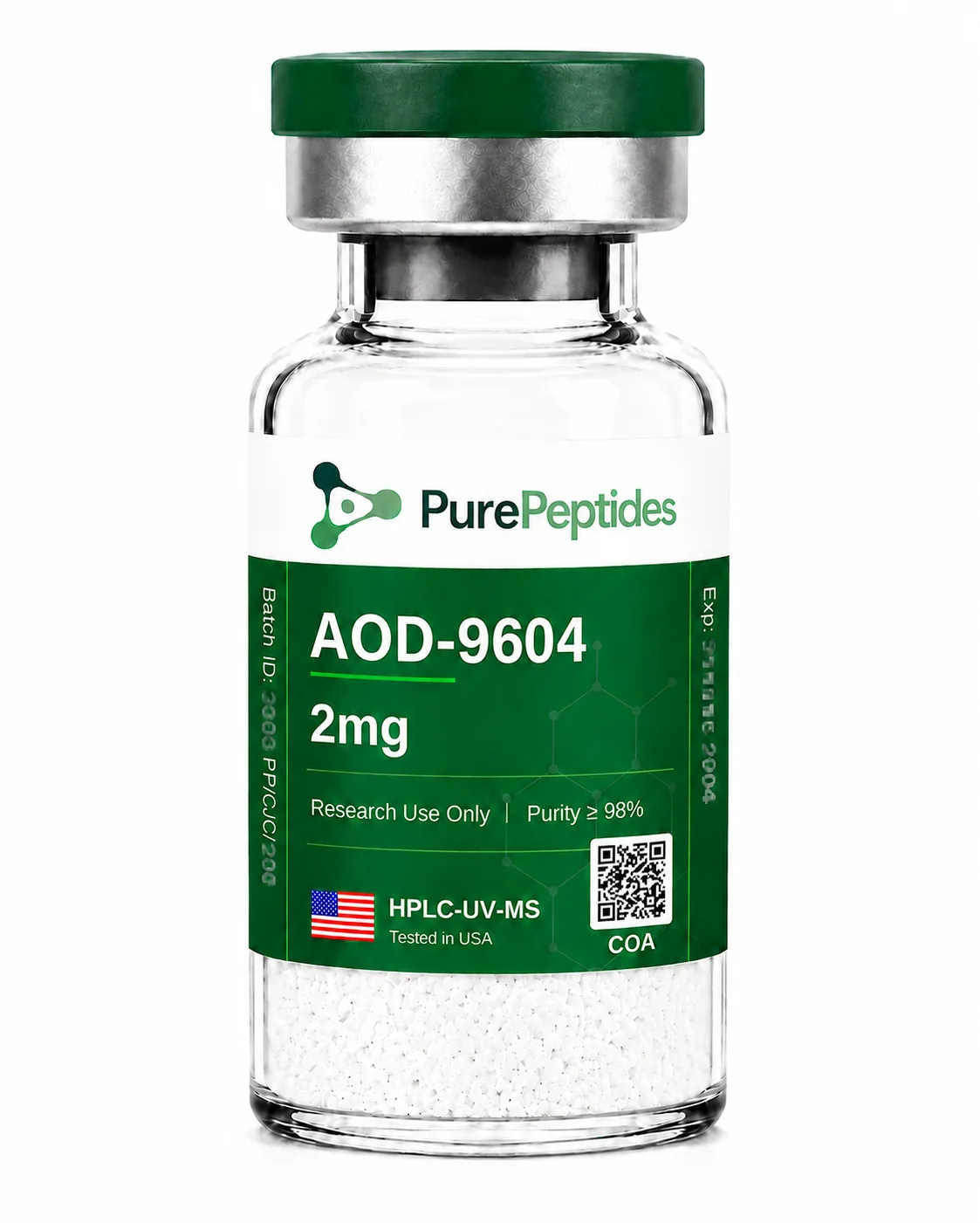
AOD-9604


$47.00
Supplied as a lyophilised powder and independently verified to ≥98% purity by HPLC and MS-UPLC analysis.
1000 in stock
🔥 Exclusive Crypto Offer
Get an INSTANT 15% DISCOUNT when you pay with Bitcoin, Ethereum, Dogecoin, Bitcoin Cash, XRP, Solana, or USDT.
⚡ Don't have crypto? Buy it here in 5 minutes with easy guidance.
💡 Pro Tip: You can also pay with cryptocurrency using your verified Cash App or PayPal account for a fast and secure checkout!
What is AOD-9604?
AOD-9604 is a synthetic peptide based on the tail end (residues 176 to 191) of human growth hormone. It is studied in animal and laboratory research for its effects on how the body breaks down and stores fat.
- Based on the fat-metabolism region of human growth hormone, without the growth-promoting part of the molecule
- Studied in animal research for its effects on fat metabolism
- Investigated in rodent studies for its effects on the breakdown of stored fat, with research noting it did not change blood sugar
- Used in laboratory research as a reference compound for this region of the growth hormone molecule
For research use only. Not approved for human therapeutic use.
AOD-9604 (CAS 221231-10-3), also known as Tyr-hGH Fragment 176-191, is a synthetic 16-amino acid peptide derived from the C-terminal region of human growth hormone (hGH). With the molecular formula C78H123N23O23S2 and a molecular weight of 1815.13 g/mol, AOD-9604 features a characteristic intramolecular disulfide bridge between Cys7 and Cys14. This oxidised disulfide configuration is the defining structural distinction between AOD-9604 and the linear (reduced) form of HGH Fragment 176-191. Produced via solid-phase peptide synthesis.
AOD-9604 has been investigated in preclinical metabolic and adipose tissue research as a structurally constrained derivative of the hGH C-terminal domain. The presence of the intramolecular disulfide bridge has been characterised in published structure-activity studies as conferring conformational rigidity, with researchers comparing the oxidised and reduced forms to characterise the role of disulfide bonding in receptor-independent signalling. In vitro studies in adipocyte-based experimental preparations have examined AOD-9604’s intracellular lipid metabolism pathways and beta-adrenergic receptor-mediated signalling, documenting lipolytic cascade activation and metabolic pathway engagement associated with the oxidised disulfide form of the hGH C-terminal domain [1]. In vivo studies in obese mouse models including beta-3 adrenergic receptor knockout strains have investigated body composition parameters and adipose tissue dynamics following AOD-9604 administration, with published research documenting lipid metabolism outcomes under repeated administration and characterising whether the compound’s metabolic activity operates through beta-3 adrenergic receptor-dependent or receptor-independent mechanisms by directly comparing responses in wild-type and beta-3 AR-deficient animals [2], making AOD-9604 a key reference compound in structure-activity research examining the role of disulfide bonding in hGH C-terminal domain metabolic activity.
AOD-9604 is produced to research-grade standards and independently verified by third-party HPLC and MS-UPLC analysis before dispatch. Vials are vacuum sealed and stored in a temperature controlled, monitored cold storage system. Certificates of Analysis are available on request.
Sold strictly for in vitro research purposes only. Not for human consumption. Intended for use by qualified researchers in laboratory settings only.
References
1Ng FM, Sun J, Sharma L, Libinaka R, Jiang WJ, Gianello R. Metabolic studies of a synthetic lipolytic domain (AOD9604) of human growth hormone. Horm Res. 2000;53(6):274–8. .PubMed PMID: 111463672Heffernan M, Summers RJ, Thorburn A, Ogru E, Gianello R, Jiang WJ, et al. The effects of human GH and its lipolytic fragment (AOD9604) on lipid metabolism following chronic treatment in obese mice and beta(3)-AR knock-out mice. Endocrinology. 2001 Dec;142(12):5182–9. .PubMed PMID: 11713213
Scientific Review

Dr. Martina Rossi, PhD
Scientific Contributor and Reviewer
Reviewed for scientific accuracy, 14 June 2026
View credentials →
AOD-9604 (CAS 221231-10-3), also known as Tyr-hGH Fragment 176-191, is a synthetic 16-amino acid peptide derived from the C-terminal region of human growth hormone (hGH). With the molecular formula C78H123N23O23S2 and a molecular weight of 1815.13 g/mol, AOD-9604 features a characteristic intramolecular disulfide bridge between Cys7 and Cys14. This oxidised disulfide configuration is the defining structural distinction between AOD-9604 and the linear (reduced) form of HGH Fragment 176-191. Produced via solid-phase peptide synthesis.
AOD-9604 has been investigated in preclinical metabolic and adipose tissue research as a structurally constrained derivative of the hGH C-terminal domain. The presence of the intramolecular disulfide bridge has been characterised in published structure-activity studies as conferring conformational rigidity, with researchers comparing the oxidised and reduced forms to characterise the role of disulfide bonding in receptor-independent signalling. In vitro studies in adipocyte-based experimental preparations have examined AOD-9604’s intracellular lipid metabolism pathways and beta-adrenergic receptor-mediated signalling, documenting lipolytic cascade activation and metabolic pathway engagement associated with the oxidised disulfide form of the hGH C-terminal domain [1]. In vivo studies in obese mouse models including beta-3 adrenergic receptor knockout strains have investigated body composition parameters and adipose tissue dynamics following AOD-9604 administration, with published research documenting lipid metabolism outcomes under repeated administration and characterising whether the compound’s metabolic activity operates through beta-3 adrenergic receptor-dependent or receptor-independent mechanisms by directly comparing responses in wild-type and beta-3 AR-deficient animals [2], making AOD-9604 a key reference compound in structure-activity research examining the role of disulfide bonding in hGH C-terminal domain metabolic activity.
AOD-9604 is produced to research-grade standards and independently verified by third-party HPLC and MS-UPLC analysis before dispatch. Vials are vacuum sealed and stored in a temperature controlled, monitored cold storage system. Certificates of Analysis are available on request.
Sold strictly for in vitro research purposes only. Not for human consumption. Intended for use by qualified researchers in laboratory settings only.
References
1Ng FM, Sun J, Sharma L, Libinaka R, Jiang WJ, Gianello R. Metabolic studies of a synthetic lipolytic domain (AOD9604) of human growth hormone. Horm Res. 2000;53(6):274–8. .PubMed PMID: 111463672Heffernan M, Summers RJ, Thorburn A, Ogru E, Gianello R, Jiang WJ, et al. The effects of human GH and its lipolytic fragment (AOD9604) on lipid metabolism following chronic treatment in obese mice and beta(3)-AR knock-out mice. Endocrinology. 2001 Dec;142(12):5182–9. .PubMed PMID: 11713213
Scientific Review
Dr. Martina Rossi, PhD
Scientific Contributor and Reviewer
Reviewed for scientific accuracy, 14 June 2026
View credentials →CAS Number221231-10-3Molecular Weight1,815.07 g/molPurity≥98%Physical FormLyophilised PowderManufacturingManufactured in an ISO9001 Certified LaboratoryTestingHPLC + MS-UPLCSKUAOD9604
Lyophilised powder: store at -20 °C or below, away from light and moisture. Once reconstituted in an appropriate laboratory diluent (e.g. sterile water, PBS, or assay buffer), store at 2–8 °C and use within the validated period for your protocol. Do not refreeze.
AOD-9604 (CAS 221231-10-3), also known as Tyr-hGH Fragment 176-191, is a synthetic 16-amino acid peptide derived from the C-terminal region of human growth hormone (hGH). With the molecular formula C78H123N23O23S2 and a molecular weight of 1815.13 g/mol, AOD-9604 features a characteristic intramolecular disulfide bridge between Cys7 and Cys14. This oxidised disulfide configuration is the defining structural distinction between AOD-9604 and the linear (reduced) form of HGH Fragment 176-191. Produced via solid-phase peptide synthesis.
AOD-9604 has been investigated in preclinical metabolic and adipose tissue research as a structurally constrained derivative of the hGH C-terminal domain. The presence of the intramolecular disulfide bridge has been characterised in published structure-activity studies as conferring conformational rigidity, with researchers comparing the oxidised and reduced forms to characterise the role of disulfide bonding in receptor-independent signalling. In vitro studies in adipocyte-based experimental preparations have examined AOD-9604’s intracellular lipid metabolism pathways and beta-adrenergic receptor-mediated signalling, documenting lipolytic cascade activation and metabolic pathway engagement associated with the oxidised disulfide form of the hGH C-terminal domain [1]. In vivo studies in obese mouse models including beta-3 adrenergic receptor knockout strains have investigated body composition parameters and adipose tissue dynamics following AOD-9604 administration, with published research documenting lipid metabolism outcomes under repeated administration and characterising whether the compound’s metabolic activity operates through beta-3 adrenergic receptor-dependent or receptor-independent mechanisms by directly comparing responses in wild-type and beta-3 AR-deficient animals [2], making AOD-9604 a key reference compound in structure-activity research examining the role of disulfide bonding in hGH C-terminal domain metabolic activity.
AOD-9604 is produced to research-grade standards and independently verified by third-party HPLC and MS-UPLC analysis before dispatch. Vials are vacuum sealed and stored in a temperature controlled, monitored cold storage system. Certificates of Analysis are available on request.
Sold strictly for in vitro research purposes only. Not for human consumption. Intended for use by qualified researchers in laboratory settings only.
References
1Ng FM, Sun J, Sharma L, Libinaka R, Jiang WJ, Gianello R. Metabolic studies of a synthetic lipolytic domain (AOD9604) of human growth hormone. Horm Res. 2000;53(6):274–8. .PubMed PMID: 111463672Heffernan M, Summers RJ, Thorburn A, Ogru E, Gianello R, Jiang WJ, et al. The effects of human GH and its lipolytic fragment (AOD9604) on lipid metabolism following chronic treatment in obese mice and beta(3)-AR knock-out mice. Endocrinology. 2001 Dec;142(12):5182–9. .PubMed PMID: 11713213
Scientific Review
Dr. Martina Rossi, PhD
Scientific Contributor and Reviewer
Reviewed for scientific accuracy, 14 June 2026
View credentials →CAS Number221231-10-3Molecular Weight1,815.07 g/molPurity≥98%Physical FormLyophilised PowderManufacturingManufactured in an ISO9001 Certified LaboratoryTestingHPLC + MS-UPLCSKUAOD9604
Lyophilised powder: store at -20 °C or below, away from light and moisture. Once reconstituted in an appropriate laboratory diluent (e.g. sterile water, PBS, or assay buffer), store at 2–8 °C and use within the validated period for your protocol. Do not refreeze.
Related products

GH Axis Research
GH Axis Research

GH Axis Research
GH Axis Research

GH Axis Research

GH Axis Research
GH Axis Research
GH Axis Research