
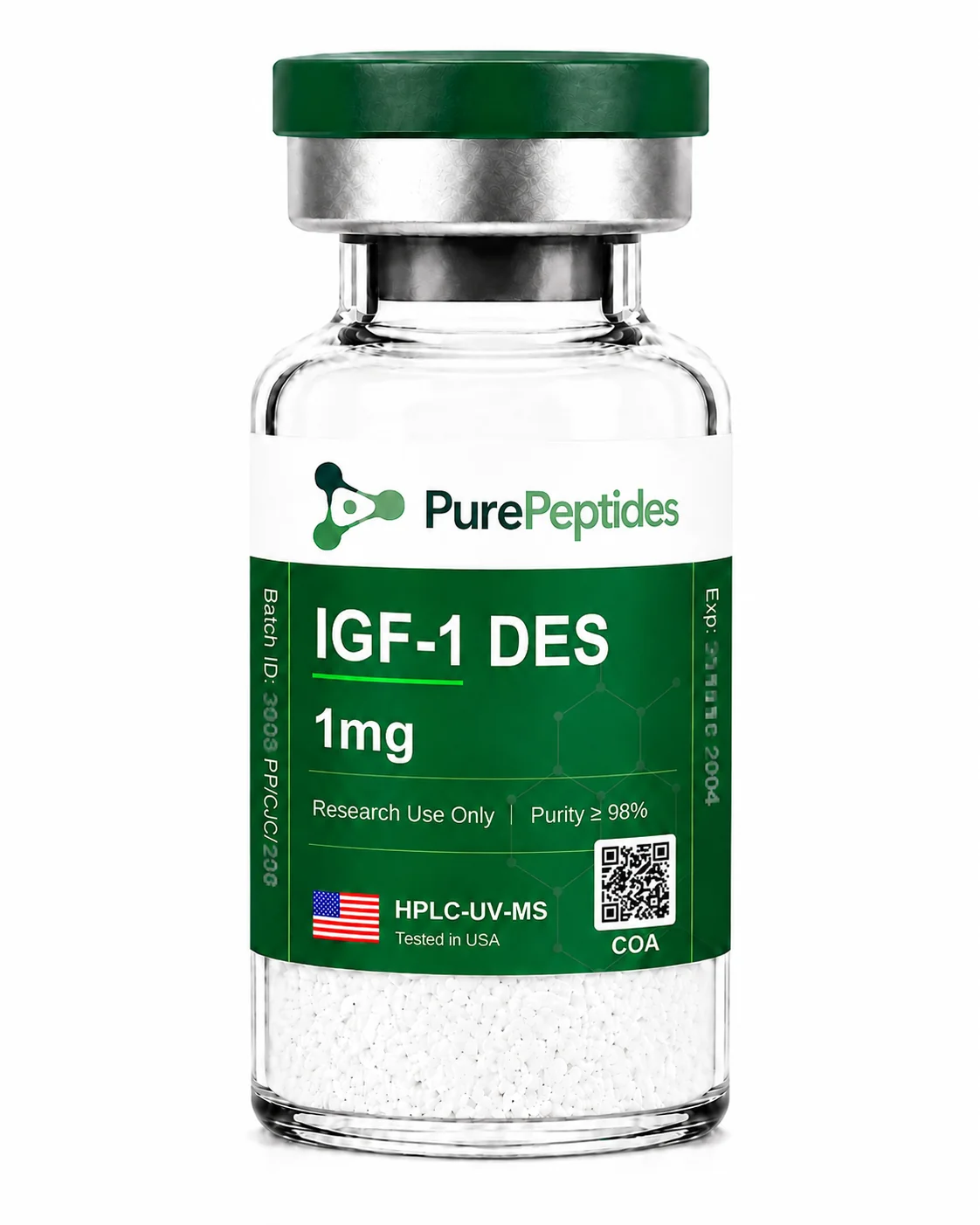
IGF-1 DES Research Protein
$21.00
Supplied as a lyophilised powder and independently verified to ≥98% purity by HPLC and MS-UPLC analysis.
1000 in stock
🔥 Exclusive Crypto Offer
Get an INSTANT 15% DISCOUNT when you pay with Bitcoin, Ethereum, Dogecoin, Bitcoin Cash, XRP, Solana, or USDT.
⚡ Don't have crypto? Buy it here in 5 minutes with easy guidance.
💡 Pro Tip: You can also pay with cryptocurrency using your verified Cash App or PayPal account for a fast and secure checkout!
What is IGF-1 DES?
IGF-1 DES is a naturally occurring short form of IGF-1 that is missing its first three building blocks. That change lets it slip past the binding proteins that normally hold IGF-1 back, making it a more potent, shorter-acting form used in research on brain, gut and muscle tissue.
- A naturally shortened IGF-1 missing its first three amino acids
- Slips past IGF-binding proteins, so more is available in research models
- Around 10 times more potent than standard IGF-1 in some tissue studies
- Particularly active in brain, gut and muscle tissue in animal research
For research use only. Not approved for human therapeutic use.
IGF-1 DES, formally designated Des(1-3)IGF-1 (CAS 112603-35-7), is a truncated 67-amino acid analogue of human insulin-like growth factor 1 (IGF-1). With a molecular weight of 7371.48 g/mol, IGF-1 DES corresponds to residues 4-70 of native IGF-1. The absence of the N-terminal tripeptide Gly-Pro-Glu is the defining structural feature of Des(1-3)IGF-1 and is considered central to its altered IGFBP binding characteristics. Produced via solid-phase peptide synthesis, IGF-1 DES acts as an agonist at the IGF-1 receptor (IGF-1R).
Des(1-3)IGF-1 has been extensively investigated in preclinical cell biology and growth factor research for the functional consequences of its N-terminal truncation. The removal of the Gly-Pro-Glu tripeptide has been documented in published studies to reduce binding affinity for insulin-like growth factor-binding proteins (IGFBPs), proteins that regulate IGF-1 bioavailability and tissue distribution in native physiology. In vitro studies in L6 rat myoblast and related muscle-derived cell preparations have examined IGF-1 DES’s receptor activation and mitogenic signalling, characterising binding properties and biological potencies at the IGF-1 receptor relative to native IGF-1 [1]. Comparative preclinical studies have also examined IGFBP interaction profiles and receptor binding kinetics of Des(1-3)IGF-1 relative to native IGF-1, with published findings documenting that IGFBP-dependent inhibition of receptor-mediated biological activity is substantially attenuated for Des(1-3)IGF-1, making it a key reference compound in IGF-1 analogue research [2].
IGF-1 DES is produced to research-grade standards and independently verified by third-party HPLC and MS-UPLC analysis before dispatch. Vials are vacuum sealed and stored in a temperature controlled, monitored cold storage system. Certificates of Analysis are available on request.
Sold strictly for in vitro research purposes only. Not for human consumption. Intended for use by qualified researchers in laboratory settings only.
References
1Ballard FJ, Read LC, Francis GL, Bagley CJ, Wallace JC. Binding properties and biological potencies of insulin-like growth factors in L6 myoblasts. Biochem J. 1986 Jan 1;233(1):223–30. ; PubMed Central PMCID: PMC1153007.PubMed PMID: 39547262Ross M, Francis GL, Szabo L, Wallace JC, Ballard FJ. Insulin-like growth factor (IGF)-binding proteins inhibit the biological activities of IGF-1 and IGF-2 but not des-(1-3)-IGF-1. Biochem J. 1989 Feb 15;258(1):267–72. ; PubMed Central PMCID: PMC1138350.PubMed PMID: 2539101
Scientific Review

Dr. Martina Rossi, PhD
Scientific Contributor and Reviewer
Reviewed for scientific accuracy, 14 June 2026
View credentials →
IGF-1 DES, formally designated Des(1-3)IGF-1 (CAS 112603-35-7), is a truncated 67-amino acid analogue of human insulin-like growth factor 1 (IGF-1). With a molecular weight of 7371.48 g/mol, IGF-1 DES corresponds to residues 4-70 of native IGF-1. The absence of the N-terminal tripeptide Gly-Pro-Glu is the defining structural feature of Des(1-3)IGF-1 and is considered central to its altered IGFBP binding characteristics. Produced via solid-phase peptide synthesis, IGF-1 DES acts as an agonist at the IGF-1 receptor (IGF-1R).
Des(1-3)IGF-1 has been extensively investigated in preclinical cell biology and growth factor research for the functional consequences of its N-terminal truncation. The removal of the Gly-Pro-Glu tripeptide has been documented in published studies to reduce binding affinity for insulin-like growth factor-binding proteins (IGFBPs), proteins that regulate IGF-1 bioavailability and tissue distribution in native physiology. In vitro studies in L6 rat myoblast and related muscle-derived cell preparations have examined IGF-1 DES’s receptor activation and mitogenic signalling, characterising binding properties and biological potencies at the IGF-1 receptor relative to native IGF-1 [1]. Comparative preclinical studies have also examined IGFBP interaction profiles and receptor binding kinetics of Des(1-3)IGF-1 relative to native IGF-1, with published findings documenting that IGFBP-dependent inhibition of receptor-mediated biological activity is substantially attenuated for Des(1-3)IGF-1, making it a key reference compound in IGF-1 analogue research [2].
IGF-1 DES is produced to research-grade standards and independently verified by third-party HPLC and MS-UPLC analysis before dispatch. Vials are vacuum sealed and stored in a temperature controlled, monitored cold storage system. Certificates of Analysis are available on request.
Sold strictly for in vitro research purposes only. Not for human consumption. Intended for use by qualified researchers in laboratory settings only.
References
1Ballard FJ, Read LC, Francis GL, Bagley CJ, Wallace JC. Binding properties and biological potencies of insulin-like growth factors in L6 myoblasts. Biochem J. 1986 Jan 1;233(1):223–30. ; PubMed Central PMCID: PMC1153007.PubMed PMID: 39547262Ross M, Francis GL, Szabo L, Wallace JC, Ballard FJ. Insulin-like growth factor (IGF)-binding proteins inhibit the biological activities of IGF-1 and IGF-2 but not des-(1-3)-IGF-1. Biochem J. 1989 Feb 15;258(1):267–72. ; PubMed Central PMCID: PMC1138350.PubMed PMID: 2539101
Scientific Review
Dr. Martina Rossi, PhD
Scientific Contributor and Reviewer
Reviewed for scientific accuracy, 14 June 2026
View credentials →CAS Number112603-35-7Molecular Weight~7,371 g/molPurity≥98%Physical FormLyophilised PowderManufacturingManufactured in an ISO9001 Certified LaboratoryTestingHPLC + MS-UPLCSKUIGF1DES
Lyophilised powder: store at -20 °C or below, away from light and moisture. Once reconstituted in an appropriate laboratory diluent (e.g. sterile water, PBS, or assay buffer), store at 2–8 °C and use within the validated period for your protocol. Do not refreeze.
IGF-1 DES, formally designated Des(1-3)IGF-1 (CAS 112603-35-7), is a truncated 67-amino acid analogue of human insulin-like growth factor 1 (IGF-1). With a molecular weight of 7371.48 g/mol, IGF-1 DES corresponds to residues 4-70 of native IGF-1. The absence of the N-terminal tripeptide Gly-Pro-Glu is the defining structural feature of Des(1-3)IGF-1 and is considered central to its altered IGFBP binding characteristics. Produced via solid-phase peptide synthesis, IGF-1 DES acts as an agonist at the IGF-1 receptor (IGF-1R).
Des(1-3)IGF-1 has been extensively investigated in preclinical cell biology and growth factor research for the functional consequences of its N-terminal truncation. The removal of the Gly-Pro-Glu tripeptide has been documented in published studies to reduce binding affinity for insulin-like growth factor-binding proteins (IGFBPs), proteins that regulate IGF-1 bioavailability and tissue distribution in native physiology. In vitro studies in L6 rat myoblast and related muscle-derived cell preparations have examined IGF-1 DES’s receptor activation and mitogenic signalling, characterising binding properties and biological potencies at the IGF-1 receptor relative to native IGF-1 [1]. Comparative preclinical studies have also examined IGFBP interaction profiles and receptor binding kinetics of Des(1-3)IGF-1 relative to native IGF-1, with published findings documenting that IGFBP-dependent inhibition of receptor-mediated biological activity is substantially attenuated for Des(1-3)IGF-1, making it a key reference compound in IGF-1 analogue research [2].
IGF-1 DES is produced to research-grade standards and independently verified by third-party HPLC and MS-UPLC analysis before dispatch. Vials are vacuum sealed and stored in a temperature controlled, monitored cold storage system. Certificates of Analysis are available on request.
Sold strictly for in vitro research purposes only. Not for human consumption. Intended for use by qualified researchers in laboratory settings only.
References
1Ballard FJ, Read LC, Francis GL, Bagley CJ, Wallace JC. Binding properties and biological potencies of insulin-like growth factors in L6 myoblasts. Biochem J. 1986 Jan 1;233(1):223–30. ; PubMed Central PMCID: PMC1153007.PubMed PMID: 39547262Ross M, Francis GL, Szabo L, Wallace JC, Ballard FJ. Insulin-like growth factor (IGF)-binding proteins inhibit the biological activities of IGF-1 and IGF-2 but not des-(1-3)-IGF-1. Biochem J. 1989 Feb 15;258(1):267–72. ; PubMed Central PMCID: PMC1138350.PubMed PMID: 2539101
Scientific Review
Dr. Martina Rossi, PhD
Scientific Contributor and Reviewer
Reviewed for scientific accuracy, 14 June 2026
View credentials →CAS Number112603-35-7Molecular Weight~7,371 g/molPurity≥98%Physical FormLyophilised PowderManufacturingManufactured in an ISO9001 Certified LaboratoryTestingHPLC + MS-UPLCSKUIGF1DES
Lyophilised powder: store at -20 °C or below, away from light and moisture. Once reconstituted in an appropriate laboratory diluent (e.g. sterile water, PBS, or assay buffer), store at 2–8 °C and use within the validated period for your protocol. Do not refreeze.
Related products

GH Axis Research

GH Axis Research
GH Axis Research
GH Axis Research

GH Axis Research
GH Axis Research

GH Axis Research

GH Axis Research