
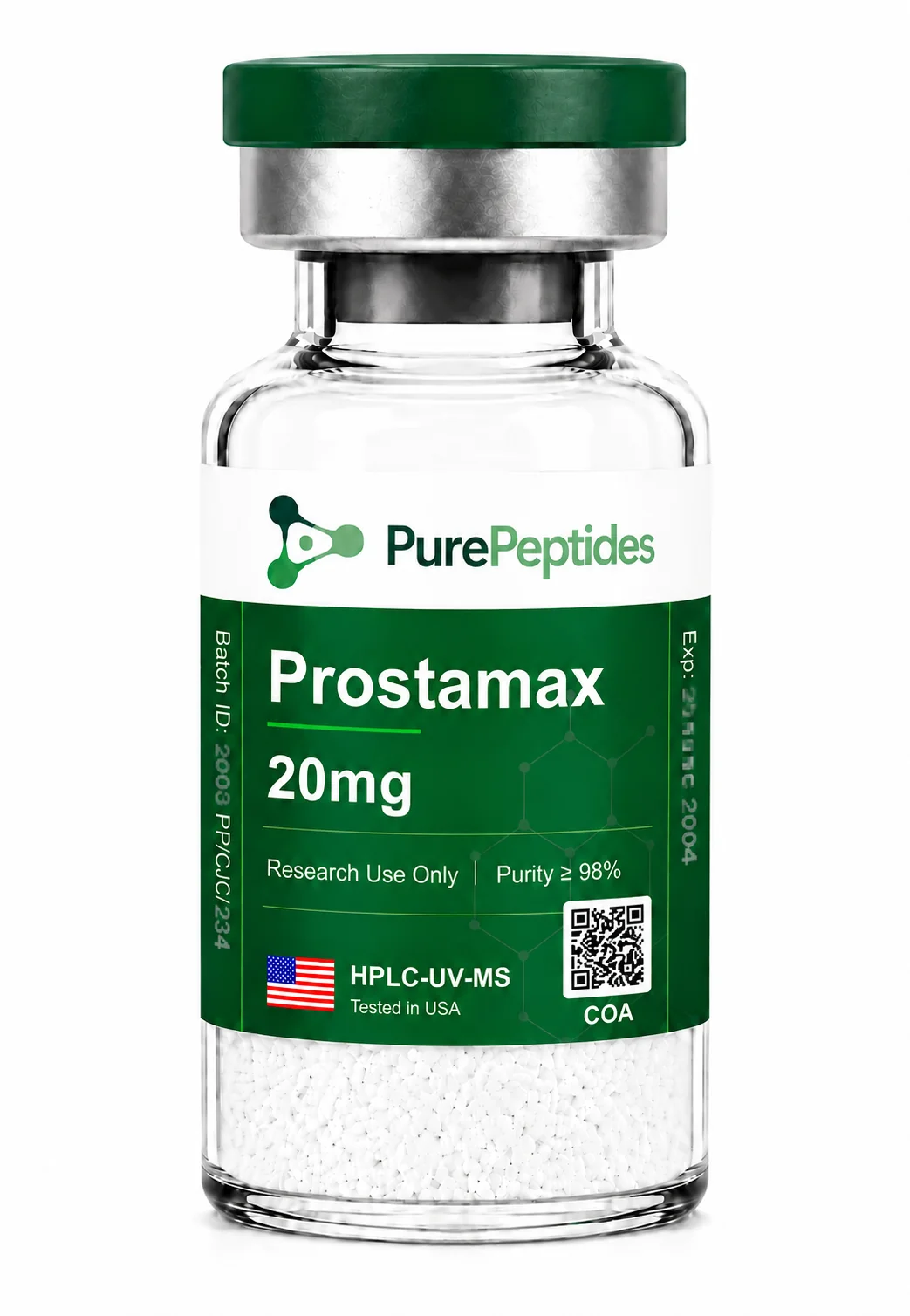
Prostamax
$65.00
Supplied as a lyophilised powder and independently verified to ≥98% purity by HPLC and MS-UPLC analysis.
1000 in stock
🔥 Exclusive Crypto Offer
Get an INSTANT 15% DISCOUNT when you pay with Bitcoin, Ethereum, Dogecoin, Bitcoin Cash, XRP, Solana, or USDT.
⚡ Don't have crypto? Buy it here in 5 minutes with easy guidance.
💡 Pro Tip: You can also pay with cryptocurrency using your verified Cash App or PayPal account for a fast and secure checkout!
What is Prostamax?
Prostamax is a peptide bioregulator from the Russian program, designed to target prostate tissue. It is studied in animal research for its effects on prostate-tissue signaling in the context of aging.
- A short peptide studied for its effects on prostate tissue
- Part of the Russian organ-targeted bioregulator research program
- Studied in aged animal models for its effects on prostate-cell gene activity
- Investigated alongside other organ-specific bioregulators from the same program
For research use only. Not approved for human therapeutic use.
Prostamax, also known by its tetrapeptide designation KEDP (Lys-Glu-Asp-Pro), is a synthetic tetrapeptide bioregulator with a molecular weight of 487.50 g/mol. Developed at the Saint Petersburg Institute of Bioregulation and Gerontology as part of the Khavinson peptide bioregulator series, Prostamax was designed based on peptide fractions associated with prostate tissue. Its sequence, Lys-Glu-Asp-Pro, incorporates a C-terminal proline residue, a conformationally constrained amino acid that introduces a characteristic backbone turn and may influence the peptide’s interaction with target nucleotide sequences. Like other tetrapeptide bioregulators in the Khavinson series, Prostamax is proposed to modulate tissue-specific gene expression through direct DNA interaction. Produced via solid-phase peptide synthesis, Prostamax is associated with prostatic tissue gene expression.
Prostamax is as an organ-specific tetrapeptide bioregulator within the Khavinson framework. A dedicated in vivo study has documented KEDP-specific activity on prostatic tissue: in sulpiride-treated Wistar rats used as a model of benign prostatic hyperplasia, administration of the tetrapeptide Lys-Glu-Asp-Pro was associated with reductions in prostate weight and volume and a decrease in acini epithelial area relative to untreated controls, with the comparison drawn against a Serenoa repens reference preparation [1]. At the mechanistic level, consistent with the proposed direct-to-DNA mode of action, peptides of the Khavinson ultrashort class have been shown in cell-free and cellular systems to penetrate the cell nucleus and bind DNA in a sequence-selective manner, providing a structural basis for peptide-directed modulation of gene expression [2], making Prostamax a reference compound in preclinical urological bioregulation research examining prostate-tropic short-peptide activity, benign prostatic hyperplasia models, and direct-to-DNA mechanisms of tissue-specific gene regulation.
Prostamax is produced to research-grade standards and independently verified by third-party HPLC and MS-UPLC analysis before dispatch. Vials are vacuum sealed and stored in a temperature controlled, monitored cold storage system. Certificates of Analysis are available on request.
Sold strictly for in vitro research purposes only. Not for human consumption. Intended for use by qualified researchers in laboratory settings only.
References
1Borovskaya TG, Fomina TI, Shchemerova JA, Poluektova ME, Vychuzhanina AV, Kamalova SI, et al. Experimental Study of Efficiency of Tertapeptide Lysil-Glutamyl-Aspartyl- Proline Using the Model of Benign Prostatic Hyperplasia. Modern Research in Inflammation. 2014 Jul 31;3(3):108–12.doi:10.4236/mri.2014.330132Fedoreyeva LI, Kireev II, Khavinson VK, Vanyushin BF. Penetration of short fluorescence-labeled peptides into the nucleus in HeLa cells and in vitro specific interaction of the peptides with deoxyribooligonucleotides and DNA. Biochemistry (Mosc). 2011 Nov;76(11):1210–9. .PubMed PMID: 22117547
Scientific Review

Dr. Martina Rossi, PhD
Scientific Contributor and Reviewer
Reviewed for scientific accuracy, 14 June 2026
View credentials →
Prostamax, also known by its tetrapeptide designation KEDP (Lys-Glu-Asp-Pro), is a synthetic tetrapeptide bioregulator with a molecular weight of 487.50 g/mol. Developed at the Saint Petersburg Institute of Bioregulation and Gerontology as part of the Khavinson peptide bioregulator series, Prostamax was designed based on peptide fractions associated with prostate tissue. Its sequence, Lys-Glu-Asp-Pro, incorporates a C-terminal proline residue, a conformationally constrained amino acid that introduces a characteristic backbone turn and may influence the peptide’s interaction with target nucleotide sequences. Like other tetrapeptide bioregulators in the Khavinson series, Prostamax is proposed to modulate tissue-specific gene expression through direct DNA interaction. Produced via solid-phase peptide synthesis, Prostamax is associated with prostatic tissue gene expression.
Prostamax is as an organ-specific tetrapeptide bioregulator within the Khavinson framework. A dedicated in vivo study has documented KEDP-specific activity on prostatic tissue: in sulpiride-treated Wistar rats used as a model of benign prostatic hyperplasia, administration of the tetrapeptide Lys-Glu-Asp-Pro was associated with reductions in prostate weight and volume and a decrease in acini epithelial area relative to untreated controls, with the comparison drawn against a Serenoa repens reference preparation [1]. At the mechanistic level, consistent with the proposed direct-to-DNA mode of action, peptides of the Khavinson ultrashort class have been shown in cell-free and cellular systems to penetrate the cell nucleus and bind DNA in a sequence-selective manner, providing a structural basis for peptide-directed modulation of gene expression [2], making Prostamax a reference compound in preclinical urological bioregulation research examining prostate-tropic short-peptide activity, benign prostatic hyperplasia models, and direct-to-DNA mechanisms of tissue-specific gene regulation.
Prostamax is produced to research-grade standards and independently verified by third-party HPLC and MS-UPLC analysis before dispatch. Vials are vacuum sealed and stored in a temperature controlled, monitored cold storage system. Certificates of Analysis are available on request.
Sold strictly for in vitro research purposes only. Not for human consumption. Intended for use by qualified researchers in laboratory settings only.
References
1Borovskaya TG, Fomina TI, Shchemerova JA, Poluektova ME, Vychuzhanina AV, Kamalova SI, et al. Experimental Study of Efficiency of Tertapeptide Lysil-Glutamyl-Aspartyl- Proline Using the Model of Benign Prostatic Hyperplasia. Modern Research in Inflammation. 2014 Jul 31;3(3):108–12.doi:10.4236/mri.2014.330132Fedoreyeva LI, Kireev II, Khavinson VK, Vanyushin BF. Penetration of short fluorescence-labeled peptides into the nucleus in HeLa cells and in vitro specific interaction of the peptides with deoxyribooligonucleotides and DNA. Biochemistry (Mosc). 2011 Nov;76(11):1210–9. .PubMed PMID: 22117547
Scientific Review
Dr. Martina Rossi, PhD
Scientific Contributor and Reviewer
Reviewed for scientific accuracy, 14 June 2026
View credentials →CAS NumberN/A (Khavinson bioregulator)Molecular Weight487.51 g/molPurity≥98%Physical FormLyophilised PowderManufacturingManufactured in an ISO9001 Certified LaboratoryTestingHPLC + MS-UPLCSKURSC-PROSTAMAX-7969
Lyophilised powder: store at -20 °C or below, away from light and moisture. Once reconstituted in an appropriate laboratory diluent (e.g. sterile water, PBS, or assay buffer), store at 2–8 °C and use within the validated period for your protocol. Do not refreeze.
Prostamax, also known by its tetrapeptide designation KEDP (Lys-Glu-Asp-Pro), is a synthetic tetrapeptide bioregulator with a molecular weight of 487.50 g/mol. Developed at the Saint Petersburg Institute of Bioregulation and Gerontology as part of the Khavinson peptide bioregulator series, Prostamax was designed based on peptide fractions associated with prostate tissue. Its sequence, Lys-Glu-Asp-Pro, incorporates a C-terminal proline residue, a conformationally constrained amino acid that introduces a characteristic backbone turn and may influence the peptide’s interaction with target nucleotide sequences. Like other tetrapeptide bioregulators in the Khavinson series, Prostamax is proposed to modulate tissue-specific gene expression through direct DNA interaction. Produced via solid-phase peptide synthesis, Prostamax is associated with prostatic tissue gene expression.
Prostamax is as an organ-specific tetrapeptide bioregulator within the Khavinson framework. A dedicated in vivo study has documented KEDP-specific activity on prostatic tissue: in sulpiride-treated Wistar rats used as a model of benign prostatic hyperplasia, administration of the tetrapeptide Lys-Glu-Asp-Pro was associated with reductions in prostate weight and volume and a decrease in acini epithelial area relative to untreated controls, with the comparison drawn against a Serenoa repens reference preparation [1]. At the mechanistic level, consistent with the proposed direct-to-DNA mode of action, peptides of the Khavinson ultrashort class have been shown in cell-free and cellular systems to penetrate the cell nucleus and bind DNA in a sequence-selective manner, providing a structural basis for peptide-directed modulation of gene expression [2], making Prostamax a reference compound in preclinical urological bioregulation research examining prostate-tropic short-peptide activity, benign prostatic hyperplasia models, and direct-to-DNA mechanisms of tissue-specific gene regulation.
Prostamax is produced to research-grade standards and independently verified by third-party HPLC and MS-UPLC analysis before dispatch. Vials are vacuum sealed and stored in a temperature controlled, monitored cold storage system. Certificates of Analysis are available on request.
Sold strictly for in vitro research purposes only. Not for human consumption. Intended for use by qualified researchers in laboratory settings only.
References
1Borovskaya TG, Fomina TI, Shchemerova JA, Poluektova ME, Vychuzhanina AV, Kamalova SI, et al. Experimental Study of Efficiency of Tertapeptide Lysil-Glutamyl-Aspartyl- Proline Using the Model of Benign Prostatic Hyperplasia. Modern Research in Inflammation. 2014 Jul 31;3(3):108–12.doi:10.4236/mri.2014.330132Fedoreyeva LI, Kireev II, Khavinson VK, Vanyushin BF. Penetration of short fluorescence-labeled peptides into the nucleus in HeLa cells and in vitro specific interaction of the peptides with deoxyribooligonucleotides and DNA. Biochemistry (Mosc). 2011 Nov;76(11):1210–9. .PubMed PMID: 22117547
Scientific Review
Dr. Martina Rossi, PhD
Scientific Contributor and Reviewer
Reviewed for scientific accuracy, 14 June 2026
View credentials →CAS NumberN/A (Khavinson bioregulator)Molecular Weight487.51 g/molPurity≥98%Physical FormLyophilised PowderManufacturingManufactured in an ISO9001 Certified LaboratoryTestingHPLC + MS-UPLCSKURSC-PROSTAMAX-7969
Lyophilised powder: store at -20 °C or below, away from light and moisture. Once reconstituted in an appropriate laboratory diluent (e.g. sterile water, PBS, or assay buffer), store at 2–8 °C and use within the validated period for your protocol. Do not refreeze.
Related products

Peptide Bioregulators

Peptide Bioregulators
Peptide Bioregulators
Peptide Bioregulators
Peptide Bioregulators
Peptide Bioregulators

Peptide Bioregulators
Peptide Bioregulators