
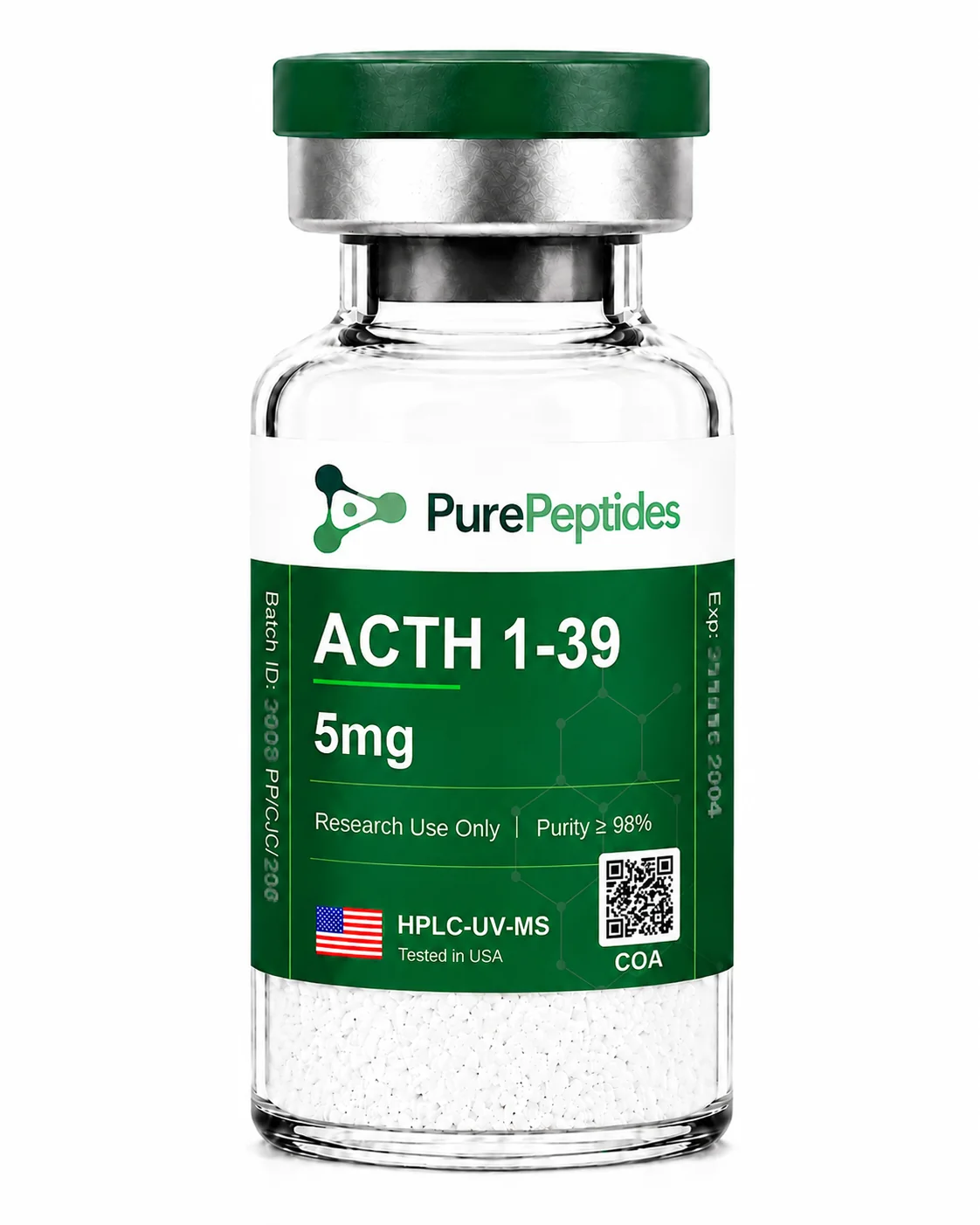
ACTH 1-39

$57.00
Supplied as a lyophilised powder and independently verified to ≥98% purity by HPLC and MS-UPLC analysis.
1000 in stock
🔥 Exclusive Crypto Offer
Get an INSTANT 15% DISCOUNT when you pay with Bitcoin, Ethereum, Dogecoin, Bitcoin Cash, XRP, Solana, or USDT.
⚡ Don't have crypto? Buy it here in 5 minutes with easy guidance.
💡 Pro Tip: You can also pay with cryptocurrency using your verified Cash App or PayPal account for a fast and secure checkout!
What is ACTH 1-39?
ACTH 1-39 is the full 39-amino-acid form of adrenocorticotropic hormone, a hormone made by the pituitary gland that tells the adrenal glands to release cortisol and other stress hormones. It is used in laboratory research to study how the body controls its stress-hormone system.
- A pituitary hormone that signals the adrenal glands to release cortisol and other stress hormones
- Used in research to study how the body’s stress-hormone system is regulated
- A tool for studying the signaling axis between the brain, pituitary and adrenal glands
- Corresponds to the full-length ACTH(1-39) sequence used as a reference standard in this research
For research use only. Not approved for human therapeutic use.
ACTH 1-39 (CAS 9002-60-2), also known as Adrenocorticotropic Hormone or Corticotropin, is a synthetic 39-amino acid polypeptide with a molecular weight of 4541.14 g/mol. The full-length ACTH sequence is derived from the larger 241-amino acid precursor protein pro-opiomelanocortin (POMC) through post-translational proteolytic processing. ACTH contains the melanocortin pharmacophore sequence His-Phe-Arg-Trp (residues 6-9) shared across the melanocortin peptide family. Produced via solid-phase peptide synthesis, Corticotropin signals through the melanocortin-2 receptor (MC2R) and is the principal endogenous regulator of adrenal glucocorticoid secretion.
ACTH 1-39’s obligate requirement for the melanocortin receptor accessory protein (MRAP) to achieve functional MC2R signalling distinguishes it from other melanocortin peptides and has been the subject of detailed receptor pharmacology investigation. In vitro studies have shown that MRAP is a small single-transmembrane protein that interacts directly with MC2R, is required for receptor trafficking to the plasma membrane, and enables ACTH responsiveness, with MRAP loss-of-function mutations causing familial glucocorticoid deficiency type 2 [1]. Isogenic cell-system studies further established that human MRAP isoforms reconstitute ACTH-driven cAMP signalling at MC2R, confirming the MC2R/MRAP complex as the functional unit responding to ACTH [2]. ACTH also serves as the parent sequence for shorter melanocortin-derived peptides, including alpha-MSH (ACTH 1-13) and pharmacophore regions used in Semax/Selank-related analogues. In vivo, its defining whole-animal action is activation of the hypothalamic-pituitary-adrenal axis, with ACTH administration driving adrenal corticosterone responses in neonatal rats [3], making ACTH 1-39 an essential reference compound for structure-activity studies mapping ACTH-analogue binding and receptor-subtype selectivity across the MC1R-MC5R family.
ACTH 1-39 is produced to research-grade standards and independently verified by third-party HPLC and MS-UPLC analysis before dispatch. Vials are vacuum sealed and stored in a temperature controlled, monitored cold storage system. Certificates of Analysis are available on request.
Sold strictly for in vitro research purposes only. Not for human consumption. Intended for use by qualified researchers in laboratory settings only.
References
1Metherell LA, Chapple JP, Cooray S, David A, Becker C, Rüschendorf F, et al. Mutations in MRAP, encoding a new interacting partner of the ACTH receptor, cause familial glucocorticoid deficiency type 2. Nat Genet. 2005 Feb;37(2):166–70. .PubMed PMID: 156543382Chan LF, Webb TR, Chung TT, Meimaridou E, Cooray SN, Guasti L, et al. MRAP and MRAP2 are bidirectional regulators of the melanocortin receptor family. Proc Natl Acad Sci U S A. 2009 Apr 14;106(15):6146–51. ; PubMed Central PMCID: PMC2661846.PubMed PMID: 193294863Nensey NK, Bodager J, Gehrand AL, Raff H. Effect of Novel Melanocortin Type 2 Receptor Antagonists on the Corticosterone Response to ACTH in the Neonatal Rat Adrenal Gland In Vivo and In Vitro. Front Endocrinol (Lausanne). 2016;7:23. ; PubMed Central PMCID: PMC4800183.PubMed PMID: 27047449
Scientific Review

Dr. Martina Rossi, PhD
Scientific Contributor and Reviewer
Reviewed for scientific accuracy, 14 June 2026
View credentials →
ACTH 1-39 (CAS 9002-60-2), also known as Adrenocorticotropic Hormone or Corticotropin, is a synthetic 39-amino acid polypeptide with a molecular weight of 4541.14 g/mol. The full-length ACTH sequence is derived from the larger 241-amino acid precursor protein pro-opiomelanocortin (POMC) through post-translational proteolytic processing. ACTH contains the melanocortin pharmacophore sequence His-Phe-Arg-Trp (residues 6-9) shared across the melanocortin peptide family. Produced via solid-phase peptide synthesis, Corticotropin signals through the melanocortin-2 receptor (MC2R) and is the principal endogenous regulator of adrenal glucocorticoid secretion.
ACTH 1-39’s obligate requirement for the melanocortin receptor accessory protein (MRAP) to achieve functional MC2R signalling distinguishes it from other melanocortin peptides and has been the subject of detailed receptor pharmacology investigation. In vitro studies have shown that MRAP is a small single-transmembrane protein that interacts directly with MC2R, is required for receptor trafficking to the plasma membrane, and enables ACTH responsiveness, with MRAP loss-of-function mutations causing familial glucocorticoid deficiency type 2 [1]. Isogenic cell-system studies further established that human MRAP isoforms reconstitute ACTH-driven cAMP signalling at MC2R, confirming the MC2R/MRAP complex as the functional unit responding to ACTH [2]. ACTH also serves as the parent sequence for shorter melanocortin-derived peptides, including alpha-MSH (ACTH 1-13) and pharmacophore regions used in Semax/Selank-related analogues. In vivo, its defining whole-animal action is activation of the hypothalamic-pituitary-adrenal axis, with ACTH administration driving adrenal corticosterone responses in neonatal rats [3], making ACTH 1-39 an essential reference compound for structure-activity studies mapping ACTH-analogue binding and receptor-subtype selectivity across the MC1R-MC5R family.
ACTH 1-39 is produced to research-grade standards and independently verified by third-party HPLC and MS-UPLC analysis before dispatch. Vials are vacuum sealed and stored in a temperature controlled, monitored cold storage system. Certificates of Analysis are available on request.
Sold strictly for in vitro research purposes only. Not for human consumption. Intended for use by qualified researchers in laboratory settings only.
References
1Metherell LA, Chapple JP, Cooray S, David A, Becker C, Rüschendorf F, et al. Mutations in MRAP, encoding a new interacting partner of the ACTH receptor, cause familial glucocorticoid deficiency type 2. Nat Genet. 2005 Feb;37(2):166–70. .PubMed PMID: 156543382Chan LF, Webb TR, Chung TT, Meimaridou E, Cooray SN, Guasti L, et al. MRAP and MRAP2 are bidirectional regulators of the melanocortin receptor family. Proc Natl Acad Sci U S A. 2009 Apr 14;106(15):6146–51. ; PubMed Central PMCID: PMC2661846.PubMed PMID: 193294863Nensey NK, Bodager J, Gehrand AL, Raff H. Effect of Novel Melanocortin Type 2 Receptor Antagonists on the Corticosterone Response to ACTH in the Neonatal Rat Adrenal Gland In Vivo and In Vitro. Front Endocrinol (Lausanne). 2016;7:23. ; PubMed Central PMCID: PMC4800183.PubMed PMID: 27047449
Scientific Review
Dr. Martina Rossi, PhD
Scientific Contributor and Reviewer
Reviewed for scientific accuracy, 14 June 2026
View credentials →CAS Number9002-60-2Molecular Weight4,541.10 g/molPurity≥98%Physical FormLyophilised PowderManufacturingManufactured in an ISO9001 Certified LaboratoryTestingHPLC + MS-UPLCSKURSC-ACTH139-7176
Lyophilised powder: store at -20 °C or below, away from light and moisture. Once reconstituted in an appropriate laboratory diluent (e.g. sterile water, PBS, or assay buffer), store at 2–8 °C and use within the validated period for your protocol. Do not refreeze.
ACTH 1-39 (CAS 9002-60-2), also known as Adrenocorticotropic Hormone or Corticotropin, is a synthetic 39-amino acid polypeptide with a molecular weight of 4541.14 g/mol. The full-length ACTH sequence is derived from the larger 241-amino acid precursor protein pro-opiomelanocortin (POMC) through post-translational proteolytic processing. ACTH contains the melanocortin pharmacophore sequence His-Phe-Arg-Trp (residues 6-9) shared across the melanocortin peptide family. Produced via solid-phase peptide synthesis, Corticotropin signals through the melanocortin-2 receptor (MC2R) and is the principal endogenous regulator of adrenal glucocorticoid secretion.
ACTH 1-39’s obligate requirement for the melanocortin receptor accessory protein (MRAP) to achieve functional MC2R signalling distinguishes it from other melanocortin peptides and has been the subject of detailed receptor pharmacology investigation. In vitro studies have shown that MRAP is a small single-transmembrane protein that interacts directly with MC2R, is required for receptor trafficking to the plasma membrane, and enables ACTH responsiveness, with MRAP loss-of-function mutations causing familial glucocorticoid deficiency type 2 [1]. Isogenic cell-system studies further established that human MRAP isoforms reconstitute ACTH-driven cAMP signalling at MC2R, confirming the MC2R/MRAP complex as the functional unit responding to ACTH [2]. ACTH also serves as the parent sequence for shorter melanocortin-derived peptides, including alpha-MSH (ACTH 1-13) and pharmacophore regions used in Semax/Selank-related analogues. In vivo, its defining whole-animal action is activation of the hypothalamic-pituitary-adrenal axis, with ACTH administration driving adrenal corticosterone responses in neonatal rats [3], making ACTH 1-39 an essential reference compound for structure-activity studies mapping ACTH-analogue binding and receptor-subtype selectivity across the MC1R-MC5R family.
ACTH 1-39 is produced to research-grade standards and independently verified by third-party HPLC and MS-UPLC analysis before dispatch. Vials are vacuum sealed and stored in a temperature controlled, monitored cold storage system. Certificates of Analysis are available on request.
Sold strictly for in vitro research purposes only. Not for human consumption. Intended for use by qualified researchers in laboratory settings only.
References
1Metherell LA, Chapple JP, Cooray S, David A, Becker C, Rüschendorf F, et al. Mutations in MRAP, encoding a new interacting partner of the ACTH receptor, cause familial glucocorticoid deficiency type 2. Nat Genet. 2005 Feb;37(2):166–70. .PubMed PMID: 156543382Chan LF, Webb TR, Chung TT, Meimaridou E, Cooray SN, Guasti L, et al. MRAP and MRAP2 are bidirectional regulators of the melanocortin receptor family. Proc Natl Acad Sci U S A. 2009 Apr 14;106(15):6146–51. ; PubMed Central PMCID: PMC2661846.PubMed PMID: 193294863Nensey NK, Bodager J, Gehrand AL, Raff H. Effect of Novel Melanocortin Type 2 Receptor Antagonists on the Corticosterone Response to ACTH in the Neonatal Rat Adrenal Gland In Vivo and In Vitro. Front Endocrinol (Lausanne). 2016;7:23. ; PubMed Central PMCID: PMC4800183.PubMed PMID: 27047449
Scientific Review
Dr. Martina Rossi, PhD
Scientific Contributor and Reviewer
Reviewed for scientific accuracy, 14 June 2026
View credentials →CAS Number9002-60-2Molecular Weight4,541.10 g/molPurity≥98%Physical FormLyophilised PowderManufacturingManufactured in an ISO9001 Certified LaboratoryTestingHPLC + MS-UPLCSKURSC-ACTH139-7176
Lyophilised powder: store at -20 °C or below, away from light and moisture. Once reconstituted in an appropriate laboratory diluent (e.g. sterile water, PBS, or assay buffer), store at 2–8 °C and use within the validated period for your protocol. Do not refreeze.
Related products
Regeneration Research
Regeneration Research
Regeneration Research
Regeneration Research
Regeneration Research
Regeneration Research
Regeneration Research
Regeneration Research