
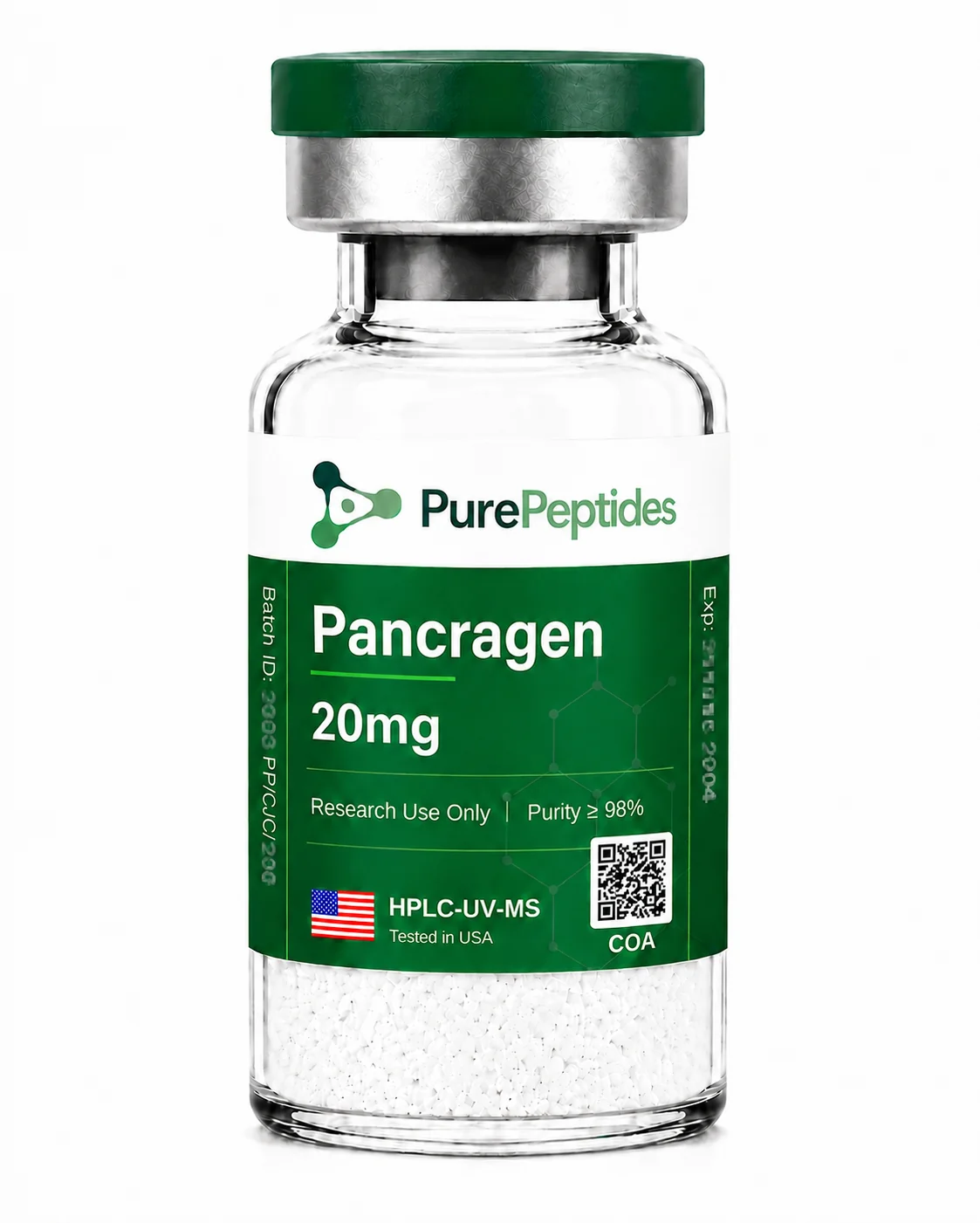
Pancragen

$65.00
Supplied as a lyophilised powder and independently verified to ≥98% purity by HPLC and MS-UPLC analysis.
1000 in stock
🔥 Exclusive Crypto Offer
Get an INSTANT 15% DISCOUNT when you pay with Bitcoin, Ethereum, Dogecoin, Bitcoin Cash, XRP, Solana, or USDT.
⚡ Don't have crypto? Buy it here in 5 minutes with easy guidance.
💡 Pro Tip: You can also pay with cryptocurrency using your verified Cash App or PayPal account for a fast and secure checkout!
What is Pancragen?
Pancragen is a synthetic four-amino-acid peptide bioregulator from the Russian program, designed to target the pancreas. It is studied in animal research for its effects on insulin-producing cells and blood-sugar control in the context of aging.
- A short peptide studied for its effects on pancreas tissue
- Studied in animal research for its effects on insulin-producing cell gene activity
- Investigated in aged primate models with impaired blood-sugar control
- Research focus includes age-related changes in blood-sugar handling
For research use only. Not approved for human therapeutic use.
Pancragen, also known by its tetrapeptide designation KEDW (Lys-Glu-Asp-Trp), is a synthetic tetrapeptide bioregulator with an approximate molecular weight of 576 g/mol. Developed at the Saint Petersburg Institute of Bioregulation and Gerontology as part of the Khavinson peptide bioregulator series, Pancragen was designed based on peptide fractions associated with pancreatic tissue. Its sequence, Lys-Glu-Asp-Trp, incorporates a C-terminal tryptophan residue, an aromatic amino acid containing the indole ring system. The KED core motif is shared with Vesugen, Testagen, and Prostamax, with the C-terminal residue varying across the organ-specific bioregulator series. Produced via solid-phase peptide synthesis, Pancragen is associated with pancreatic tissue gene expression and endocrine pancreatic signalling pathways.
Pancragen is an organ-specific tetrapeptide bioregulator within the Khavinson framework. A dedicated in vitro study has shown that in dissociated cultures of pancreatic cells from young and aged animals, pancragen stimulated the expression of differentiation factors of acinar cells and of the islets of Langerhans, the expression of which otherwise declined with culture ageing, consistent with a model in which the peptide acts on the transcriptional programme governing insulin-producing and acinar cell identity [1]. An in vivo study in aged female rhesus monkeys with impaired glucose tolerance reported that pancragen administration was associated with greater glucose clearance and normalisation of the insulin and C-peptide responses relative to the aged control pattern, with partial persistence after administration ceased [2], making Pancragen a reference compound in preclinical endocrinology research examining pancreatic-cell differentiation, age-associated glucose intolerance, and organ-specific short-peptide regulation of endocrine pancreatic function.
Pancragen is produced to research-grade standards and independently verified by third-party HPLC and MS-UPLC analysis before dispatch. Vials are vacuum sealed and stored in a temperature controlled, monitored cold storage system. Certificates of Analysis are available on request.
Sold strictly for in vitro research purposes only. Not for human consumption. Intended for use by qualified researchers in laboratory settings only.
References
1Khavinson VK, Durnova AO, Polyakova VO, Tolibova GH, Linkova NS, Kvetnoy IM, et al. Effects of pancragen on the differentiation of pancreatic cells during their ageing. Bull Exp Biol Med. 2013 Feb;154(4):501–4. .PubMed PMID: 234865912Goncharova ND, Ivanova LG, Oganyan TE, Vengerin AA, Khavinson VK. [Correction of impaired glucose tolerance using tetrapeptide (Pancragen) in old female rhesus monkeys]. Adv Gerontol. 2015;28(3):579–85. .PubMed PMID: 28509500
Scientific Review

Dr. Martina Rossi, PhD
Scientific Contributor and Reviewer
Reviewed for scientific accuracy, 14 June 2026
View credentials →
Pancragen, also known by its tetrapeptide designation KEDW (Lys-Glu-Asp-Trp), is a synthetic tetrapeptide bioregulator with an approximate molecular weight of 576 g/mol. Developed at the Saint Petersburg Institute of Bioregulation and Gerontology as part of the Khavinson peptide bioregulator series, Pancragen was designed based on peptide fractions associated with pancreatic tissue. Its sequence, Lys-Glu-Asp-Trp, incorporates a C-terminal tryptophan residue, an aromatic amino acid containing the indole ring system. The KED core motif is shared with Vesugen, Testagen, and Prostamax, with the C-terminal residue varying across the organ-specific bioregulator series. Produced via solid-phase peptide synthesis, Pancragen is associated with pancreatic tissue gene expression and endocrine pancreatic signalling pathways.
Pancragen is an organ-specific tetrapeptide bioregulator within the Khavinson framework. A dedicated in vitro study has shown that in dissociated cultures of pancreatic cells from young and aged animals, pancragen stimulated the expression of differentiation factors of acinar cells and of the islets of Langerhans, the expression of which otherwise declined with culture ageing, consistent with a model in which the peptide acts on the transcriptional programme governing insulin-producing and acinar cell identity [1]. An in vivo study in aged female rhesus monkeys with impaired glucose tolerance reported that pancragen administration was associated with greater glucose clearance and normalisation of the insulin and C-peptide responses relative to the aged control pattern, with partial persistence after administration ceased [2], making Pancragen a reference compound in preclinical endocrinology research examining pancreatic-cell differentiation, age-associated glucose intolerance, and organ-specific short-peptide regulation of endocrine pancreatic function.
Pancragen is produced to research-grade standards and independently verified by third-party HPLC and MS-UPLC analysis before dispatch. Vials are vacuum sealed and stored in a temperature controlled, monitored cold storage system. Certificates of Analysis are available on request.
Sold strictly for in vitro research purposes only. Not for human consumption. Intended for use by qualified researchers in laboratory settings only.
References
1Khavinson VK, Durnova AO, Polyakova VO, Tolibova GH, Linkova NS, Kvetnoy IM, et al. Effects of pancragen on the differentiation of pancreatic cells during their ageing. Bull Exp Biol Med. 2013 Feb;154(4):501–4. .PubMed PMID: 234865912Goncharova ND, Ivanova LG, Oganyan TE, Vengerin AA, Khavinson VK. [Correction of impaired glucose tolerance using tetrapeptide (Pancragen) in old female rhesus monkeys]. Adv Gerontol. 2015;28(3):579–85. .PubMed PMID: 28509500
Scientific Review
Dr. Martina Rossi, PhD
Scientific Contributor and Reviewer
Reviewed for scientific accuracy, 14 June 2026
View credentials →CAS NumberN/A (Khavinson bioregulator)Molecular Weight576.60 g/molPurity≥98%Physical FormLyophilised PowderManufacturingManufactured in an ISO9001 Certified LaboratoryTestingHPLC + MS-UPLCSKURSC-PANCRAGEN-4053
Lyophilised powder: store at -20 °C or below, away from light and moisture. Once reconstituted in an appropriate laboratory diluent (e.g. sterile water, PBS, or assay buffer), store at 2–8 °C and use within the validated period for your protocol. Do not refreeze.
Pancragen, also known by its tetrapeptide designation KEDW (Lys-Glu-Asp-Trp), is a synthetic tetrapeptide bioregulator with an approximate molecular weight of 576 g/mol. Developed at the Saint Petersburg Institute of Bioregulation and Gerontology as part of the Khavinson peptide bioregulator series, Pancragen was designed based on peptide fractions associated with pancreatic tissue. Its sequence, Lys-Glu-Asp-Trp, incorporates a C-terminal tryptophan residue, an aromatic amino acid containing the indole ring system. The KED core motif is shared with Vesugen, Testagen, and Prostamax, with the C-terminal residue varying across the organ-specific bioregulator series. Produced via solid-phase peptide synthesis, Pancragen is associated with pancreatic tissue gene expression and endocrine pancreatic signalling pathways.
Pancragen is an organ-specific tetrapeptide bioregulator within the Khavinson framework. A dedicated in vitro study has shown that in dissociated cultures of pancreatic cells from young and aged animals, pancragen stimulated the expression of differentiation factors of acinar cells and of the islets of Langerhans, the expression of which otherwise declined with culture ageing, consistent with a model in which the peptide acts on the transcriptional programme governing insulin-producing and acinar cell identity [1]. An in vivo study in aged female rhesus monkeys with impaired glucose tolerance reported that pancragen administration was associated with greater glucose clearance and normalisation of the insulin and C-peptide responses relative to the aged control pattern, with partial persistence after administration ceased [2], making Pancragen a reference compound in preclinical endocrinology research examining pancreatic-cell differentiation, age-associated glucose intolerance, and organ-specific short-peptide regulation of endocrine pancreatic function.
Pancragen is produced to research-grade standards and independently verified by third-party HPLC and MS-UPLC analysis before dispatch. Vials are vacuum sealed and stored in a temperature controlled, monitored cold storage system. Certificates of Analysis are available on request.
Sold strictly for in vitro research purposes only. Not for human consumption. Intended for use by qualified researchers in laboratory settings only.
References
1Khavinson VK, Durnova AO, Polyakova VO, Tolibova GH, Linkova NS, Kvetnoy IM, et al. Effects of pancragen on the differentiation of pancreatic cells during their ageing. Bull Exp Biol Med. 2013 Feb;154(4):501–4. .PubMed PMID: 234865912Goncharova ND, Ivanova LG, Oganyan TE, Vengerin AA, Khavinson VK. [Correction of impaired glucose tolerance using tetrapeptide (Pancragen) in old female rhesus monkeys]. Adv Gerontol. 2015;28(3):579–85. .PubMed PMID: 28509500
Scientific Review
Dr. Martina Rossi, PhD
Scientific Contributor and Reviewer
Reviewed for scientific accuracy, 14 June 2026
View credentials →CAS NumberN/A (Khavinson bioregulator)Molecular Weight576.60 g/molPurity≥98%Physical FormLyophilised PowderManufacturingManufactured in an ISO9001 Certified LaboratoryTestingHPLC + MS-UPLCSKURSC-PANCRAGEN-4053
Lyophilised powder: store at -20 °C or below, away from light and moisture. Once reconstituted in an appropriate laboratory diluent (e.g. sterile water, PBS, or assay buffer), store at 2–8 °C and use within the validated period for your protocol. Do not refreeze.
Related products
Peptide Bioregulators
Peptide Bioregulators

Peptide Bioregulators
Peptide Bioregulators
Peptide Bioregulators

Peptide Bioregulators
Peptide Bioregulators
Peptide Bioregulators