
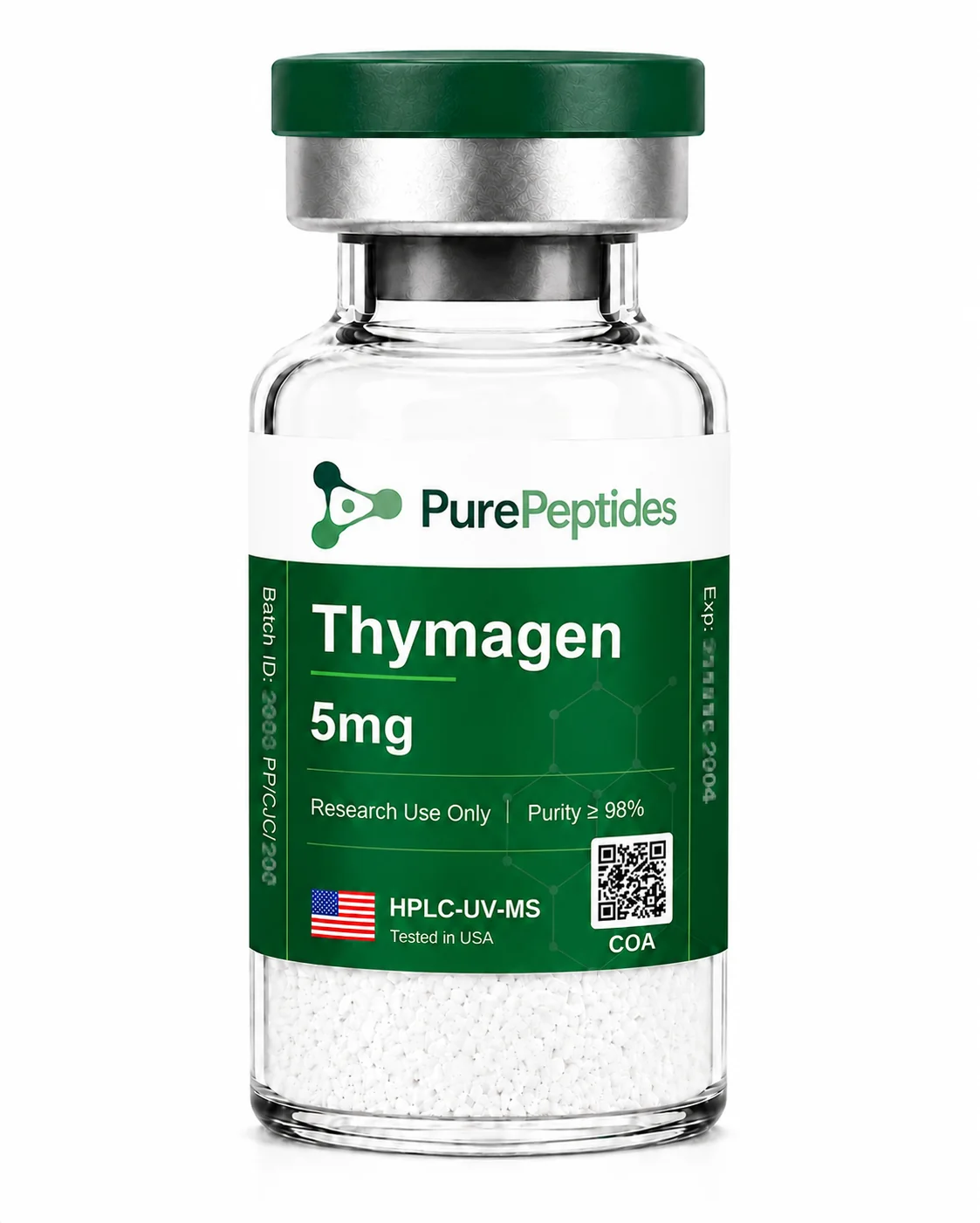
Thymagen (Thymogen)
$65.00
Supplied as a lyophilised powder and independently verified to ≥98% purity by HPLC and MS-UPLC analysis.
1000 in stock
🔥 Exclusive Crypto Offer
Get an INSTANT 15% DISCOUNT when you pay with Bitcoin, Ethereum, Dogecoin, Bitcoin Cash, XRP, Solana, or USDT.
⚡ Don't have crypto? Buy it here in 5 minutes with easy guidance.
💡 Pro Tip: You can also pay with cryptocurrency using your verified Cash App or PayPal account for a fast and secure checkout!
What is Thymagen (Thymogen)?
Thymagen (also called Thymogen) is a synthetic two-amino-acid peptide (Glu-Trp) based on thymopoietin, a thymus hormone involved in immune-cell maturation. It is studied in laboratory and animal research for its effects on immune-cell signaling.
- A two-amino-acid peptide (Glu-Trp) based on the thymus hormone thymopoietin
- Studied in research for its effects on T-cell maturation and immune signaling
- Investigated in animal models for immune signaling in the context of aging
- Studied alongside Thymalin and Thymulin in thymus-peptide research
For research use only. Not approved for human therapeutic use.
Thymogen, also known by its dipeptide designation EW (Glu-Trp), is a synthetic dipeptide bioregulator with a molecular weight of 333.34 g/mol. Defined by the amino acid sequence Glu-Trp (L-Glutamyl-L-Tryptophan), Thymogen is one of several ultra-short synthetic peptides developed at the Saint Petersburg Institute of Bioregulation and Gerontology as minimal-sequence bioregulators of immune function. Its structure pairs an acidic glutamic acid residue with the aromatic indole-containing tryptophan residue, a combination that has been the subject of structure-function investigation in the context of thymic peptide signalling. Produced via solid-phase peptide synthesis.
Thymogen has been investigated in preclinical immunology as a dipeptide bioregulator, with published research characterising a mechanism of action distinct from conventional receptor-mediated signalling. In vitro studies in a human monocyte/macrophage cell line have examined the Glu-Trp dipeptide’s modulation of proliferative activity and inflammatory signalling, documenting effects on MAPK (ERK1/2, JNK) and STAT1/STAT3 phosphorylation and characterising reduced secretion of pro-inflammatory cytokines (including TNF-α, IL-6 and IL-17) as a primary readout of the dipeptide’s interaction with immune cell populations [1]. In vivo rodent studies have examined L-glutamyl-L-tryptophan as an immune-mediated antitumour agent, documenting tumour-growth suppression in mice despite the absence of direct tumour-cell cytotoxicity in culture. The study characterised this activity as dependent on NK/NKT-cell cytolytic function, perforin and IL-12 signalling, consistent with an interaction with innate immune effector mechanisms in controlled preclinical tumour models [2], making Thymogen a key reference compound in thymic-peptide research examining minimal-sequence dipeptide modulation of immune cell signalling in preclinical models.
Thymogen is produced to research-grade standards and independently verified by third-party HPLC and MS-UPLC analysis before dispatch. Vials are vacuum sealed and stored in a temperature controlled, monitored cold storage system. Certificates of Analysis are available on request.
Sold strictly for in vitro research purposes only. Not for human consumption. Intended for use by qualified researchers in laboratory settings only.
References
1Avolio F, Martinotti S, Khavinson VK, Esposito JE, Giambuzzi G, Marino A, et al. Peptides Regulating Proliferative Activity and Inflammatory Pathways in the Monocyte/Macrophage THP-1 Cell Line. Int J Mol Sci. 2022 Mar 25;23(7):3607. ; PubMed Central PMCID: PMC8999041.PubMed PMID: 354089632Smith DL, Cai J, Zhu S, Wei W, Fukumoto J, Sharma S, et al. Natural killer cell cytolytic activity is necessary for in vivo antitumor activity of the dipeptide L-glutamyl-L-tryptophan. Int J Cancer. 2003 Sep 10;106(4):528–33. .PubMed PMID: 12845648
Scientific Review

Dr. Martina Rossi, PhD
Scientific Contributor and Reviewer
Reviewed for scientific accuracy, 14 June 2026
View credentials →
Thymogen, also known by its dipeptide designation EW (Glu-Trp), is a synthetic dipeptide bioregulator with a molecular weight of 333.34 g/mol. Defined by the amino acid sequence Glu-Trp (L-Glutamyl-L-Tryptophan), Thymogen is one of several ultra-short synthetic peptides developed at the Saint Petersburg Institute of Bioregulation and Gerontology as minimal-sequence bioregulators of immune function. Its structure pairs an acidic glutamic acid residue with the aromatic indole-containing tryptophan residue, a combination that has been the subject of structure-function investigation in the context of thymic peptide signalling. Produced via solid-phase peptide synthesis.
Thymogen has been investigated in preclinical immunology as a dipeptide bioregulator, with published research characterising a mechanism of action distinct from conventional receptor-mediated signalling. In vitro studies in a human monocyte/macrophage cell line have examined the Glu-Trp dipeptide’s modulation of proliferative activity and inflammatory signalling, documenting effects on MAPK (ERK1/2, JNK) and STAT1/STAT3 phosphorylation and characterising reduced secretion of pro-inflammatory cytokines (including TNF-α, IL-6 and IL-17) as a primary readout of the dipeptide’s interaction with immune cell populations [1]. In vivo rodent studies have examined L-glutamyl-L-tryptophan as an immune-mediated antitumour agent, documenting tumour-growth suppression in mice despite the absence of direct tumour-cell cytotoxicity in culture. The study characterised this activity as dependent on NK/NKT-cell cytolytic function, perforin and IL-12 signalling, consistent with an interaction with innate immune effector mechanisms in controlled preclinical tumour models [2], making Thymogen a key reference compound in thymic-peptide research examining minimal-sequence dipeptide modulation of immune cell signalling in preclinical models.
Thymogen is produced to research-grade standards and independently verified by third-party HPLC and MS-UPLC analysis before dispatch. Vials are vacuum sealed and stored in a temperature controlled, monitored cold storage system. Certificates of Analysis are available on request.
Sold strictly for in vitro research purposes only. Not for human consumption. Intended for use by qualified researchers in laboratory settings only.
References
1Avolio F, Martinotti S, Khavinson VK, Esposito JE, Giambuzzi G, Marino A, et al. Peptides Regulating Proliferative Activity and Inflammatory Pathways in the Monocyte/Macrophage THP-1 Cell Line. Int J Mol Sci. 2022 Mar 25;23(7):3607. ; PubMed Central PMCID: PMC8999041.PubMed PMID: 354089632Smith DL, Cai J, Zhu S, Wei W, Fukumoto J, Sharma S, et al. Natural killer cell cytolytic activity is necessary for in vivo antitumor activity of the dipeptide L-glutamyl-L-tryptophan. Int J Cancer. 2003 Sep 10;106(4):528–33. .PubMed PMID: 12845648
Scientific Review
Dr. Martina Rossi, PhD
Scientific Contributor and Reviewer
Reviewed for scientific accuracy, 14 June 2026
View credentials →CAS Number53321-28-9Molecular Weight333.34 g/molPurity≥98%Physical FormLyophilised PowderManufacturingManufactured in an ISO9001 Certified LaboratoryTestingHPLC + MS-UPLCSKURSC-THYMAGENTH-1675
Lyophilised powder: store at -20 °C or below, away from light and moisture. Once reconstituted in an appropriate laboratory diluent (e.g. sterile water, PBS, or assay buffer), store at 2–8 °C and use within the validated period for your protocol. Do not refreeze.
Thymogen, also known by its dipeptide designation EW (Glu-Trp), is a synthetic dipeptide bioregulator with a molecular weight of 333.34 g/mol. Defined by the amino acid sequence Glu-Trp (L-Glutamyl-L-Tryptophan), Thymogen is one of several ultra-short synthetic peptides developed at the Saint Petersburg Institute of Bioregulation and Gerontology as minimal-sequence bioregulators of immune function. Its structure pairs an acidic glutamic acid residue with the aromatic indole-containing tryptophan residue, a combination that has been the subject of structure-function investigation in the context of thymic peptide signalling. Produced via solid-phase peptide synthesis.
Thymogen has been investigated in preclinical immunology as a dipeptide bioregulator, with published research characterising a mechanism of action distinct from conventional receptor-mediated signalling. In vitro studies in a human monocyte/macrophage cell line have examined the Glu-Trp dipeptide’s modulation of proliferative activity and inflammatory signalling, documenting effects on MAPK (ERK1/2, JNK) and STAT1/STAT3 phosphorylation and characterising reduced secretion of pro-inflammatory cytokines (including TNF-α, IL-6 and IL-17) as a primary readout of the dipeptide’s interaction with immune cell populations [1]. In vivo rodent studies have examined L-glutamyl-L-tryptophan as an immune-mediated antitumour agent, documenting tumour-growth suppression in mice despite the absence of direct tumour-cell cytotoxicity in culture. The study characterised this activity as dependent on NK/NKT-cell cytolytic function, perforin and IL-12 signalling, consistent with an interaction with innate immune effector mechanisms in controlled preclinical tumour models [2], making Thymogen a key reference compound in thymic-peptide research examining minimal-sequence dipeptide modulation of immune cell signalling in preclinical models.
Thymogen is produced to research-grade standards and independently verified by third-party HPLC and MS-UPLC analysis before dispatch. Vials are vacuum sealed and stored in a temperature controlled, monitored cold storage system. Certificates of Analysis are available on request.
Sold strictly for in vitro research purposes only. Not for human consumption. Intended for use by qualified researchers in laboratory settings only.
References
1Avolio F, Martinotti S, Khavinson VK, Esposito JE, Giambuzzi G, Marino A, et al. Peptides Regulating Proliferative Activity and Inflammatory Pathways in the Monocyte/Macrophage THP-1 Cell Line. Int J Mol Sci. 2022 Mar 25;23(7):3607. ; PubMed Central PMCID: PMC8999041.PubMed PMID: 354089632Smith DL, Cai J, Zhu S, Wei W, Fukumoto J, Sharma S, et al. Natural killer cell cytolytic activity is necessary for in vivo antitumor activity of the dipeptide L-glutamyl-L-tryptophan. Int J Cancer. 2003 Sep 10;106(4):528–33. .PubMed PMID: 12845648
Scientific Review
Dr. Martina Rossi, PhD
Scientific Contributor and Reviewer
Reviewed for scientific accuracy, 14 June 2026
View credentials →CAS Number53321-28-9Molecular Weight333.34 g/molPurity≥98%Physical FormLyophilised PowderManufacturingManufactured in an ISO9001 Certified LaboratoryTestingHPLC + MS-UPLCSKURSC-THYMAGENTH-1675
Lyophilised powder: store at -20 °C or below, away from light and moisture. Once reconstituted in an appropriate laboratory diluent (e.g. sterile water, PBS, or assay buffer), store at 2–8 °C and use within the validated period for your protocol. Do not refreeze.
Related products
Peptide Bioregulators
Peptide Bioregulators

Peptide Bioregulators
Peptide Bioregulators

Peptide Bioregulators

Peptide Bioregulators

Peptide Bioregulators

Peptide Bioregulators