
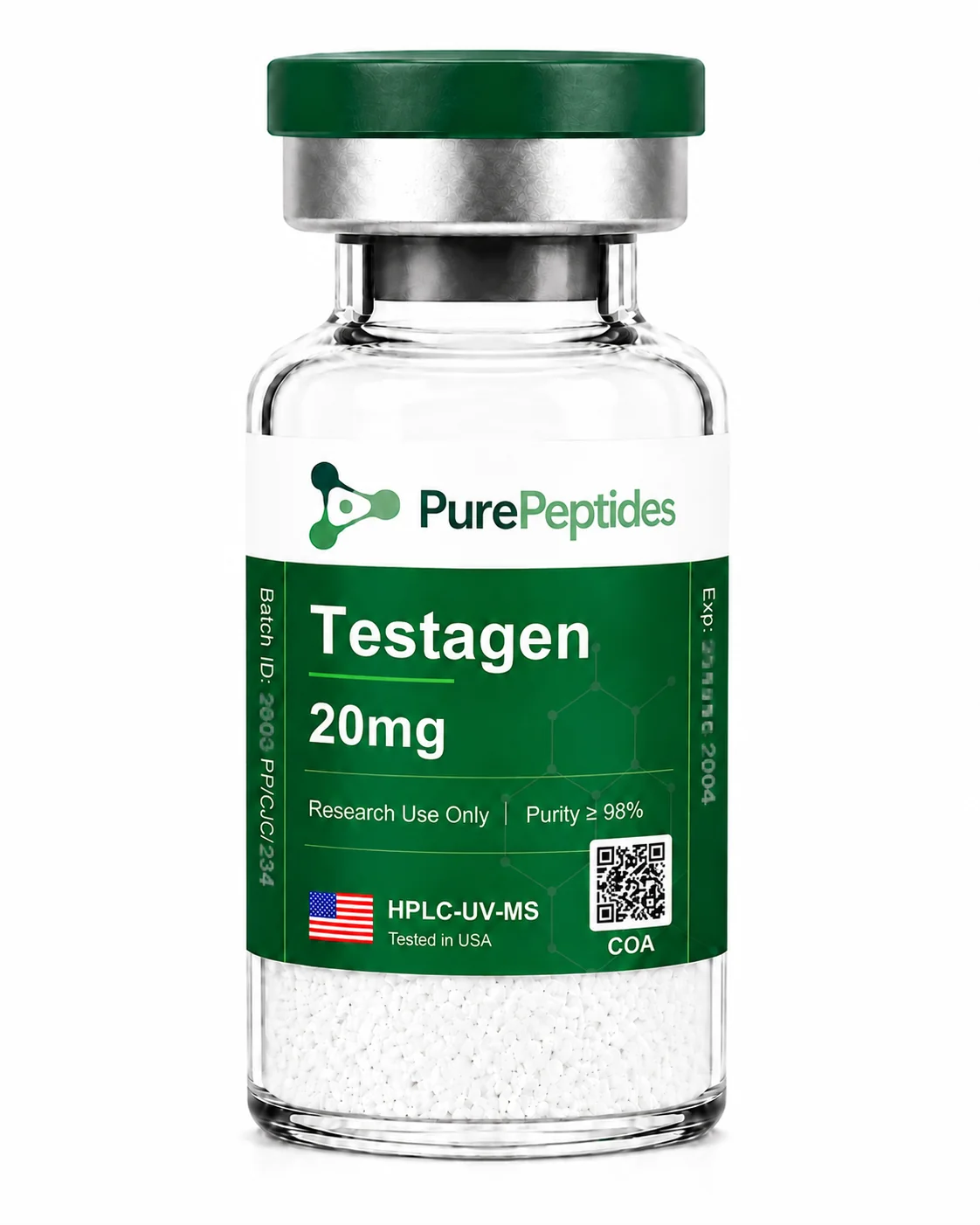
Testagen
$65.00
Supplied as a lyophilised powder and independently verified to ≥98% purity by HPLC and MS-UPLC analysis.
1000 in stock
🔥 Exclusive Crypto Offer
Get an INSTANT 15% DISCOUNT when you pay with Bitcoin, Ethereum, Dogecoin, Bitcoin Cash, XRP, Solana, or USDT.
⚡ Don't have crypto? Buy it here in 5 minutes with easy guidance.
💡 Pro Tip: You can also pay with cryptocurrency using your verified Cash App or PayPal account for a fast and secure checkout!
What is Testagen?
Testagen is a peptide bioregulator from the Russian program, designed to target testicular tissue and the cells that make testosterone. It is studied in animal research for its effects on testosterone-related signaling in the context of aging.
- A short peptide studied for its effects on testicular tissue
- Part of the Russian organ-targeted bioregulator research program
- Studied in aged animal models for its effects on testosterone-related gene activity
- Research focus includes age-related changes in male reproductive tissue
For research use only. Not approved for human therapeutic use.
Testagen, also known by its tetrapeptide designation KEDG (Lys-Glu-Asp-Gly), is a synthetic tetrapeptide bioregulator with a molecular weight of 474.53 g/mol. Developed at the Saint Petersburg Institute of Bioregulation and Gerontology as part of the Khavinson peptide bioregulator series, Testagen was designed based on peptide fractions associated with testicular tissue. Its sequence, Lys-Glu-Asp-Gly, shares the KED core motif found in the vascular bioregulator Vesugen, with the addition of a C-terminal glycine residue. Like other tetrapeptide bioregulators in the Khavinson series, Testagen is proposed to modulate tissue-specific gene expression through direct DNA interaction. Produced via solid-phase peptide synthesis, Testagen is associated with gonadal tissue gene expression and reproductive endocrine signalling pathways.
Testagen is an organ-specific tetrapeptide bioregulator within the Khavinson framework. Consistent with the proposed direct-to-DNA mechanism, published in vitro work has documented that testagen specifically penetrates into the cell nucleus and interacts with DNA in a sequence-selective manner: in FITC-labelled studies in HeLa cells, testagen entered the nucleus and bound preferentially to CAG-containing oligodeoxyribonucleotide sequences, consistent with the model that these ultrashort peptides can engage DNA directly and thereby influence gene expression epigenetically [1] . The broader principle under which Testagen is studied has been consolidated for the Khavinson ultrashort-peptide class in a systematic review of the field, and the foundational tissue-specific short-peptide bioregulator and geroprotector concept into which the gonadal-tropic Testagen is placed was established in the foundational survey of the field [2][3], making Testagen a reference compound in preclinical gerontology examining the direct-to-DNA, tissue-specific gene-regulatory mode of action characteristic of the Khavinson ultrashort peptides.
Testagen is produced to research-grade standards and independently verified by third-party HPLC and MS-UPLC analysis before dispatch. Vials are vacuum sealed and stored in a temperature controlled, monitored cold storage system. Certificates of Analysis are available on request.
Sold strictly for in vitro research purposes only. Not for human consumption. Intended for use by qualified researchers in laboratory settings only.
References
1Fedoreyeva LI, Kireev II, Khavinson VK, Vanyushin BF. Penetration of short fluorescence-labeled peptides into the nucleus in HeLa cells and in vitro specific interaction of the peptides with deoxyribooligonucleotides and DNA. Biochemistry (Mosc). 2011 Nov;76(11):1210–9. .PubMed PMID: 221175472Khavinson VK, Popovich IG, Linkova NS, Mironova ES, Ilina AR. Peptide Regulation of Gene Expression: A Systematic Review. Molecules. 2021 Nov 22;26(22):7053. ; PubMed Central PMCID: PMC8619776.PubMed PMID: 348341473Khavinson VK. Peptides and Ageing. Neuro Endocrinol Lett. 2002;23 Suppl 3:11–144. .PubMed PMID: 12374906
Scientific Review

Dr. Martina Rossi, PhD
Scientific Contributor and Reviewer
Reviewed for scientific accuracy, 14 June 2026
View credentials →
Testagen, also known by its tetrapeptide designation KEDG (Lys-Glu-Asp-Gly), is a synthetic tetrapeptide bioregulator with a molecular weight of 474.53 g/mol. Developed at the Saint Petersburg Institute of Bioregulation and Gerontology as part of the Khavinson peptide bioregulator series, Testagen was designed based on peptide fractions associated with testicular tissue. Its sequence, Lys-Glu-Asp-Gly, shares the KED core motif found in the vascular bioregulator Vesugen, with the addition of a C-terminal glycine residue. Like other tetrapeptide bioregulators in the Khavinson series, Testagen is proposed to modulate tissue-specific gene expression through direct DNA interaction. Produced via solid-phase peptide synthesis, Testagen is associated with gonadal tissue gene expression and reproductive endocrine signalling pathways.
Testagen is an organ-specific tetrapeptide bioregulator within the Khavinson framework. Consistent with the proposed direct-to-DNA mechanism, published in vitro work has documented that testagen specifically penetrates into the cell nucleus and interacts with DNA in a sequence-selective manner: in FITC-labelled studies in HeLa cells, testagen entered the nucleus and bound preferentially to CAG-containing oligodeoxyribonucleotide sequences, consistent with the model that these ultrashort peptides can engage DNA directly and thereby influence gene expression epigenetically [1] . The broader principle under which Testagen is studied has been consolidated for the Khavinson ultrashort-peptide class in a systematic review of the field, and the foundational tissue-specific short-peptide bioregulator and geroprotector concept into which the gonadal-tropic Testagen is placed was established in the foundational survey of the field [2][3], making Testagen a reference compound in preclinical gerontology examining the direct-to-DNA, tissue-specific gene-regulatory mode of action characteristic of the Khavinson ultrashort peptides.
Testagen is produced to research-grade standards and independently verified by third-party HPLC and MS-UPLC analysis before dispatch. Vials are vacuum sealed and stored in a temperature controlled, monitored cold storage system. Certificates of Analysis are available on request.
Sold strictly for in vitro research purposes only. Not for human consumption. Intended for use by qualified researchers in laboratory settings only.
References
1Fedoreyeva LI, Kireev II, Khavinson VK, Vanyushin BF. Penetration of short fluorescence-labeled peptides into the nucleus in HeLa cells and in vitro specific interaction of the peptides with deoxyribooligonucleotides and DNA. Biochemistry (Mosc). 2011 Nov;76(11):1210–9. .PubMed PMID: 221175472Khavinson VK, Popovich IG, Linkova NS, Mironova ES, Ilina AR. Peptide Regulation of Gene Expression: A Systematic Review. Molecules. 2021 Nov 22;26(22):7053. ; PubMed Central PMCID: PMC8619776.PubMed PMID: 348341473Khavinson VK. Peptides and Ageing. Neuro Endocrinol Lett. 2002;23 Suppl 3:11–144. .PubMed PMID: 12374906
Scientific Review
Dr. Martina Rossi, PhD
Scientific Contributor and Reviewer
Reviewed for scientific accuracy, 14 June 2026
View credentials →CAS NumberN/A (Khavinson bioregulator)Molecular Weight451.44 g/molPurity≥98%Physical FormLyophilised PowderManufacturingManufactured in an ISO9001 Certified LaboratoryTestingHPLC + MS-UPLCSKURSC-TESTAGEN-0530
Lyophilised powder: store at -20 °C or below, away from light and moisture. Once reconstituted in an appropriate laboratory diluent (e.g. sterile water, PBS, or assay buffer), store at 2–8 °C and use within the validated period for your protocol. Do not refreeze.
Testagen, also known by its tetrapeptide designation KEDG (Lys-Glu-Asp-Gly), is a synthetic tetrapeptide bioregulator with a molecular weight of 474.53 g/mol. Developed at the Saint Petersburg Institute of Bioregulation and Gerontology as part of the Khavinson peptide bioregulator series, Testagen was designed based on peptide fractions associated with testicular tissue. Its sequence, Lys-Glu-Asp-Gly, shares the KED core motif found in the vascular bioregulator Vesugen, with the addition of a C-terminal glycine residue. Like other tetrapeptide bioregulators in the Khavinson series, Testagen is proposed to modulate tissue-specific gene expression through direct DNA interaction. Produced via solid-phase peptide synthesis, Testagen is associated with gonadal tissue gene expression and reproductive endocrine signalling pathways.
Testagen is an organ-specific tetrapeptide bioregulator within the Khavinson framework. Consistent with the proposed direct-to-DNA mechanism, published in vitro work has documented that testagen specifically penetrates into the cell nucleus and interacts with DNA in a sequence-selective manner: in FITC-labelled studies in HeLa cells, testagen entered the nucleus and bound preferentially to CAG-containing oligodeoxyribonucleotide sequences, consistent with the model that these ultrashort peptides can engage DNA directly and thereby influence gene expression epigenetically [1] . The broader principle under which Testagen is studied has been consolidated for the Khavinson ultrashort-peptide class in a systematic review of the field, and the foundational tissue-specific short-peptide bioregulator and geroprotector concept into which the gonadal-tropic Testagen is placed was established in the foundational survey of the field [2][3], making Testagen a reference compound in preclinical gerontology examining the direct-to-DNA, tissue-specific gene-regulatory mode of action characteristic of the Khavinson ultrashort peptides.
Testagen is produced to research-grade standards and independently verified by third-party HPLC and MS-UPLC analysis before dispatch. Vials are vacuum sealed and stored in a temperature controlled, monitored cold storage system. Certificates of Analysis are available on request.
Sold strictly for in vitro research purposes only. Not for human consumption. Intended for use by qualified researchers in laboratory settings only.
References
1Fedoreyeva LI, Kireev II, Khavinson VK, Vanyushin BF. Penetration of short fluorescence-labeled peptides into the nucleus in HeLa cells and in vitro specific interaction of the peptides with deoxyribooligonucleotides and DNA. Biochemistry (Mosc). 2011 Nov;76(11):1210–9. .PubMed PMID: 221175472Khavinson VK, Popovich IG, Linkova NS, Mironova ES, Ilina AR. Peptide Regulation of Gene Expression: A Systematic Review. Molecules. 2021 Nov 22;26(22):7053. ; PubMed Central PMCID: PMC8619776.PubMed PMID: 348341473Khavinson VK. Peptides and Ageing. Neuro Endocrinol Lett. 2002;23 Suppl 3:11–144. .PubMed PMID: 12374906
Scientific Review
Dr. Martina Rossi, PhD
Scientific Contributor and Reviewer
Reviewed for scientific accuracy, 14 June 2026
View credentials →CAS NumberN/A (Khavinson bioregulator)Molecular Weight451.44 g/molPurity≥98%Physical FormLyophilised PowderManufacturingManufactured in an ISO9001 Certified LaboratoryTestingHPLC + MS-UPLCSKURSC-TESTAGEN-0530
Lyophilised powder: store at -20 °C or below, away from light and moisture. Once reconstituted in an appropriate laboratory diluent (e.g. sterile water, PBS, or assay buffer), store at 2–8 °C and use within the validated period for your protocol. Do not refreeze.
Related products
Peptide Bioregulators

Peptide Bioregulators
Peptide Bioregulators
Peptide Bioregulators

Peptide Bioregulators
Peptide Bioregulators

Peptide Bioregulators

Peptide Bioregulators