
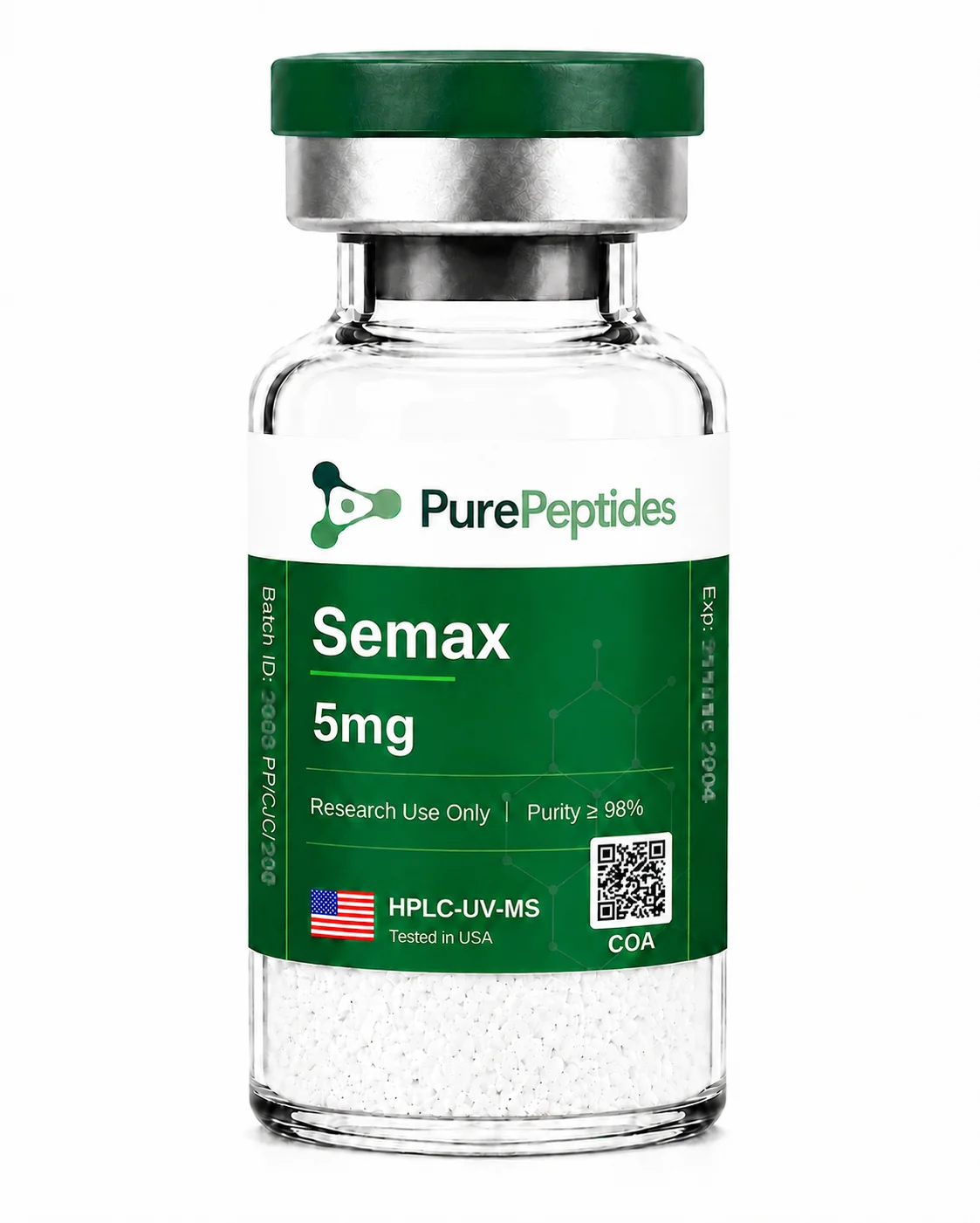
Semax
$35.00
Supplied as a lyophilised powder and independently verified to ≥98% purity by HPLC and MS-UPLC analysis.
1000 in stock
🔥 Exclusive Crypto Offer
Get an INSTANT 15% DISCOUNT when you pay with Bitcoin, Ethereum, Dogecoin, Bitcoin Cash, XRP, Solana, or USDT.
⚡ Don't have crypto? Buy it here in 5 minutes with easy guidance.
💡 Pro Tip: You can also pay with cryptocurrency using your verified Cash App or PayPal account for a fast and secure checkout!
What is Semax?
Semax is a synthetic seven-amino-acid peptide based on a fragment of ACTH, modified to last longer in the body. It does not carry the hormone activity of its parent, and is studied in animal research for its effects on brain-cell growth signaling.
- A seven-amino-acid peptide from the ACTH 4-7 fragment, modified for stability
- Lacks the hormone activity of its parent ACTH sequence in research
- Studied in published research for its effects on BDNF and NGF nerve-growth signaling
- Investigated in animal brain-injury models for nerve-growth signaling and brain-cell survival
For research use only. Not approved for human therapeutic use.
Semax (CAS 80714-61-0), also known as ACTH(4-7)-PGP, is a synthetic heptapeptide analogue of a fragment of adrenocorticotropic hormone (ACTH). With the molecular formula C37H51N9O10S and a molecular weight of 813.93 g/mol, Semax is defined by the amino acid sequence Met-Glu-His-Phe-Pro-Gly-Pro, consisting of the ACTH(4-7) tetrapeptide core extended at the C-terminus with a Pro-Gly-Pro tripeptide motif. This structural modification is considered relevant to its metabolic stability and central nervous system accessibility. Produced via solid-phase peptide synthesis, ACTH(4-7)-PGP is associated with neurotrophic factor signalling pathways in preclinical neuroscience research.
Semax has been extensively investigated in preclinical neurobiology as one of the most frequently referenced synthetic melanocortin-derived peptides. The ACTH(4-10) fragment from which it is derived has been the subject of extensive structure-activity research examining the non-endocrine signalling properties of melanocortin peptides independently of their adrenal axis activity. In vitro studies have investigated Semax’s interaction with brain-derived neurotrophic factor (BDNF) and nerve growth factor (NGF) expression, with published research documenting ACTH(4-7)-PGP-mediated activation of BDNF and NGF in rat basal forebrain tissue preparations and characterising the neurotrophic factor response as a basis of Semax’s neurotrophic signalling profile [1]. In vivo rodent studies have examined ACTH(4-7)-PGP in experimental models of cerebral ischaemia, with published research documenting Semax’s influence on nitric oxide levels in ischaemic rat brain and characterising neuroprotective effects through NO-mediated signalling under conditions of reduced cerebral perfusion [2], making Semax a key reference compound in melanocortin-derived neuropeptide research across neurotrophic factor signalling and neuroprotection models.
Semax is produced to research-grade standards and independently verified by third-party HPLC and MS-UPLC analysis before dispatch. Vials are vacuum sealed and stored in a temperature controlled, monitored cold storage system. Certificates of Analysis are available on request.
Sold strictly for in vitro research purposes only. Not for human consumption. Intended for use by qualified researchers in laboratory settings only.
References
1Dolotov OV, Karpenko EA, Seredenina TS, Inozemtseva LS, Levitskaya NG, Zolotarev YA, et al. Semax, an analogue of adrenocorticotropin (4–10), binds specifically and increases levels of brain-derived neurotrophic factor protein in rat basal forebrain. Journal of Neurochemistry. 2006;97(s1):82–6.doi:10.1111/j.1471-4159.2006.03658.x2Fadiukova OE, Alekseev AA, Bashkatova VG, Tolordava IA, Kuzenkov VS, Mikoian VD, et al. [Semax prevents elevation of nitric oxide generation caused by incomplete global ischemia in the rat brain]. Eksp Klin Farmakol. 2001;64(2):31–4. .PubMed PMID: 11548444
Scientific Review

Dr. Martina Rossi, PhD
Scientific Contributor and Reviewer
Reviewed for scientific accuracy, 14 June 2026
View credentials →
Semax (CAS 80714-61-0), also known as ACTH(4-7)-PGP, is a synthetic heptapeptide analogue of a fragment of adrenocorticotropic hormone (ACTH). With the molecular formula C37H51N9O10S and a molecular weight of 813.93 g/mol, Semax is defined by the amino acid sequence Met-Glu-His-Phe-Pro-Gly-Pro, consisting of the ACTH(4-7) tetrapeptide core extended at the C-terminus with a Pro-Gly-Pro tripeptide motif. This structural modification is considered relevant to its metabolic stability and central nervous system accessibility. Produced via solid-phase peptide synthesis, ACTH(4-7)-PGP is associated with neurotrophic factor signalling pathways in preclinical neuroscience research.
Semax has been extensively investigated in preclinical neurobiology as one of the most frequently referenced synthetic melanocortin-derived peptides. The ACTH(4-10) fragment from which it is derived has been the subject of extensive structure-activity research examining the non-endocrine signalling properties of melanocortin peptides independently of their adrenal axis activity. In vitro studies have investigated Semax’s interaction with brain-derived neurotrophic factor (BDNF) and nerve growth factor (NGF) expression, with published research documenting ACTH(4-7)-PGP-mediated activation of BDNF and NGF in rat basal forebrain tissue preparations and characterising the neurotrophic factor response as a basis of Semax’s neurotrophic signalling profile [1]. In vivo rodent studies have examined ACTH(4-7)-PGP in experimental models of cerebral ischaemia, with published research documenting Semax’s influence on nitric oxide levels in ischaemic rat brain and characterising neuroprotective effects through NO-mediated signalling under conditions of reduced cerebral perfusion [2], making Semax a key reference compound in melanocortin-derived neuropeptide research across neurotrophic factor signalling and neuroprotection models.
Semax is produced to research-grade standards and independently verified by third-party HPLC and MS-UPLC analysis before dispatch. Vials are vacuum sealed and stored in a temperature controlled, monitored cold storage system. Certificates of Analysis are available on request.
Sold strictly for in vitro research purposes only. Not for human consumption. Intended for use by qualified researchers in laboratory settings only.
References
1Dolotov OV, Karpenko EA, Seredenina TS, Inozemtseva LS, Levitskaya NG, Zolotarev YA, et al. Semax, an analogue of adrenocorticotropin (4–10), binds specifically and increases levels of brain-derived neurotrophic factor protein in rat basal forebrain. Journal of Neurochemistry. 2006;97(s1):82–6.doi:10.1111/j.1471-4159.2006.03658.x2Fadiukova OE, Alekseev AA, Bashkatova VG, Tolordava IA, Kuzenkov VS, Mikoian VD, et al. [Semax prevents elevation of nitric oxide generation caused by incomplete global ischemia in the rat brain]. Eksp Klin Farmakol. 2001;64(2):31–4. .PubMed PMID: 11548444
Scientific Review
Dr. Martina Rossi, PhD
Scientific Contributor and Reviewer
Reviewed for scientific accuracy, 14 June 2026
View credentials →CAS Number80714-61-0Molecular Weight813.92 g/molPurity≥98%Physical FormLyophilised PowderManufacturingManufactured in an ISO9001 Certified LaboratoryTestingHPLC + MS-UPLCSKUSEMAX
Lyophilised powder: store at -20 °C or below, away from light and moisture. Once reconstituted in an appropriate laboratory diluent (e.g. sterile water, PBS, or assay buffer), store at 2–8 °C and use within the validated period for your protocol. Do not refreeze.
Semax (CAS 80714-61-0), also known as ACTH(4-7)-PGP, is a synthetic heptapeptide analogue of a fragment of adrenocorticotropic hormone (ACTH). With the molecular formula C37H51N9O10S and a molecular weight of 813.93 g/mol, Semax is defined by the amino acid sequence Met-Glu-His-Phe-Pro-Gly-Pro, consisting of the ACTH(4-7) tetrapeptide core extended at the C-terminus with a Pro-Gly-Pro tripeptide motif. This structural modification is considered relevant to its metabolic stability and central nervous system accessibility. Produced via solid-phase peptide synthesis, ACTH(4-7)-PGP is associated with neurotrophic factor signalling pathways in preclinical neuroscience research.
Semax has been extensively investigated in preclinical neurobiology as one of the most frequently referenced synthetic melanocortin-derived peptides. The ACTH(4-10) fragment from which it is derived has been the subject of extensive structure-activity research examining the non-endocrine signalling properties of melanocortin peptides independently of their adrenal axis activity. In vitro studies have investigated Semax’s interaction with brain-derived neurotrophic factor (BDNF) and nerve growth factor (NGF) expression, with published research documenting ACTH(4-7)-PGP-mediated activation of BDNF and NGF in rat basal forebrain tissue preparations and characterising the neurotrophic factor response as a basis of Semax’s neurotrophic signalling profile [1]. In vivo rodent studies have examined ACTH(4-7)-PGP in experimental models of cerebral ischaemia, with published research documenting Semax’s influence on nitric oxide levels in ischaemic rat brain and characterising neuroprotective effects through NO-mediated signalling under conditions of reduced cerebral perfusion [2], making Semax a key reference compound in melanocortin-derived neuropeptide research across neurotrophic factor signalling and neuroprotection models.
Semax is produced to research-grade standards and independently verified by third-party HPLC and MS-UPLC analysis before dispatch. Vials are vacuum sealed and stored in a temperature controlled, monitored cold storage system. Certificates of Analysis are available on request.
Sold strictly for in vitro research purposes only. Not for human consumption. Intended for use by qualified researchers in laboratory settings only.
References
1Dolotov OV, Karpenko EA, Seredenina TS, Inozemtseva LS, Levitskaya NG, Zolotarev YA, et al. Semax, an analogue of adrenocorticotropin (4–10), binds specifically and increases levels of brain-derived neurotrophic factor protein in rat basal forebrain. Journal of Neurochemistry. 2006;97(s1):82–6.doi:10.1111/j.1471-4159.2006.03658.x2Fadiukova OE, Alekseev AA, Bashkatova VG, Tolordava IA, Kuzenkov VS, Mikoian VD, et al. [Semax prevents elevation of nitric oxide generation caused by incomplete global ischemia in the rat brain]. Eksp Klin Farmakol. 2001;64(2):31–4. .PubMed PMID: 11548444
Scientific Review
Dr. Martina Rossi, PhD
Scientific Contributor and Reviewer
Reviewed for scientific accuracy, 14 June 2026
View credentials →CAS Number80714-61-0Molecular Weight813.92 g/molPurity≥98%Physical FormLyophilised PowderManufacturingManufactured in an ISO9001 Certified LaboratoryTestingHPLC + MS-UPLCSKUSEMAX
Lyophilised powder: store at -20 °C or below, away from light and moisture. Once reconstituted in an appropriate laboratory diluent (e.g. sterile water, PBS, or assay buffer), store at 2–8 °C and use within the validated period for your protocol. Do not refreeze.
Related products
Cognitive & Neuropeptide Research
Cognitive & Neuropeptide Research

Cognitive & Neuropeptide Research

Cognitive & Neuropeptide Research
Cognitive & Neuropeptide Research
Cognitive & Neuropeptide Research

Cognitive & Neuropeptide Research
Cognitive & Neuropeptide Research