
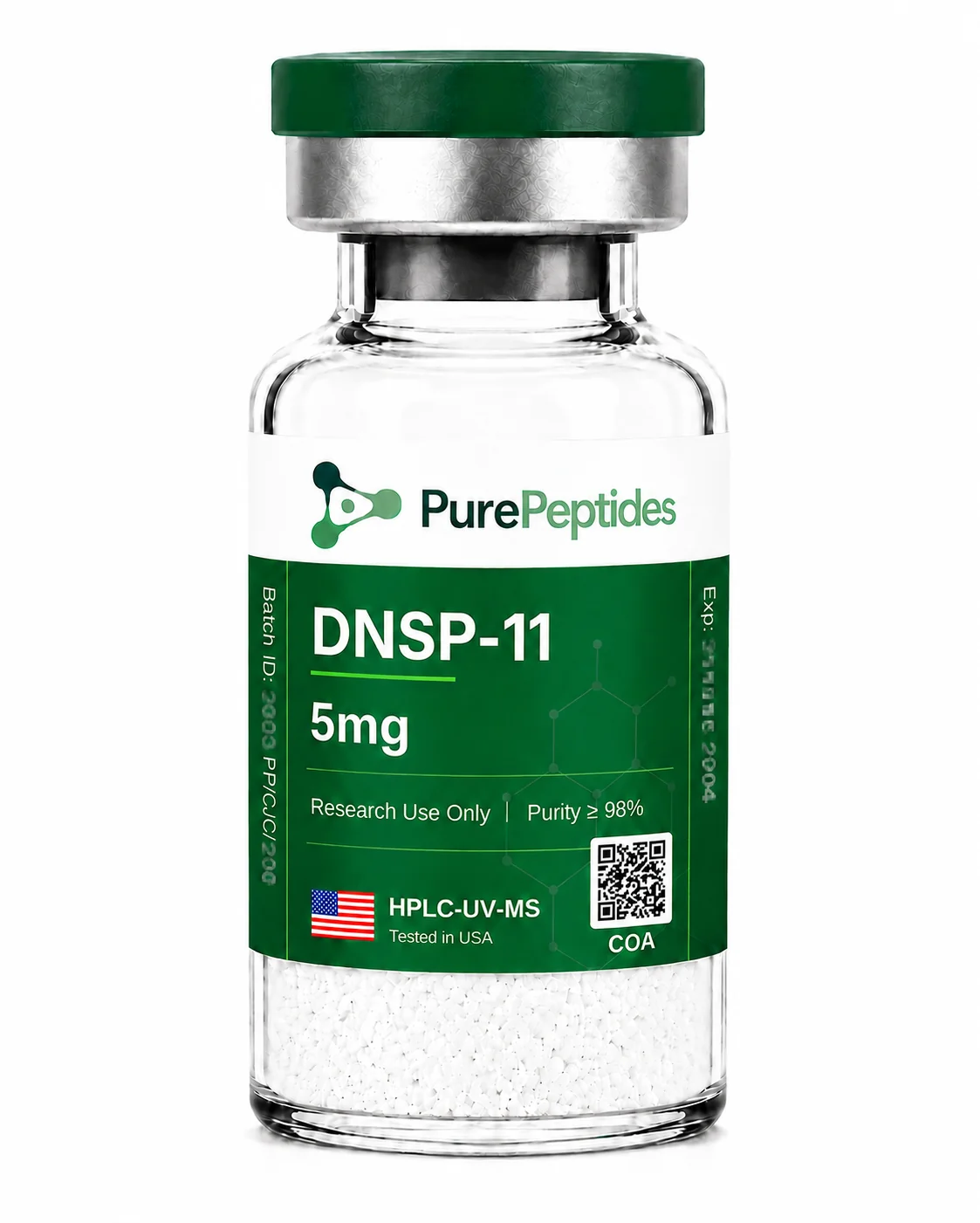
DNSP-11
$35.00
Supplied as a lyophilised powder and independently verified to ≥98% purity by HPLC and MS-UPLC analysis.
1000 in stock
🔥 Exclusive Crypto Offer
Get an INSTANT 15% DISCOUNT when you pay with Bitcoin, Ethereum, Dogecoin, Bitcoin Cash, XRP, Solana, or USDT.
⚡ Don't have crypto? Buy it here in 5 minutes with easy guidance.
💡 Pro Tip: You can also pay with cryptocurrency using your verified Cash App or PayPal account for a fast and secure checkout!
What is DNSP-11?
DNSP-11 is a small 11-amino-acid peptide taken from the precursor of GDNF, a natural brain growth factor. It is studied in animal research for its effects on dopamine-producing brain cells, and it reaches the brain more easily than full GDNF.
- An 11-amino-acid peptide derived from the precursor of the brain growth factor GDNF
- Studied in animal research for its effects on the survival of dopamine-producing brain cells
- Reaches the brain more readily than the full GDNF protein
- Investigated in animal models of dopamine-cell loss
For research use only. Not approved for human therapeutic use.
DNSP-11 (Dopamine Neuron Stimulating Peptide-11) is a synthetic C-terminal amidated 11-amino acid peptide with an molecular weight of 1180.27 g/mol. Defined by the amino acid sequence Pro-Pro-Glu-Ala-Pro-Ala-Glu-Asp-Arg-Ser-Leu-NH2 (PPEAPAEDRSL-NH2), DNSP-11 is derived from the proprotein domain of human glial cell line-derived neurotrophic factor (GDNF). The peptide corresponds to a predicted endopeptidase cleavage product from the GDNF pro-sequence, flanked by dibasic processing sites. Its sequence is highly conserved across human, rat, and mouse GDNF proprotein sequences. Produced via solid-phase peptide synthesis, DNSP-11 is associated with dopaminergic neuron survival and ERK1/2 signalling pathways in preclinical Parkinson’s disease research.
DNSP-11 is a small GDNF pro-domain-derived peptide that retains neurotrophic-like properties in dopaminergic cell populations but without requiring the GFRalpha1 receptor complex that mediates canonical GDNF signalling. Published in vitro studies have documented that DNSP-11 increases the survival and neurite outgrowth of cultured embryonic ventral mesencephalic dopaminergic neurons, reduces cytochrome c release and maintains mitochondrial integrity in dopaminergic cell lines, and that it does not bind the GFRalpha1 co-receptor [1], and that DNSP-11 exposure increases ERK1/2 phosphorylation in dopaminergic MN9D cells to levels comparable with GDNF [2]. In vivo rodent studies have investigated DNSP-11 in 6-hydroxydopamine (6-OHDA) lesion models of Parkinson’s disease, with published research documenting that repeated administration of DNSP-11 in the 6-OHDA rat model was associated with changes in striatal dopamine turnover, sparing of tyrosine-hydroxylase-positive neurons, and reduced amphetamine-induced rotational behaviour [3], making DNSP-11 a reference compound in preclinical neuroscience research examining GDNF pro-domain-derived peptide modulation of dopaminergic neuron survival and nigrostriatal function in rodent models.
DNSP-11 is produced to research-grade standards and independently verified by third-party HPLC and MS-UPLC analysis before dispatch. Vials are vacuum sealed and stored in a temperature controlled, monitored cold storage system. Certificates of Analysis are available on request.
Sold strictly for in vitro research purposes only. Not for human consumption. Intended for use by qualified researchers in laboratory settings only.
References
1Bradley LH, Fuqua J, Richardson A, Turchan-Cholewo J, Ai Y, Kelps KA, et al. Dopamine Neuron Stimulating Actions of a GDNF Propeptide. PLoS One. 2010 Mar 18;5(3):e9752. ; PubMed Central PMCID: PMC2841203.PubMed PMID: 203057892Fuqua JL, Littrell OM, Lundblad M, Turchan-Cholewo J, Abdelmoti LG, Galperin E, et al. Dynamic changes in dopamine neuron function after DNSP-11 treatment: effects in vivo and increased ERK 1/2 phosphorylation in vitro. Peptides. 2014 Apr;54:1–8. ; PubMed Central PMCID: PMC3989369.PubMed PMID: 244068993Stenslik MJ, Potts LF, Sonne JWH, Cass WA, Turchan-Cholewo J, Pomerleau F, et al. Methodology and effects of repeated intranasal delivery of DNSP-11 in a rat model of Parkinson’s disease. J Neurosci Methods. 2015 Aug 15;251:120–9. ; PubMed Central PMCID: PMC4500736.PubMed PMID: 25999268
Scientific Review

Dr. Martina Rossi, PhD
Scientific Contributor and Reviewer
Reviewed for scientific accuracy, 14 June 2026
View credentials →
DNSP-11 (Dopamine Neuron Stimulating Peptide-11) is a synthetic C-terminal amidated 11-amino acid peptide with an molecular weight of 1180.27 g/mol. Defined by the amino acid sequence Pro-Pro-Glu-Ala-Pro-Ala-Glu-Asp-Arg-Ser-Leu-NH2 (PPEAPAEDRSL-NH2), DNSP-11 is derived from the proprotein domain of human glial cell line-derived neurotrophic factor (GDNF). The peptide corresponds to a predicted endopeptidase cleavage product from the GDNF pro-sequence, flanked by dibasic processing sites. Its sequence is highly conserved across human, rat, and mouse GDNF proprotein sequences. Produced via solid-phase peptide synthesis, DNSP-11 is associated with dopaminergic neuron survival and ERK1/2 signalling pathways in preclinical Parkinson’s disease research.
DNSP-11 is a small GDNF pro-domain-derived peptide that retains neurotrophic-like properties in dopaminergic cell populations but without requiring the GFRalpha1 receptor complex that mediates canonical GDNF signalling. Published in vitro studies have documented that DNSP-11 increases the survival and neurite outgrowth of cultured embryonic ventral mesencephalic dopaminergic neurons, reduces cytochrome c release and maintains mitochondrial integrity in dopaminergic cell lines, and that it does not bind the GFRalpha1 co-receptor [1], and that DNSP-11 exposure increases ERK1/2 phosphorylation in dopaminergic MN9D cells to levels comparable with GDNF [2]. In vivo rodent studies have investigated DNSP-11 in 6-hydroxydopamine (6-OHDA) lesion models of Parkinson’s disease, with published research documenting that repeated administration of DNSP-11 in the 6-OHDA rat model was associated with changes in striatal dopamine turnover, sparing of tyrosine-hydroxylase-positive neurons, and reduced amphetamine-induced rotational behaviour [3], making DNSP-11 a reference compound in preclinical neuroscience research examining GDNF pro-domain-derived peptide modulation of dopaminergic neuron survival and nigrostriatal function in rodent models.
DNSP-11 is produced to research-grade standards and independently verified by third-party HPLC and MS-UPLC analysis before dispatch. Vials are vacuum sealed and stored in a temperature controlled, monitored cold storage system. Certificates of Analysis are available on request.
Sold strictly for in vitro research purposes only. Not for human consumption. Intended for use by qualified researchers in laboratory settings only.
References
1Bradley LH, Fuqua J, Richardson A, Turchan-Cholewo J, Ai Y, Kelps KA, et al. Dopamine Neuron Stimulating Actions of a GDNF Propeptide. PLoS One. 2010 Mar 18;5(3):e9752. ; PubMed Central PMCID: PMC2841203.PubMed PMID: 203057892Fuqua JL, Littrell OM, Lundblad M, Turchan-Cholewo J, Abdelmoti LG, Galperin E, et al. Dynamic changes in dopamine neuron function after DNSP-11 treatment: effects in vivo and increased ERK 1/2 phosphorylation in vitro. Peptides. 2014 Apr;54:1–8. ; PubMed Central PMCID: PMC3989369.PubMed PMID: 244068993Stenslik MJ, Potts LF, Sonne JWH, Cass WA, Turchan-Cholewo J, Pomerleau F, et al. Methodology and effects of repeated intranasal delivery of DNSP-11 in a rat model of Parkinson’s disease. J Neurosci Methods. 2015 Aug 15;251:120–9. ; PubMed Central PMCID: PMC4500736.PubMed PMID: 25999268
Scientific Review
Dr. Martina Rossi, PhD
Scientific Contributor and Reviewer
Reviewed for scientific accuracy, 14 June 2026
View credentials →CAS NumberN/A (novel research peptide)Molecular Weight~1,307 g/molPurity≥98%Physical FormLyophilised PowderManufacturingManufactured in an ISO9001 Certified LaboratoryTestingHPLC + MS-UPLCSKURSC-DNSP11-1470
Lyophilised powder: store at -20 °C or below, away from light and moisture. Once reconstituted in an appropriate laboratory diluent (e.g. sterile water, PBS, or assay buffer), store at 2–8 °C and use within the validated period for your protocol. Do not refreeze.
DNSP-11 (Dopamine Neuron Stimulating Peptide-11) is a synthetic C-terminal amidated 11-amino acid peptide with an molecular weight of 1180.27 g/mol. Defined by the amino acid sequence Pro-Pro-Glu-Ala-Pro-Ala-Glu-Asp-Arg-Ser-Leu-NH2 (PPEAPAEDRSL-NH2), DNSP-11 is derived from the proprotein domain of human glial cell line-derived neurotrophic factor (GDNF). The peptide corresponds to a predicted endopeptidase cleavage product from the GDNF pro-sequence, flanked by dibasic processing sites. Its sequence is highly conserved across human, rat, and mouse GDNF proprotein sequences. Produced via solid-phase peptide synthesis, DNSP-11 is associated with dopaminergic neuron survival and ERK1/2 signalling pathways in preclinical Parkinson’s disease research.
DNSP-11 is a small GDNF pro-domain-derived peptide that retains neurotrophic-like properties in dopaminergic cell populations but without requiring the GFRalpha1 receptor complex that mediates canonical GDNF signalling. Published in vitro studies have documented that DNSP-11 increases the survival and neurite outgrowth of cultured embryonic ventral mesencephalic dopaminergic neurons, reduces cytochrome c release and maintains mitochondrial integrity in dopaminergic cell lines, and that it does not bind the GFRalpha1 co-receptor [1], and that DNSP-11 exposure increases ERK1/2 phosphorylation in dopaminergic MN9D cells to levels comparable with GDNF [2]. In vivo rodent studies have investigated DNSP-11 in 6-hydroxydopamine (6-OHDA) lesion models of Parkinson’s disease, with published research documenting that repeated administration of DNSP-11 in the 6-OHDA rat model was associated with changes in striatal dopamine turnover, sparing of tyrosine-hydroxylase-positive neurons, and reduced amphetamine-induced rotational behaviour [3], making DNSP-11 a reference compound in preclinical neuroscience research examining GDNF pro-domain-derived peptide modulation of dopaminergic neuron survival and nigrostriatal function in rodent models.
DNSP-11 is produced to research-grade standards and independently verified by third-party HPLC and MS-UPLC analysis before dispatch. Vials are vacuum sealed and stored in a temperature controlled, monitored cold storage system. Certificates of Analysis are available on request.
Sold strictly for in vitro research purposes only. Not for human consumption. Intended for use by qualified researchers in laboratory settings only.
References
1Bradley LH, Fuqua J, Richardson A, Turchan-Cholewo J, Ai Y, Kelps KA, et al. Dopamine Neuron Stimulating Actions of a GDNF Propeptide. PLoS One. 2010 Mar 18;5(3):e9752. ; PubMed Central PMCID: PMC2841203.PubMed PMID: 203057892Fuqua JL, Littrell OM, Lundblad M, Turchan-Cholewo J, Abdelmoti LG, Galperin E, et al. Dynamic changes in dopamine neuron function after DNSP-11 treatment: effects in vivo and increased ERK 1/2 phosphorylation in vitro. Peptides. 2014 Apr;54:1–8. ; PubMed Central PMCID: PMC3989369.PubMed PMID: 244068993Stenslik MJ, Potts LF, Sonne JWH, Cass WA, Turchan-Cholewo J, Pomerleau F, et al. Methodology and effects of repeated intranasal delivery of DNSP-11 in a rat model of Parkinson’s disease. J Neurosci Methods. 2015 Aug 15;251:120–9. ; PubMed Central PMCID: PMC4500736.PubMed PMID: 25999268
Scientific Review
Dr. Martina Rossi, PhD
Scientific Contributor and Reviewer
Reviewed for scientific accuracy, 14 June 2026
View credentials →CAS NumberN/A (novel research peptide)Molecular Weight~1,307 g/molPurity≥98%Physical FormLyophilised PowderManufacturingManufactured in an ISO9001 Certified LaboratoryTestingHPLC + MS-UPLCSKURSC-DNSP11-1470
Lyophilised powder: store at -20 °C or below, away from light and moisture. Once reconstituted in an appropriate laboratory diluent (e.g. sterile water, PBS, or assay buffer), store at 2–8 °C and use within the validated period for your protocol. Do not refreeze.
Related products
Cognitive & Neuropeptide Research
Cognitive & Neuropeptide Research
Cognitive & Neuropeptide Research
Cognitive & Neuropeptide Research

Cognitive & Neuropeptide Research

Cognitive & Neuropeptide Research

Cognitive & Neuropeptide Research
Cognitive & Neuropeptide Research