
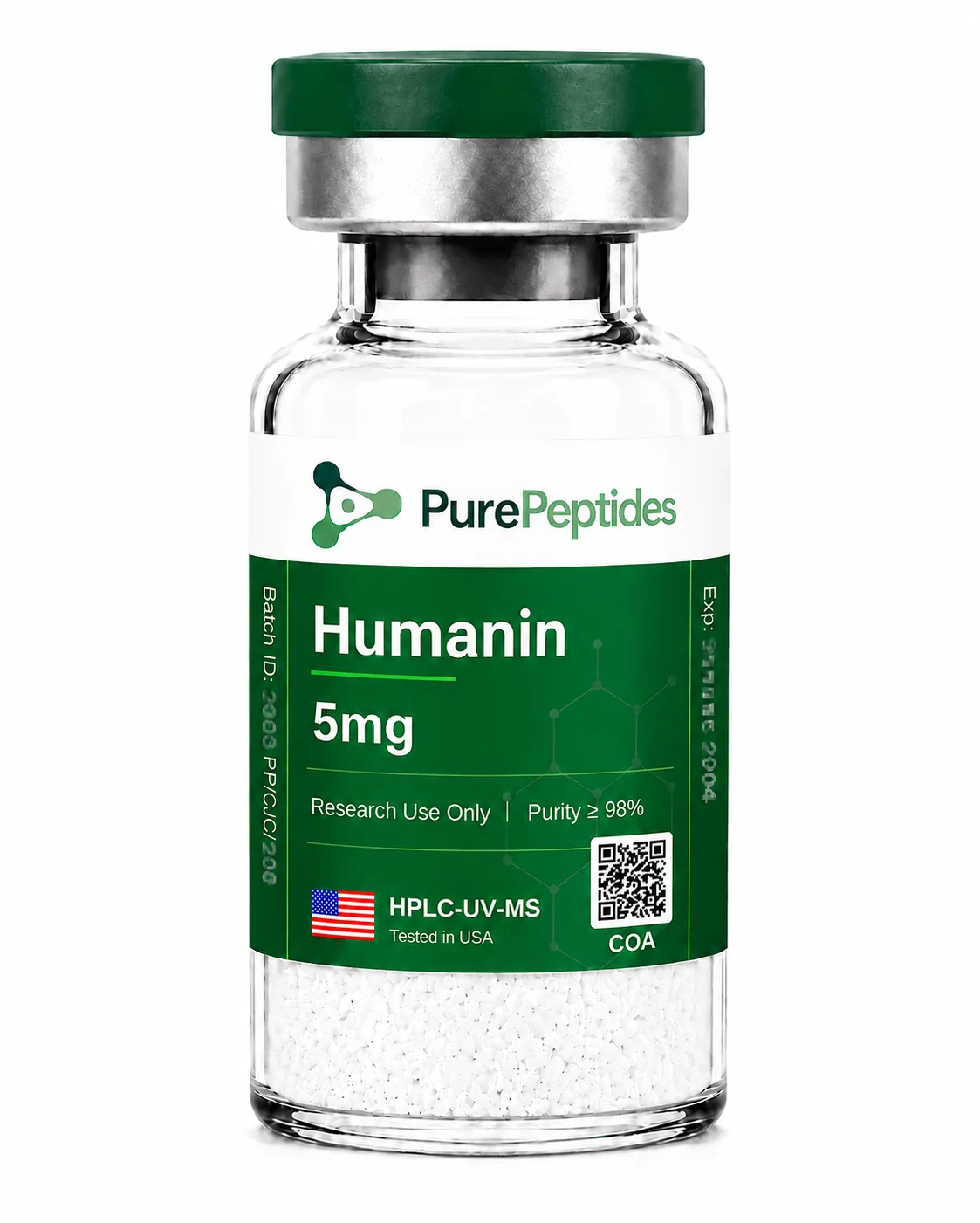
Humanin
$35.00
Supplied as a lyophilised powder and independently verified to ≥98% purity by HPLC and MS-UPLC analysis.
1000 in stock
🔥 Exclusive Crypto Offer
Get an INSTANT 15% DISCOUNT when you pay with Bitcoin, Ethereum, Dogecoin, Bitcoin Cash, XRP, Solana, or USDT.
⚡ Don't have crypto? Buy it here in 5 minutes with easy guidance.
💡 Pro Tip: You can also pay with cryptocurrency using your verified Cash App or PayPal account for a fast and secure checkout!
What is Humanin?
Humanin is a 21-amino-acid peptide that is unusual because it is encoded inside the mitochondria, the cell’s energy compartments. It is studied in laboratory research for its effects on cell survival signaling.
- A 21-amino-acid peptide encoded within the mitochondrial genome
- First studied in brain-cell survival models in the lab
- Investigated for how it interacts with Bax, a protein in the cell-death pathway
- Studied in research on mitochondrial signaling and cell protection
For research use only. Not approved for human therapeutic use.
Humanin is a synthetic 24-amino acid mitochondrial-derived peptide (MDP) with an approximate molecular weight of 2690 g/mol. Defined by the amino acid sequence MAPRGFSCLLLLTSEIDLPVKRRA, Humanin was first identified through functional expression screening of a cDNA library from the occipital lobe of an Alzheimer’s disease-resistant patient. It is encoded by a small open reading frame within the 16S rRNA gene (MT-RNR2) of the mitochondrial genome, a region not previously recognised as protein-coding. Together with MOTS-c, Humanin is one of the founding members of the mitochondrial-derived peptide (MDP) class. Produced via solid-phase peptide synthesis, Humanin is associated with JAK2/STAT3-mediated cytoprotective signalling in preclinical research.
Humanin has been the first identified bioactive peptide encoded within the mitochondrial genome. In vitro studies have documented that Humanin protects neurons from Alzheimer’s-disease-related cytotoxic insults by interacting with a cell-surface receptor complex involving CNTF receptor α, WSX-1 and gp130 [1]. The peptide’s interaction with the pro-apoptotic protein BAX represents a distinct and mechanistically independent axis of investigation, with research documenting that Humanin binds BAX, prevents its translocation from the cytosol to mitochondria, and thereby suppresses apoptosis, characterising direct antagonism of BAX activation as a cytoprotective mechanism [2]. In vivo studies have examined circulating Humanin concentrations in relation to ageing, documenting that Humanin levels decline with age in mice and that the rodent homolog is reduced in the hypothalamus and skeletal muscle of aged rats, with circulating concentrations also declining across age in humans [3], making Humanin a reference compound in mitochondrial-derived-peptide research examining cytoprotective receptor signalling and age-associated peptide decline in preclinical models.
Humanin is produced to research-grade standards and independently verified by third-party HPLC and MS-UPLC analysis before dispatch. Vials are vacuum sealed and stored in a temperature controlled, monitored cold storage system. Certificates of Analysis are available on request.
Sold strictly for in vitro research purposes only. Not for human consumption. Intended for use by qualified researchers in laboratory settings only.
References
1Hashimoto Y, Kurita M, Aiso S, Nishimoto I, Matsuoka M. Humanin inhibits neuronal cell death by interacting with a cytokine receptor complex or complexes involving CNTF receptor alpha/WSX-1/gp130. Mol Biol Cell. 2009 Jun;20(12):2864–73. ; PubMed Central PMCID: PMC2695794.PubMed PMID: 193867612Guo B, Zhai D, Cabezas E, Welsh K, Nouraini S, Satterthwait AC, et al. Humanin peptide suppresses apoptosis by interfering with Bax activation. Nature. 2003 May 22;423(6938):456–61. .PubMed PMID: 127328503Muzumdar RH, Huffman DM, Atzmon G, Buettner C, Cobb LJ, Fishman S, et al. Humanin: a novel central regulator of peripheral insulin action. PLoS One. 2009 Jul 22;4(7):e6334. ; PubMed Central PMCID: PMC2709436.PubMed PMID: 19623253
Scientific Review

Dr. Martina Rossi, PhD
Scientific Contributor and Reviewer
Reviewed for scientific accuracy, 14 June 2026
View credentials →
Humanin is a synthetic 24-amino acid mitochondrial-derived peptide (MDP) with an approximate molecular weight of 2690 g/mol. Defined by the amino acid sequence MAPRGFSCLLLLTSEIDLPVKRRA, Humanin was first identified through functional expression screening of a cDNA library from the occipital lobe of an Alzheimer’s disease-resistant patient. It is encoded by a small open reading frame within the 16S rRNA gene (MT-RNR2) of the mitochondrial genome, a region not previously recognised as protein-coding. Together with MOTS-c, Humanin is one of the founding members of the mitochondrial-derived peptide (MDP) class. Produced via solid-phase peptide synthesis, Humanin is associated with JAK2/STAT3-mediated cytoprotective signalling in preclinical research.
Humanin has been the first identified bioactive peptide encoded within the mitochondrial genome. In vitro studies have documented that Humanin protects neurons from Alzheimer’s-disease-related cytotoxic insults by interacting with a cell-surface receptor complex involving CNTF receptor α, WSX-1 and gp130 [1]. The peptide’s interaction with the pro-apoptotic protein BAX represents a distinct and mechanistically independent axis of investigation, with research documenting that Humanin binds BAX, prevents its translocation from the cytosol to mitochondria, and thereby suppresses apoptosis, characterising direct antagonism of BAX activation as a cytoprotective mechanism [2]. In vivo studies have examined circulating Humanin concentrations in relation to ageing, documenting that Humanin levels decline with age in mice and that the rodent homolog is reduced in the hypothalamus and skeletal muscle of aged rats, with circulating concentrations also declining across age in humans [3], making Humanin a reference compound in mitochondrial-derived-peptide research examining cytoprotective receptor signalling and age-associated peptide decline in preclinical models.
Humanin is produced to research-grade standards and independently verified by third-party HPLC and MS-UPLC analysis before dispatch. Vials are vacuum sealed and stored in a temperature controlled, monitored cold storage system. Certificates of Analysis are available on request.
Sold strictly for in vitro research purposes only. Not for human consumption. Intended for use by qualified researchers in laboratory settings only.
References
1Hashimoto Y, Kurita M, Aiso S, Nishimoto I, Matsuoka M. Humanin inhibits neuronal cell death by interacting with a cytokine receptor complex or complexes involving CNTF receptor alpha/WSX-1/gp130. Mol Biol Cell. 2009 Jun;20(12):2864–73. ; PubMed Central PMCID: PMC2695794.PubMed PMID: 193867612Guo B, Zhai D, Cabezas E, Welsh K, Nouraini S, Satterthwait AC, et al. Humanin peptide suppresses apoptosis by interfering with Bax activation. Nature. 2003 May 22;423(6938):456–61. .PubMed PMID: 127328503Muzumdar RH, Huffman DM, Atzmon G, Buettner C, Cobb LJ, Fishman S, et al. Humanin: a novel central regulator of peripheral insulin action. PLoS One. 2009 Jul 22;4(7):e6334. ; PubMed Central PMCID: PMC2709436.PubMed PMID: 19623253
Scientific Review
Dr. Martina Rossi, PhD
Scientific Contributor and Reviewer
Reviewed for scientific accuracy, 14 June 2026
View credentials →CAS Number330936-69-1Molecular Weight2,806.15 g/molPurity≥98%Physical FormLyophilised PowderManufacturingManufactured in an ISO9001 Certified LaboratoryTestingHPLC + MS-UPLCSKUHUM
Lyophilised powder: store at -20 °C or below, away from light and moisture. Once reconstituted in an appropriate laboratory diluent (e.g. sterile water, PBS, or assay buffer), store at 2–8 °C and use within the validated period for your protocol. Do not refreeze.
Humanin is a synthetic 24-amino acid mitochondrial-derived peptide (MDP) with an approximate molecular weight of 2690 g/mol. Defined by the amino acid sequence MAPRGFSCLLLLTSEIDLPVKRRA, Humanin was first identified through functional expression screening of a cDNA library from the occipital lobe of an Alzheimer’s disease-resistant patient. It is encoded by a small open reading frame within the 16S rRNA gene (MT-RNR2) of the mitochondrial genome, a region not previously recognised as protein-coding. Together with MOTS-c, Humanin is one of the founding members of the mitochondrial-derived peptide (MDP) class. Produced via solid-phase peptide synthesis, Humanin is associated with JAK2/STAT3-mediated cytoprotective signalling in preclinical research.
Humanin has been the first identified bioactive peptide encoded within the mitochondrial genome. In vitro studies have documented that Humanin protects neurons from Alzheimer’s-disease-related cytotoxic insults by interacting with a cell-surface receptor complex involving CNTF receptor α, WSX-1 and gp130 [1]. The peptide’s interaction with the pro-apoptotic protein BAX represents a distinct and mechanistically independent axis of investigation, with research documenting that Humanin binds BAX, prevents its translocation from the cytosol to mitochondria, and thereby suppresses apoptosis, characterising direct antagonism of BAX activation as a cytoprotective mechanism [2]. In vivo studies have examined circulating Humanin concentrations in relation to ageing, documenting that Humanin levels decline with age in mice and that the rodent homolog is reduced in the hypothalamus and skeletal muscle of aged rats, with circulating concentrations also declining across age in humans [3], making Humanin a reference compound in mitochondrial-derived-peptide research examining cytoprotective receptor signalling and age-associated peptide decline in preclinical models.
Humanin is produced to research-grade standards and independently verified by third-party HPLC and MS-UPLC analysis before dispatch. Vials are vacuum sealed and stored in a temperature controlled, monitored cold storage system. Certificates of Analysis are available on request.
Sold strictly for in vitro research purposes only. Not for human consumption. Intended for use by qualified researchers in laboratory settings only.
References
1Hashimoto Y, Kurita M, Aiso S, Nishimoto I, Matsuoka M. Humanin inhibits neuronal cell death by interacting with a cytokine receptor complex or complexes involving CNTF receptor alpha/WSX-1/gp130. Mol Biol Cell. 2009 Jun;20(12):2864–73. ; PubMed Central PMCID: PMC2695794.PubMed PMID: 193867612Guo B, Zhai D, Cabezas E, Welsh K, Nouraini S, Satterthwait AC, et al. Humanin peptide suppresses apoptosis by interfering with Bax activation. Nature. 2003 May 22;423(6938):456–61. .PubMed PMID: 127328503Muzumdar RH, Huffman DM, Atzmon G, Buettner C, Cobb LJ, Fishman S, et al. Humanin: a novel central regulator of peripheral insulin action. PLoS One. 2009 Jul 22;4(7):e6334. ; PubMed Central PMCID: PMC2709436.PubMed PMID: 19623253
Scientific Review
Dr. Martina Rossi, PhD
Scientific Contributor and Reviewer
Reviewed for scientific accuracy, 14 June 2026
View credentials →CAS Number330936-69-1Molecular Weight2,806.15 g/molPurity≥98%Physical FormLyophilised PowderManufacturingManufactured in an ISO9001 Certified LaboratoryTestingHPLC + MS-UPLCSKUHUM
Lyophilised powder: store at -20 °C or below, away from light and moisture. Once reconstituted in an appropriate laboratory diluent (e.g. sterile water, PBS, or assay buffer), store at 2–8 °C and use within the validated period for your protocol. Do not refreeze.
Related products
Regeneration Research
Regeneration Research
Regeneration Research
Regeneration Research

Regeneration Research
Regeneration Research
Regeneration Research

Regeneration Research