
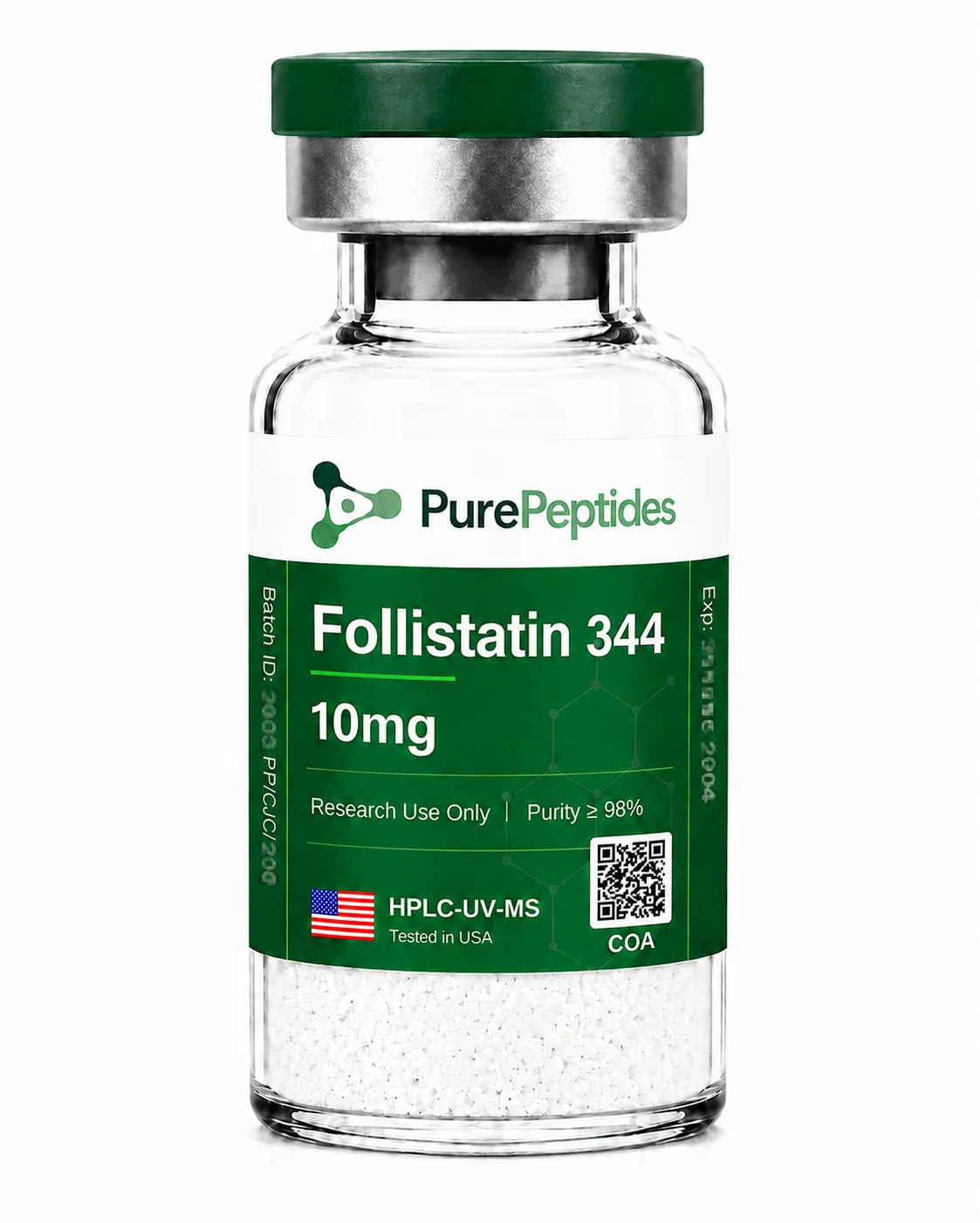
Follistatin 344 Research Protein
$47.00
Supplied as a lyophilised powder and independently verified to ≥98% purity by HPLC and MS-UPLC analysis.
1000 in stock
🔥 Exclusive Crypto Offer
Get an INSTANT 15% DISCOUNT when you pay with Bitcoin, Ethereum, Dogecoin, Bitcoin Cash, XRP, Solana, or USDT.
⚡ Don't have crypto? Buy it here in 5 minutes with easy guidance.
💡 Pro Tip: You can also pay with cryptocurrency using your verified Cash App or PayPal account for a fast and secure checkout!
What is Follistatin 344?
Follistatin-344 is a natural form of follistatin, a protein that binds and switches off myostatin and related signals that limit muscle growth. It is studied in animal research as a tool for looking at muscle regulation.
- A natural protein that binds myostatin and related muscle-limiting signals
- Studied in animal research as a tool for examining muscle-regulation pathways
- Investigated in animal models of muscle loss as a myostatin-pathway probe
- Also studied in reproductive biology for its role in ovarian signaling
For research use only. Not approved for human therapeutic use.
Follistatin 344 (FST344) is a recombinant human glycoprotein consisting of 344 amino acids, with an approximate molecular weight of 37,000 g/mol in its glycosylated form. It is the full-length isoform of Follistatin, first identified as a follicle-stimulating hormone (FSH) inhibiting factor in ovarian follicular fluid. FST344 contains three cysteine-rich Follistatin domains with EGF-like and Kazal-like motifs, an N-terminal atypical TGF-binding domain, and a highly acidic C-terminal tail. Produced via recombinant expression, Follistatin 344 functions as a high-affinity binding protein for multiple TGF-beta superfamily ligands including Activin and Myostatin (GDF-8).
Follistatin 344 is one of the most extensively investigated endogenous antagonists of the TGF-beta superfamily in preclinical research. Its capacity to bind and neutralise both Activin and Myostatin has established it as a key reference compound in studies examining the regulation of skeletal muscle mass, reproductive endocrinology, and tissue remodelling. In vitro studies in cell-based neutralisation and receptor-binding preparations have characterised FST344’s binding stoichiometry and neutralisation kinetics with Activin A and GDF-8, documenting distinct affinity profiles across the FST isoform panel, with FST288 exhibiting the highest Activin binding affinity and FST344 showing broader tissue distribution attributable to its lower heparin-binding capacity [1]. In vivo rodent studies have examined skeletal muscle phenotypes following Follistatin gene delivery in preclinical rodent models, documenting long-term increases in skeletal muscle mass and strength and characterising the mechanism within the ActRIIB signalling axis and downstream SMAD-dependent transcriptional programmes [2], making Follistatin 344 a key reference compound in multi-ligand antagonism research within the TGF-beta superfamily.
Follistatin 344 is produced to research-grade standards and independently verified by third-party HPLC and MS-UPLC analysis before dispatch. Vials are vacuum sealed and stored in a temperature controlled, monitored cold storage system. Certificates of Analysis are available on request.
Sold strictly for in vitro research purposes only. Not for human consumption. Intended for use by qualified researchers in laboratory settings only.
References
1Haidet AM, Rizo L, Handy C, Umapathi P, Eagle A, Shilling C, et al. Long-term enhancement of skeletal muscle mass and strength by single gene administration of myostatin inhibitors. Proc Natl Acad Sci U S A. 2008 Mar 18;105(11):4318–22. ; PubMed Central PMCID: PMC2393740.PubMed PMID: 183346462Sidis Y, Mukherjee A, Keutmann H, Delbaere A, Sadatsuki M, Schneyer A. Biological activity of follistatin isoforms and follistatin-like-3 is dependent on differential cell surface binding and specificity for activin, myostatin, and bone morphogenetic proteins. Endocrinology. 2006 Jul;147(7):3586–97. .PubMed PMID: 16627583
Scientific Review

Dr. Martina Rossi, PhD
Scientific Contributor and Reviewer
Reviewed for scientific accuracy, 14 June 2026
View credentials →
Follistatin 344 (FST344) is a recombinant human glycoprotein consisting of 344 amino acids, with an approximate molecular weight of 37,000 g/mol in its glycosylated form. It is the full-length isoform of Follistatin, first identified as a follicle-stimulating hormone (FSH) inhibiting factor in ovarian follicular fluid. FST344 contains three cysteine-rich Follistatin domains with EGF-like and Kazal-like motifs, an N-terminal atypical TGF-binding domain, and a highly acidic C-terminal tail. Produced via recombinant expression, Follistatin 344 functions as a high-affinity binding protein for multiple TGF-beta superfamily ligands including Activin and Myostatin (GDF-8).
Follistatin 344 is one of the most extensively investigated endogenous antagonists of the TGF-beta superfamily in preclinical research. Its capacity to bind and neutralise both Activin and Myostatin has established it as a key reference compound in studies examining the regulation of skeletal muscle mass, reproductive endocrinology, and tissue remodelling. In vitro studies in cell-based neutralisation and receptor-binding preparations have characterised FST344’s binding stoichiometry and neutralisation kinetics with Activin A and GDF-8, documenting distinct affinity profiles across the FST isoform panel, with FST288 exhibiting the highest Activin binding affinity and FST344 showing broader tissue distribution attributable to its lower heparin-binding capacity [1]. In vivo rodent studies have examined skeletal muscle phenotypes following Follistatin gene delivery in preclinical rodent models, documenting long-term increases in skeletal muscle mass and strength and characterising the mechanism within the ActRIIB signalling axis and downstream SMAD-dependent transcriptional programmes [2], making Follistatin 344 a key reference compound in multi-ligand antagonism research within the TGF-beta superfamily.
Follistatin 344 is produced to research-grade standards and independently verified by third-party HPLC and MS-UPLC analysis before dispatch. Vials are vacuum sealed and stored in a temperature controlled, monitored cold storage system. Certificates of Analysis are available on request.
Sold strictly for in vitro research purposes only. Not for human consumption. Intended for use by qualified researchers in laboratory settings only.
References
1Haidet AM, Rizo L, Handy C, Umapathi P, Eagle A, Shilling C, et al. Long-term enhancement of skeletal muscle mass and strength by single gene administration of myostatin inhibitors. Proc Natl Acad Sci U S A. 2008 Mar 18;105(11):4318–22. ; PubMed Central PMCID: PMC2393740.PubMed PMID: 183346462Sidis Y, Mukherjee A, Keutmann H, Delbaere A, Sadatsuki M, Schneyer A. Biological activity of follistatin isoforms and follistatin-like-3 is dependent on differential cell surface binding and specificity for activin, myostatin, and bone morphogenetic proteins. Endocrinology. 2006 Jul;147(7):3586–97. .PubMed PMID: 16627583
Scientific Review
Dr. Martina Rossi, PhD
Scientific Contributor and Reviewer
Reviewed for scientific accuracy, 14 June 2026
View credentials →CAS Number80449-31-6Molecular Weight~34,800 g/mol (34.8 kDa)Purity≥98%Physical FormLyophilised PowderManufacturingManufactured in an ISO9001 Certified LaboratoryTestingHPLC + MS-UPLCSKUFOLL344
Lyophilised powder: store at -20 °C or below, away from light and moisture. Once reconstituted in an appropriate laboratory diluent (e.g. sterile water, PBS, or assay buffer), store at 2–8 °C and use within the validated period for your protocol. Do not refreeze.
Follistatin 344 (FST344) is a recombinant human glycoprotein consisting of 344 amino acids, with an approximate molecular weight of 37,000 g/mol in its glycosylated form. It is the full-length isoform of Follistatin, first identified as a follicle-stimulating hormone (FSH) inhibiting factor in ovarian follicular fluid. FST344 contains three cysteine-rich Follistatin domains with EGF-like and Kazal-like motifs, an N-terminal atypical TGF-binding domain, and a highly acidic C-terminal tail. Produced via recombinant expression, Follistatin 344 functions as a high-affinity binding protein for multiple TGF-beta superfamily ligands including Activin and Myostatin (GDF-8).
Follistatin 344 is one of the most extensively investigated endogenous antagonists of the TGF-beta superfamily in preclinical research. Its capacity to bind and neutralise both Activin and Myostatin has established it as a key reference compound in studies examining the regulation of skeletal muscle mass, reproductive endocrinology, and tissue remodelling. In vitro studies in cell-based neutralisation and receptor-binding preparations have characterised FST344’s binding stoichiometry and neutralisation kinetics with Activin A and GDF-8, documenting distinct affinity profiles across the FST isoform panel, with FST288 exhibiting the highest Activin binding affinity and FST344 showing broader tissue distribution attributable to its lower heparin-binding capacity [1]. In vivo rodent studies have examined skeletal muscle phenotypes following Follistatin gene delivery in preclinical rodent models, documenting long-term increases in skeletal muscle mass and strength and characterising the mechanism within the ActRIIB signalling axis and downstream SMAD-dependent transcriptional programmes [2], making Follistatin 344 a key reference compound in multi-ligand antagonism research within the TGF-beta superfamily.
Follistatin 344 is produced to research-grade standards and independently verified by third-party HPLC and MS-UPLC analysis before dispatch. Vials are vacuum sealed and stored in a temperature controlled, monitored cold storage system. Certificates of Analysis are available on request.
Sold strictly for in vitro research purposes only. Not for human consumption. Intended for use by qualified researchers in laboratory settings only.
References
1Haidet AM, Rizo L, Handy C, Umapathi P, Eagle A, Shilling C, et al. Long-term enhancement of skeletal muscle mass and strength by single gene administration of myostatin inhibitors. Proc Natl Acad Sci U S A. 2008 Mar 18;105(11):4318–22. ; PubMed Central PMCID: PMC2393740.PubMed PMID: 183346462Sidis Y, Mukherjee A, Keutmann H, Delbaere A, Sadatsuki M, Schneyer A. Biological activity of follistatin isoforms and follistatin-like-3 is dependent on differential cell surface binding and specificity for activin, myostatin, and bone morphogenetic proteins. Endocrinology. 2006 Jul;147(7):3586–97. .PubMed PMID: 16627583
Scientific Review
Dr. Martina Rossi, PhD
Scientific Contributor and Reviewer
Reviewed for scientific accuracy, 14 June 2026
View credentials →CAS Number80449-31-6Molecular Weight~34,800 g/mol (34.8 kDa)Purity≥98%Physical FormLyophilised PowderManufacturingManufactured in an ISO9001 Certified LaboratoryTestingHPLC + MS-UPLCSKUFOLL344
Lyophilised powder: store at -20 °C or below, away from light and moisture. Once reconstituted in an appropriate laboratory diluent (e.g. sterile water, PBS, or assay buffer), store at 2–8 °C and use within the validated period for your protocol. Do not refreeze.
Related products
Regeneration Research

Regeneration Research
Regeneration Research
Regeneration Research
Regeneration Research
Regeneration Research
Regeneration Research
Regeneration Research