
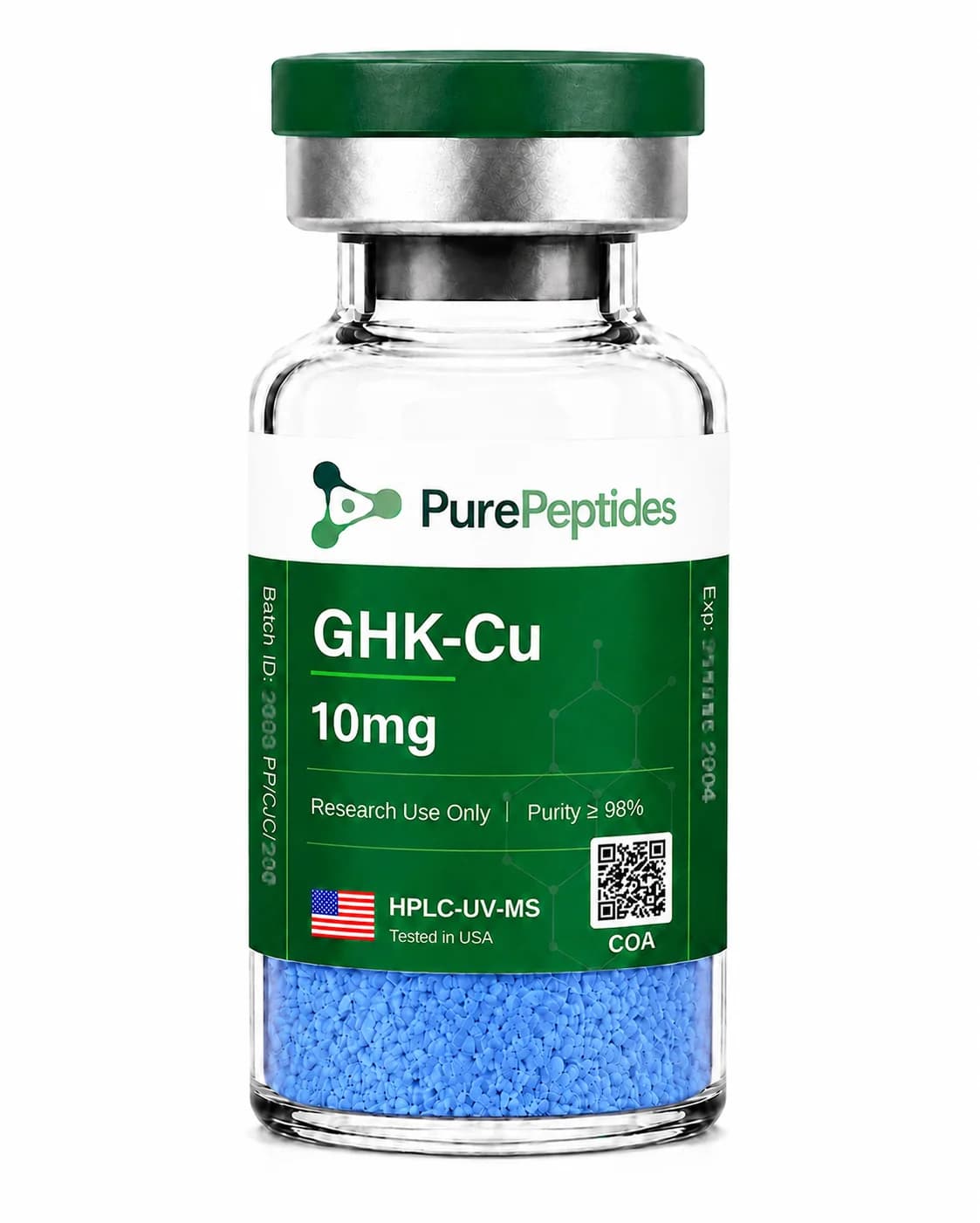
GHK-Cu (Copper Peptide)

$59.00
Supplied as a lyophilised powder and independently verified to ≥98% purity by HPLC and MS-UPLC analysis.
1000 in stock
🔥 Exclusive Crypto Offer
Get an INSTANT 15% DISCOUNT when you pay with Bitcoin, Ethereum, Dogecoin, Bitcoin Cash, XRP, Solana, or USDT.
⚡ Don't have crypto? Buy it here in 5 minutes with easy guidance.
💡 Pro Tip: You can also pay with cryptocurrency using your verified Cash App or PayPal account for a fast and secure checkout!
What is GHK-Cu (Copper Peptide)?
GHK-Cu is a natural copper-binding tripeptide (Gly-His-Lys) first found in human blood. It is studied in skin-cell and animal research for its effects on collagen, skin repair and the tissue scaffold.
- A natural copper-binding tripeptide found in human blood, saliva and urine
- Studied in skin-cell research for its effects on collagen and elastin
- Investigated in wound-repair studies and for its effects on inflammation signaling
- Studied for its effects on genes involved in tissue remodeling
For research use only. Not approved for human therapeutic use.
GHK-Cu (CAS 89030-95-5), also known as Copper Tripeptide-1, is a naturally occurring copper-chelating tripeptide complex with the molecular formula C14H24CuN6O4 and a molecular weight of 403.91 g/mol. Defined by the amino acid sequence Gly-His-Lys, GHK-Cu coordinates a single copper(II) ion through the nitrogen atoms of the glycine amino terminus, the histidine imidazole ring, and the deprotonated amide nitrogen between residues 1 and 2. This copper-peptide complex was first isolated from human plasma and represents one of the most extensively studied metallopeptides in preclinical wound biology and extracellular matrix remodelling research. Produced via solid-phase peptide synthesis with subsequent copper complexation, GHK-Cu is associated with matrix metalloproteinase regulation and growth factor signalling pathways.
GHK-Cu is one of the most widely referenced copper peptide complexes in preclinical dermatological and extracellular matrix research. In vitro studies have examined its interaction with fibroblast and keratinocyte cell preparations, documenting that the GHK-Cu complex stimulates collagen synthesis in cultured fibroblasts independently of changes in cell number [1], and that GHK-Cu increases matrix metalloproteinase-2 (MMP-2) protein and mRNA levels in fibroblast cultures; an effect reproduced by copper ions but not by the GHK peptide alone [2]. Gene expression profiling studies have reported that GHK-Cu exposure modulates several genes in human cell preparations, with published analysis of the Broad Institute Connectivity Map gene-expression datasets characterising GHK as modulating the expression of many genes and presenting these transcriptome-wide changes as a basis for the compound’s range of documented cellular activities [3], making Copper Tripeptide-1 a compound of interest beyond conventional wound biology research.
GHK-Cu is produced to research-grade standards and independently verified by third-party HPLC and MS-UPLC analysis before dispatch. Vials are vacuum sealed and stored in a temperature controlled, monitored cold storage system. Certificates of Analysis are available on request.
Sold strictly for in vitro research purposes only. Not for human consumption. Intended for use by qualified researchers in laboratory settings only.
References
1Maquart FX, Pickart L, Laurent M, Gillery P, Monboisse JC, Borel JP. Stimulation of collagen synthesis in fibroblast cultures by the tripeptide-copper complex glycyl-L-histidyl-L-lysine-Cu2+. FEBS Lett. 1988 Oct 10;238(2):343–6. .PubMed PMID: 31692642Siméon A, Emonard H, Hornebeck W, Maquart FX. The tripeptide-copper complex glycyl-L-histidyl-L-lysine-Cu2+ stimulates matrix metalloproteinase-2 expression by fibroblast cultures. Life Sci. 2000 Sep 22;67(18):2257–65. .PubMed PMID: 110456063Pickart L, Margolina A. Regenerative and Protective Actions of the GHK-Cu Peptide in the Light of the New Gene Data. Int J Mol Sci. 2018 Jul 7;19(7):1987. ; PubMed Central PMCID: PMC6073405.PubMed PMID: 29986520
Scientific Review

Dr. Martina Rossi, PhD
Scientific Contributor and Reviewer
Reviewed for scientific accuracy, 14 June 2026
View credentials →
GHK-Cu (CAS 89030-95-5), also known as Copper Tripeptide-1, is a naturally occurring copper-chelating tripeptide complex with the molecular formula C14H24CuN6O4 and a molecular weight of 403.91 g/mol. Defined by the amino acid sequence Gly-His-Lys, GHK-Cu coordinates a single copper(II) ion through the nitrogen atoms of the glycine amino terminus, the histidine imidazole ring, and the deprotonated amide nitrogen between residues 1 and 2. This copper-peptide complex was first isolated from human plasma and represents one of the most extensively studied metallopeptides in preclinical wound biology and extracellular matrix remodelling research. Produced via solid-phase peptide synthesis with subsequent copper complexation, GHK-Cu is associated with matrix metalloproteinase regulation and growth factor signalling pathways.
GHK-Cu is one of the most widely referenced copper peptide complexes in preclinical dermatological and extracellular matrix research. In vitro studies have examined its interaction with fibroblast and keratinocyte cell preparations, documenting that the GHK-Cu complex stimulates collagen synthesis in cultured fibroblasts independently of changes in cell number [1], and that GHK-Cu increases matrix metalloproteinase-2 (MMP-2) protein and mRNA levels in fibroblast cultures; an effect reproduced by copper ions but not by the GHK peptide alone [2]. Gene expression profiling studies have reported that GHK-Cu exposure modulates several genes in human cell preparations, with published analysis of the Broad Institute Connectivity Map gene-expression datasets characterising GHK as modulating the expression of many genes and presenting these transcriptome-wide changes as a basis for the compound’s range of documented cellular activities [3], making Copper Tripeptide-1 a compound of interest beyond conventional wound biology research.
GHK-Cu is produced to research-grade standards and independently verified by third-party HPLC and MS-UPLC analysis before dispatch. Vials are vacuum sealed and stored in a temperature controlled, monitored cold storage system. Certificates of Analysis are available on request.
Sold strictly for in vitro research purposes only. Not for human consumption. Intended for use by qualified researchers in laboratory settings only.
References
1Maquart FX, Pickart L, Laurent M, Gillery P, Monboisse JC, Borel JP. Stimulation of collagen synthesis in fibroblast cultures by the tripeptide-copper complex glycyl-L-histidyl-L-lysine-Cu2+. FEBS Lett. 1988 Oct 10;238(2):343–6. .PubMed PMID: 31692642Siméon A, Emonard H, Hornebeck W, Maquart FX. The tripeptide-copper complex glycyl-L-histidyl-L-lysine-Cu2+ stimulates matrix metalloproteinase-2 expression by fibroblast cultures. Life Sci. 2000 Sep 22;67(18):2257–65. .PubMed PMID: 110456063Pickart L, Margolina A. Regenerative and Protective Actions of the GHK-Cu Peptide in the Light of the New Gene Data. Int J Mol Sci. 2018 Jul 7;19(7):1987. ; PubMed Central PMCID: PMC6073405.PubMed PMID: 29986520
Scientific Review
Dr. Martina Rossi, PhD
Scientific Contributor and Reviewer
Reviewed for scientific accuracy, 14 June 2026
View credentials →CAS Number89030-95-5Molecular Weight403.91 g/molPurity≥98%Physical FormLyophilised PowderManufacturingManufactured in an ISO9001 Certified LaboratoryTestingHPLC + MS-UPLCSKUGHKCU
Lyophilised powder: store at -20 °C or below, away from light and moisture. Once reconstituted in an appropriate laboratory diluent (e.g. sterile water, PBS, or assay buffer), store at 2–8 °C and use within the validated period for your protocol. Do not refreeze.
GHK-Cu (CAS 89030-95-5), also known as Copper Tripeptide-1, is a naturally occurring copper-chelating tripeptide complex with the molecular formula C14H24CuN6O4 and a molecular weight of 403.91 g/mol. Defined by the amino acid sequence Gly-His-Lys, GHK-Cu coordinates a single copper(II) ion through the nitrogen atoms of the glycine amino terminus, the histidine imidazole ring, and the deprotonated amide nitrogen between residues 1 and 2. This copper-peptide complex was first isolated from human plasma and represents one of the most extensively studied metallopeptides in preclinical wound biology and extracellular matrix remodelling research. Produced via solid-phase peptide synthesis with subsequent copper complexation, GHK-Cu is associated with matrix metalloproteinase regulation and growth factor signalling pathways.
GHK-Cu is one of the most widely referenced copper peptide complexes in preclinical dermatological and extracellular matrix research. In vitro studies have examined its interaction with fibroblast and keratinocyte cell preparations, documenting that the GHK-Cu complex stimulates collagen synthesis in cultured fibroblasts independently of changes in cell number [1], and that GHK-Cu increases matrix metalloproteinase-2 (MMP-2) protein and mRNA levels in fibroblast cultures; an effect reproduced by copper ions but not by the GHK peptide alone [2]. Gene expression profiling studies have reported that GHK-Cu exposure modulates several genes in human cell preparations, with published analysis of the Broad Institute Connectivity Map gene-expression datasets characterising GHK as modulating the expression of many genes and presenting these transcriptome-wide changes as a basis for the compound’s range of documented cellular activities [3], making Copper Tripeptide-1 a compound of interest beyond conventional wound biology research.
GHK-Cu is produced to research-grade standards and independently verified by third-party HPLC and MS-UPLC analysis before dispatch. Vials are vacuum sealed and stored in a temperature controlled, monitored cold storage system. Certificates of Analysis are available on request.
Sold strictly for in vitro research purposes only. Not for human consumption. Intended for use by qualified researchers in laboratory settings only.
References
1Maquart FX, Pickart L, Laurent M, Gillery P, Monboisse JC, Borel JP. Stimulation of collagen synthesis in fibroblast cultures by the tripeptide-copper complex glycyl-L-histidyl-L-lysine-Cu2+. FEBS Lett. 1988 Oct 10;238(2):343–6. .PubMed PMID: 31692642Siméon A, Emonard H, Hornebeck W, Maquart FX. The tripeptide-copper complex glycyl-L-histidyl-L-lysine-Cu2+ stimulates matrix metalloproteinase-2 expression by fibroblast cultures. Life Sci. 2000 Sep 22;67(18):2257–65. .PubMed PMID: 110456063Pickart L, Margolina A. Regenerative and Protective Actions of the GHK-Cu Peptide in the Light of the New Gene Data. Int J Mol Sci. 2018 Jul 7;19(7):1987. ; PubMed Central PMCID: PMC6073405.PubMed PMID: 29986520
Scientific Review
Dr. Martina Rossi, PhD
Scientific Contributor and Reviewer
Reviewed for scientific accuracy, 14 June 2026
View credentials →CAS Number89030-95-5Molecular Weight403.91 g/molPurity≥98%Physical FormLyophilised PowderManufacturingManufactured in an ISO9001 Certified LaboratoryTestingHPLC + MS-UPLCSKUGHKCU
Lyophilised powder: store at -20 °C or below, away from light and moisture. Once reconstituted in an appropriate laboratory diluent (e.g. sterile water, PBS, or assay buffer), store at 2–8 °C and use within the validated period for your protocol. Do not refreeze.
Related products

Regeneration Research
Regeneration Research
Regeneration Research
Regeneration Research

Regeneration Research
Regeneration Research
Regeneration Research
Regeneration Research