
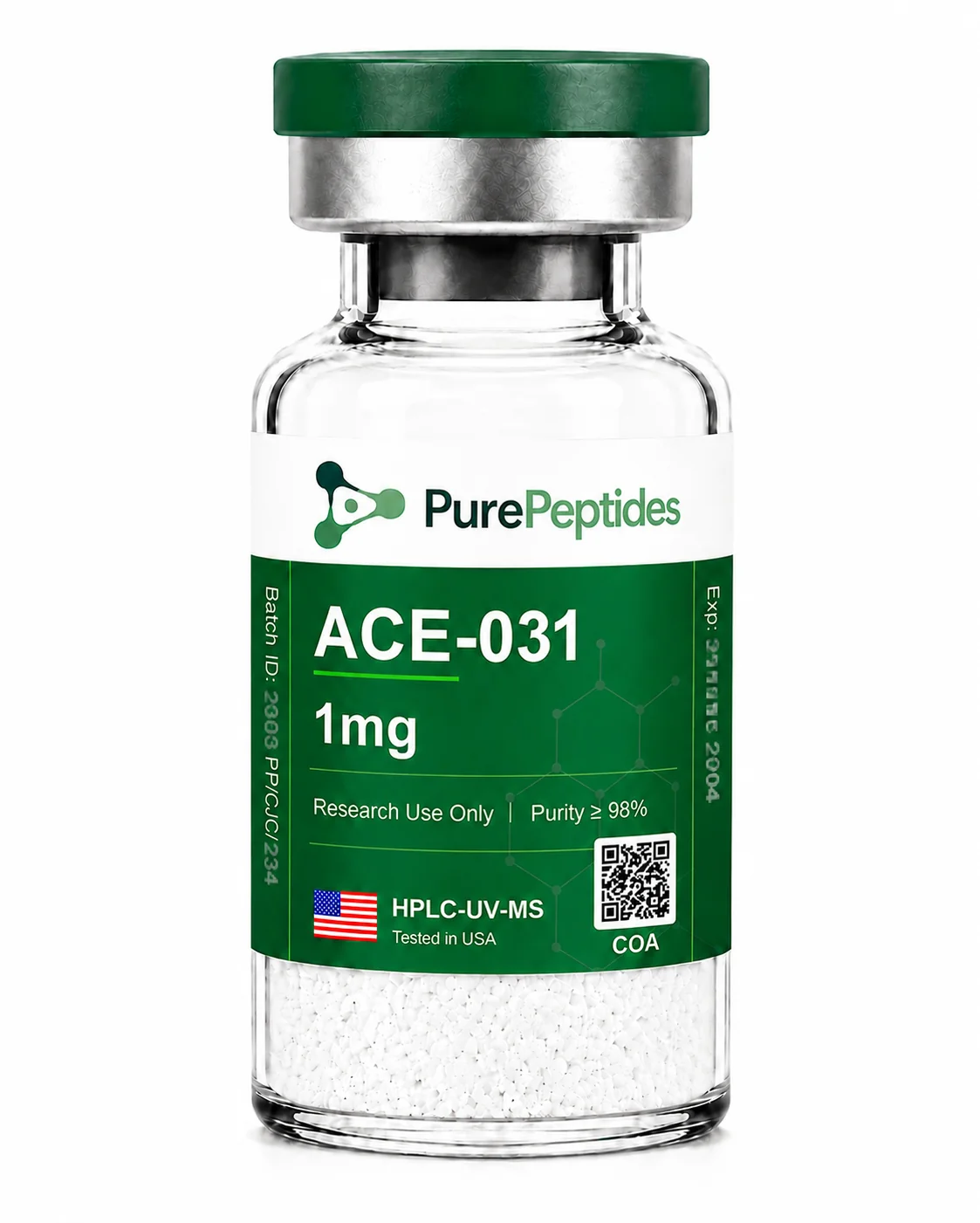
ACE-031 Research Protein
$47.00
Supplied as a lyophilised powder and independently verified to ≥98% purity by HPLC and MS-UPLC analysis.
1000 in stock
🔥 Exclusive Crypto Offer
Get an INSTANT 15% DISCOUNT when you pay with Bitcoin, Ethereum, Dogecoin, Bitcoin Cash, XRP, Solana, or USDT.
⚡ Don't have crypto? Buy it here in 5 minutes with easy guidance.
💡 Pro Tip: You can also pay with cryptocurrency using your verified Cash App or PayPal account for a fast and secure checkout!
What is ACE-031?
ACE-031 is a synthetic protein built to block a signaling pathway (the ActRIIB receptor) that the body uses to limit how much muscle it builds. It is studied in animal research for its effects on muscle size and muscle loss.
- Works by blocking ActRIIB, a receptor that normally puts a brake on muscle growth
- Studied in animal research for its effects on muscle size
- Investigated in rodent studies for its effects on muscle loss
- Binds several related signaling molecules at once, unlike single-target approaches; from the same research family as follistatin
For research use only. Not approved for human therapeutic use.
ACE-031, also known as ActRIIB-Fc, is a recombinant fusion protein consisting of the extracellular ligand-binding domain of human activin receptor type IIB (ActRIIB) fused to the Fc region of human IgG1. With an approximate molecular weight of 60,000 g/mol, ACE-031 is structurally classified as a soluble decoy receptor engineered to sequester multiple ligands within the TGF-beta superfamily, including Myostatin (GDF-8) and Activin A. Produced via recombinant expression, ActRIIB-Fc represents a distinct pharmacological approach, ligand trapping, that has generated significant research interest in preclinical musculoskeletal biology.
ACE-031 has been extensively investigated in preclinical research for its capacity to simultaneously antagonise multiple TGF-beta superfamily ligands through a single molecule. Unlike antibody-based approaches that target a single ligand, the soluble decoy receptor design of ActRIIB-Fc has been characterised in published studies as engaging Myostatin, Activin A, GDF-11, and other structurally related ligands through the ActRIIB ligand-binding domain. In vitro studies in cell-based signalling preparations have examined ActRIIB-Fc’s binding characteristics and ligand neutralisation across the ActRIIB ligand panel, documenting that GDF-8, GDF-11, and Activin A all signal through the ActRIIB receptor system and are susceptible to broad-spectrum neutralisation via soluble receptor-based trapping [1]. Preclinical studies have investigated body composition changes, skeletal muscle cross-sectional area, and contractile properties following administration of soluble ActRIIB constructs, documenting fibre type-independent increases in skeletal muscle mass and cross-sectional area under controlled experimental conditions [2], making ActRIIB-Fc a key reference compound in multi-ligand trapping research within the TGF-beta superfamily.
ACE-031 is produced to research-grade standards and independently verified by third-party HPLC and MS-UPLC analysis before dispatch. Vials are vacuum sealed and stored in a temperature controlled, monitored cold storage system. Certificates of Analysis are available on request.
Sold strictly for in vitro research purposes only. Not for human consumption. Intended for use by qualified researchers in laboratory settings only.
References
1Lee SJ, Reed LA, Davies MV, Girgenrath S, Goad MEP, Tomkinson KN, et al. Regulation of muscle growth by multiple ligands signaling through activin type II receptors. Proc Natl Acad Sci U S A. 2005 Dec 13;102(50):18117–22. ; PubMed Central PMCID: PMC1306793.PubMed PMID: 163307742Cadena SM, Tomkinson KN, Monnell TE, Spaits MS, Kumar R, Underwood KW, et al. Administration of a soluble activin type IIB receptor promotes skeletal muscle growth independent of fiber type. J Appl Physiol (1985). 2010 Sep;109(3):635–42. ; PubMed Central PMCID: PMC2944638.PubMed PMID: 20466801
Scientific Review

Dr. Martina Rossi, PhD
Scientific Contributor and Reviewer
Reviewed for scientific accuracy, 14 June 2026
View credentials →
ACE-031, also known as ActRIIB-Fc, is a recombinant fusion protein consisting of the extracellular ligand-binding domain of human activin receptor type IIB (ActRIIB) fused to the Fc region of human IgG1. With an approximate molecular weight of 60,000 g/mol, ACE-031 is structurally classified as a soluble decoy receptor engineered to sequester multiple ligands within the TGF-beta superfamily, including Myostatin (GDF-8) and Activin A. Produced via recombinant expression, ActRIIB-Fc represents a distinct pharmacological approach, ligand trapping, that has generated significant research interest in preclinical musculoskeletal biology.
ACE-031 has been extensively investigated in preclinical research for its capacity to simultaneously antagonise multiple TGF-beta superfamily ligands through a single molecule. Unlike antibody-based approaches that target a single ligand, the soluble decoy receptor design of ActRIIB-Fc has been characterised in published studies as engaging Myostatin, Activin A, GDF-11, and other structurally related ligands through the ActRIIB ligand-binding domain. In vitro studies in cell-based signalling preparations have examined ActRIIB-Fc’s binding characteristics and ligand neutralisation across the ActRIIB ligand panel, documenting that GDF-8, GDF-11, and Activin A all signal through the ActRIIB receptor system and are susceptible to broad-spectrum neutralisation via soluble receptor-based trapping [1]. Preclinical studies have investigated body composition changes, skeletal muscle cross-sectional area, and contractile properties following administration of soluble ActRIIB constructs, documenting fibre type-independent increases in skeletal muscle mass and cross-sectional area under controlled experimental conditions [2], making ActRIIB-Fc a key reference compound in multi-ligand trapping research within the TGF-beta superfamily.
ACE-031 is produced to research-grade standards and independently verified by third-party HPLC and MS-UPLC analysis before dispatch. Vials are vacuum sealed and stored in a temperature controlled, monitored cold storage system. Certificates of Analysis are available on request.
Sold strictly for in vitro research purposes only. Not for human consumption. Intended for use by qualified researchers in laboratory settings only.
References
1Lee SJ, Reed LA, Davies MV, Girgenrath S, Goad MEP, Tomkinson KN, et al. Regulation of muscle growth by multiple ligands signaling through activin type II receptors. Proc Natl Acad Sci U S A. 2005 Dec 13;102(50):18117–22. ; PubMed Central PMCID: PMC1306793.PubMed PMID: 163307742Cadena SM, Tomkinson KN, Monnell TE, Spaits MS, Kumar R, Underwood KW, et al. Administration of a soluble activin type IIB receptor promotes skeletal muscle growth independent of fiber type. J Appl Physiol (1985). 2010 Sep;109(3):635–42. ; PubMed Central PMCID: PMC2944638.PubMed PMID: 20466801
Scientific Review
Dr. Martina Rossi, PhD
Scientific Contributor and Reviewer
Reviewed for scientific accuracy, 14 June 2026
View credentials →CAS NumberN/A (recombinant fusion protein)Molecular Weight~60,000 g/mol (60 kDa)Purity≥98%Physical FormLyophilised PowderManufacturingManufactured in an ISO9001 Certified LaboratoryTestingHPLC + MS-UPLCSKUACE031
Lyophilised powder: store at -20 °C or below, away from light and moisture. Once reconstituted in an appropriate laboratory diluent (e.g. sterile water, PBS, or assay buffer), store at 2–8 °C and use within the validated period for your protocol. Do not refreeze.
ACE-031, also known as ActRIIB-Fc, is a recombinant fusion protein consisting of the extracellular ligand-binding domain of human activin receptor type IIB (ActRIIB) fused to the Fc region of human IgG1. With an approximate molecular weight of 60,000 g/mol, ACE-031 is structurally classified as a soluble decoy receptor engineered to sequester multiple ligands within the TGF-beta superfamily, including Myostatin (GDF-8) and Activin A. Produced via recombinant expression, ActRIIB-Fc represents a distinct pharmacological approach, ligand trapping, that has generated significant research interest in preclinical musculoskeletal biology.
ACE-031 has been extensively investigated in preclinical research for its capacity to simultaneously antagonise multiple TGF-beta superfamily ligands through a single molecule. Unlike antibody-based approaches that target a single ligand, the soluble decoy receptor design of ActRIIB-Fc has been characterised in published studies as engaging Myostatin, Activin A, GDF-11, and other structurally related ligands through the ActRIIB ligand-binding domain. In vitro studies in cell-based signalling preparations have examined ActRIIB-Fc’s binding characteristics and ligand neutralisation across the ActRIIB ligand panel, documenting that GDF-8, GDF-11, and Activin A all signal through the ActRIIB receptor system and are susceptible to broad-spectrum neutralisation via soluble receptor-based trapping [1]. Preclinical studies have investigated body composition changes, skeletal muscle cross-sectional area, and contractile properties following administration of soluble ActRIIB constructs, documenting fibre type-independent increases in skeletal muscle mass and cross-sectional area under controlled experimental conditions [2], making ActRIIB-Fc a key reference compound in multi-ligand trapping research within the TGF-beta superfamily.
ACE-031 is produced to research-grade standards and independently verified by third-party HPLC and MS-UPLC analysis before dispatch. Vials are vacuum sealed and stored in a temperature controlled, monitored cold storage system. Certificates of Analysis are available on request.
Sold strictly for in vitro research purposes only. Not for human consumption. Intended for use by qualified researchers in laboratory settings only.
References
1Lee SJ, Reed LA, Davies MV, Girgenrath S, Goad MEP, Tomkinson KN, et al. Regulation of muscle growth by multiple ligands signaling through activin type II receptors. Proc Natl Acad Sci U S A. 2005 Dec 13;102(50):18117–22. ; PubMed Central PMCID: PMC1306793.PubMed PMID: 163307742Cadena SM, Tomkinson KN, Monnell TE, Spaits MS, Kumar R, Underwood KW, et al. Administration of a soluble activin type IIB receptor promotes skeletal muscle growth independent of fiber type. J Appl Physiol (1985). 2010 Sep;109(3):635–42. ; PubMed Central PMCID: PMC2944638.PubMed PMID: 20466801
Scientific Review
Dr. Martina Rossi, PhD
Scientific Contributor and Reviewer
Reviewed for scientific accuracy, 14 June 2026
View credentials →CAS NumberN/A (recombinant fusion protein)Molecular Weight~60,000 g/mol (60 kDa)Purity≥98%Physical FormLyophilised PowderManufacturingManufactured in an ISO9001 Certified LaboratoryTestingHPLC + MS-UPLCSKUACE031
Lyophilised powder: store at -20 °C or below, away from light and moisture. Once reconstituted in an appropriate laboratory diluent (e.g. sterile water, PBS, or assay buffer), store at 2–8 °C and use within the validated period for your protocol. Do not refreeze.
Related products
Regeneration Research
Regeneration Research

Regeneration Research
Regeneration Research

Regeneration Research

Regeneration Research
Regeneration Research
Regeneration Research