
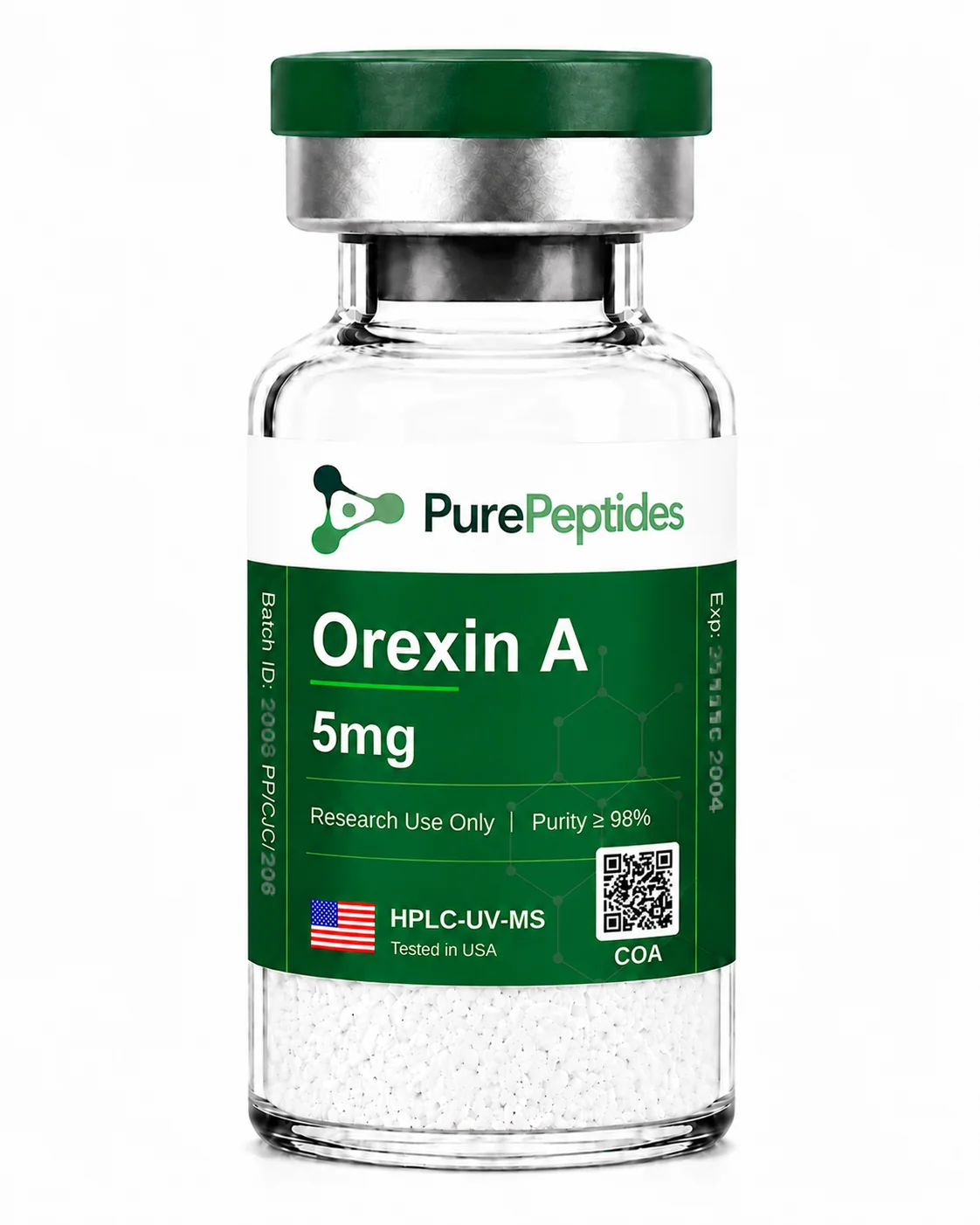
Orexin A
$35.00
Supplied as a lyophilised powder and independently verified to ≥98% purity by HPLC and MS-UPLC analysis.
1000 in stock
🔥 Exclusive Crypto Offer
Get an INSTANT 15% DISCOUNT when you pay with Bitcoin, Ethereum, Dogecoin, Bitcoin Cash, XRP, Solana, or USDT.
⚡ Don't have crypto? Buy it here in 5 minutes with easy guidance.
💡 Pro Tip: You can also pay with cryptocurrency using your verified Cash App or PayPal account for a fast and secure checkout!
What is Orexin A?
Orexin A is a 33-amino-acid brain peptide made by a small group of neurons in the hypothalamus. It plays a central role in staying awake and alert and in appetite, and is studied in animal research for its effects on sleep-wake and appetite signaling.
- A brain peptide central to wakefulness and alertness signaling
- Activates both orexin receptors, which coordinate sleep-wake cycles and feeding
- Loss of orexin neurons is linked to sleep-wake disruption in research
- Studied in animal research for its effects on sleep-wake and appetite signaling
For research use only. Not approved for human therapeutic use.
Orexin A (CAS 205640-90-0), also known as Hypocretin-1, is a synthetic 33-amino acid neuropeptide with a molecular weight of 3561.97 g/mol. Its structure features an N-terminal pyroglutamyl residue and two intramolecular disulfide bridges between Cys6-Cys12 and Cys7-Cys14, a structural arrangement that confers a compact, folded conformation considered central to its receptor binding characteristics. The amino acid sequence is fully conserved across human, bovine, mouse, and rat species. Produced via solid-phase peptide synthesis, Hypocretin-1 acts as an endogenous agonist at both orexin receptors, OX1R and OX2R.
Orexin A has been investigated in preclinical sleep neuroscience and neuroendocrine research. The orexinergic projection system, originating in the lateral hypothalamus, has been found to be implicated in the regulation of arousal state transitions, and the loss of orexin-producing neurons has been documented as a central feature of narcolepsy type 1 research models. In vitro receptor pharmacology studies have characterised Orexin A binding affinity at OX1R and OX2R, documenting Ki values in the low nanomolar range and characterising downstream Gq-coupled intracellular calcium signalling as a primary readout of orexin receptor activation in cell-based pharmacological preparations [1]. In vivo rodent studies have investigated Orexin A’s interaction with sleep-wake circuitry, documenting that central administration of Hypocretin-1 activates locus coeruleus cell firing and increases arousal under controlled experimental conditions, characterising orexin receptor-mediated activation of noradrenergic wakefulness circuitry as a primary in vivo pharmacological property of the compound [2], making Orexin A a key reference compound in neuropeptide research examining orexin receptor pharmacology and the neuroendocrine regulation of arousal state transitions.
Orexin A is produced to research-grade standards and independently verified by third-party HPLC and MS-UPLC analysis before dispatch. Vials are vacuum sealed and stored in a temperature controlled, monitored cold storage system. Certificates of Analysis are available on request.
Sold strictly for in vitro research purposes only. Not for human consumption. Intended for use by qualified researchers in laboratory settings only.
References
1Sakurai T, Amemiya A, Ishii M, Matsuzaki I, Chemelli RM, Tanaka H, et al. Orexins and orexin receptors: a family of hypothalamic neuropeptides and G protein-coupled receptors that regulate feeding behavior. Cell. 1998 Feb 20;92(4):573–85. .PubMed PMID: 94918972Hagan JJ, Leslie RA, Patel S, Evans ML, Wattam TA, Holmes S, et al. Orexin A activates locus coeruleus cell firing and increases arousal in the rat. Proc Natl Acad Sci U S A. 1999 Sep 14;96(19):10911–6. ; PubMed Central PMCID: PMC17982.PubMed PMID: 10485925
Scientific Review

Dr. Martina Rossi, PhD
Scientific Contributor and Reviewer
Reviewed for scientific accuracy, 14 June 2026
View credentials →
Orexin A (CAS 205640-90-0), also known as Hypocretin-1, is a synthetic 33-amino acid neuropeptide with a molecular weight of 3561.97 g/mol. Its structure features an N-terminal pyroglutamyl residue and two intramolecular disulfide bridges between Cys6-Cys12 and Cys7-Cys14, a structural arrangement that confers a compact, folded conformation considered central to its receptor binding characteristics. The amino acid sequence is fully conserved across human, bovine, mouse, and rat species. Produced via solid-phase peptide synthesis, Hypocretin-1 acts as an endogenous agonist at both orexin receptors, OX1R and OX2R.
Orexin A has been investigated in preclinical sleep neuroscience and neuroendocrine research. The orexinergic projection system, originating in the lateral hypothalamus, has been found to be implicated in the regulation of arousal state transitions, and the loss of orexin-producing neurons has been documented as a central feature of narcolepsy type 1 research models. In vitro receptor pharmacology studies have characterised Orexin A binding affinity at OX1R and OX2R, documenting Ki values in the low nanomolar range and characterising downstream Gq-coupled intracellular calcium signalling as a primary readout of orexin receptor activation in cell-based pharmacological preparations [1]. In vivo rodent studies have investigated Orexin A’s interaction with sleep-wake circuitry, documenting that central administration of Hypocretin-1 activates locus coeruleus cell firing and increases arousal under controlled experimental conditions, characterising orexin receptor-mediated activation of noradrenergic wakefulness circuitry as a primary in vivo pharmacological property of the compound [2], making Orexin A a key reference compound in neuropeptide research examining orexin receptor pharmacology and the neuroendocrine regulation of arousal state transitions.
Orexin A is produced to research-grade standards and independently verified by third-party HPLC and MS-UPLC analysis before dispatch. Vials are vacuum sealed and stored in a temperature controlled, monitored cold storage system. Certificates of Analysis are available on request.
Sold strictly for in vitro research purposes only. Not for human consumption. Intended for use by qualified researchers in laboratory settings only.
References
1Sakurai T, Amemiya A, Ishii M, Matsuzaki I, Chemelli RM, Tanaka H, et al. Orexins and orexin receptors: a family of hypothalamic neuropeptides and G protein-coupled receptors that regulate feeding behavior. Cell. 1998 Feb 20;92(4):573–85. .PubMed PMID: 94918972Hagan JJ, Leslie RA, Patel S, Evans ML, Wattam TA, Holmes S, et al. Orexin A activates locus coeruleus cell firing and increases arousal in the rat. Proc Natl Acad Sci U S A. 1999 Sep 14;96(19):10911–6. ; PubMed Central PMCID: PMC17982.PubMed PMID: 10485925
Scientific Review
Dr. Martina Rossi, PhD
Scientific Contributor and Reviewer
Reviewed for scientific accuracy, 14 June 2026
View credentials →CAS Number205120-57-8Molecular Weight~3,561.88 g/molPurity≥98%Physical FormLyophilised PowderManufacturingManufactured in an ISO9001 Certified LaboratoryTestingHPLC + MS-UPLCSKURSC-OREXINA-9003
Lyophilised powder: store at -20 °C or below, away from light and moisture. Once reconstituted in an appropriate laboratory diluent (e.g. sterile water, PBS, or assay buffer), store at 2–8 °C and use within the validated period for your protocol. Do not refreeze.
Orexin A (CAS 205640-90-0), also known as Hypocretin-1, is a synthetic 33-amino acid neuropeptide with a molecular weight of 3561.97 g/mol. Its structure features an N-terminal pyroglutamyl residue and two intramolecular disulfide bridges between Cys6-Cys12 and Cys7-Cys14, a structural arrangement that confers a compact, folded conformation considered central to its receptor binding characteristics. The amino acid sequence is fully conserved across human, bovine, mouse, and rat species. Produced via solid-phase peptide synthesis, Hypocretin-1 acts as an endogenous agonist at both orexin receptors, OX1R and OX2R.
Orexin A has been investigated in preclinical sleep neuroscience and neuroendocrine research. The orexinergic projection system, originating in the lateral hypothalamus, has been found to be implicated in the regulation of arousal state transitions, and the loss of orexin-producing neurons has been documented as a central feature of narcolepsy type 1 research models. In vitro receptor pharmacology studies have characterised Orexin A binding affinity at OX1R and OX2R, documenting Ki values in the low nanomolar range and characterising downstream Gq-coupled intracellular calcium signalling as a primary readout of orexin receptor activation in cell-based pharmacological preparations [1]. In vivo rodent studies have investigated Orexin A’s interaction with sleep-wake circuitry, documenting that central administration of Hypocretin-1 activates locus coeruleus cell firing and increases arousal under controlled experimental conditions, characterising orexin receptor-mediated activation of noradrenergic wakefulness circuitry as a primary in vivo pharmacological property of the compound [2], making Orexin A a key reference compound in neuropeptide research examining orexin receptor pharmacology and the neuroendocrine regulation of arousal state transitions.
Orexin A is produced to research-grade standards and independently verified by third-party HPLC and MS-UPLC analysis before dispatch. Vials are vacuum sealed and stored in a temperature controlled, monitored cold storage system. Certificates of Analysis are available on request.
Sold strictly for in vitro research purposes only. Not for human consumption. Intended for use by qualified researchers in laboratory settings only.
References
1Sakurai T, Amemiya A, Ishii M, Matsuzaki I, Chemelli RM, Tanaka H, et al. Orexins and orexin receptors: a family of hypothalamic neuropeptides and G protein-coupled receptors that regulate feeding behavior. Cell. 1998 Feb 20;92(4):573–85. .PubMed PMID: 94918972Hagan JJ, Leslie RA, Patel S, Evans ML, Wattam TA, Holmes S, et al. Orexin A activates locus coeruleus cell firing and increases arousal in the rat. Proc Natl Acad Sci U S A. 1999 Sep 14;96(19):10911–6. ; PubMed Central PMCID: PMC17982.PubMed PMID: 10485925
Scientific Review
Dr. Martina Rossi, PhD
Scientific Contributor and Reviewer
Reviewed for scientific accuracy, 14 June 2026
View credentials →CAS Number205120-57-8Molecular Weight~3,561.88 g/molPurity≥98%Physical FormLyophilised PowderManufacturingManufactured in an ISO9001 Certified LaboratoryTestingHPLC + MS-UPLCSKURSC-OREXINA-9003
Lyophilised powder: store at -20 °C or below, away from light and moisture. Once reconstituted in an appropriate laboratory diluent (e.g. sterile water, PBS, or assay buffer), store at 2–8 °C and use within the validated period for your protocol. Do not refreeze.
Related products

Cognitive & Neuropeptide Research
Cognitive & Neuropeptide Research

Cognitive & Neuropeptide Research

Cognitive & Neuropeptide Research
Cognitive & Neuropeptide Research
Cognitive & Neuropeptide Research
Cognitive & Neuropeptide Research
Cognitive & Neuropeptide Research