
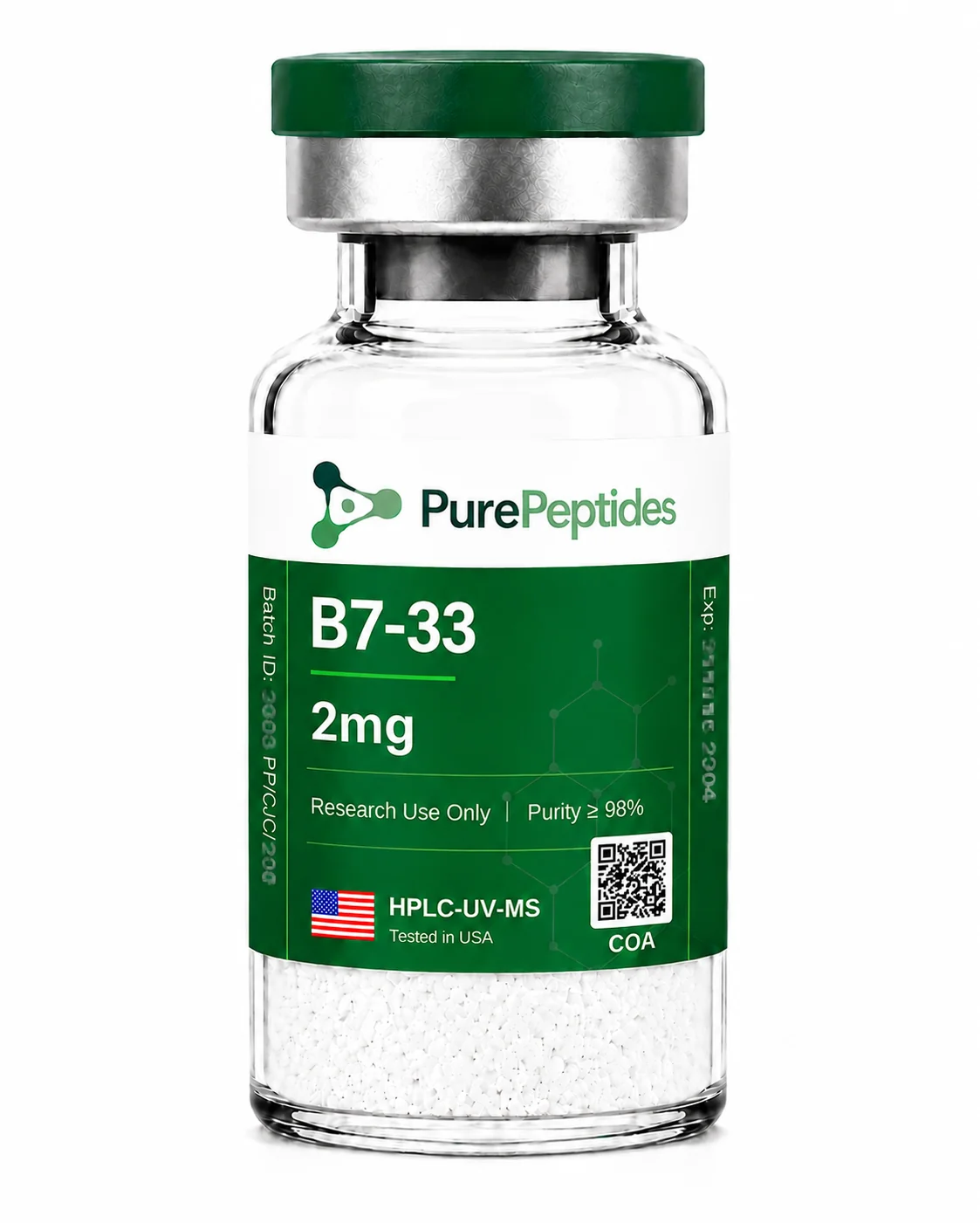
B7-33

$59.00
Supplied as a lyophilised powder and independently verified to ≥98% purity by HPLC and MS-UPLC analysis.
1000 in stock
🔥 Exclusive Crypto Offer
Get an INSTANT 15% DISCOUNT when you pay with Bitcoin, Ethereum, Dogecoin, Bitcoin Cash, XRP, Solana, or USDT.
⚡ Don't have crypto? Buy it here in 5 minutes with easy guidance.
💡 Pro Tip: You can also pay with cryptocurrency using your verified Cash App or PayPal account for a fast and secure checkout!
What is B7-33?
B7-33 is a single-chain synthetic peptide based on the B-chain of human relaxin-2, designed to keep relaxin’s anti-scarring and blood-vessel signaling while being easier to make. It is studied in animal research for its effects on tissue scarring in the heart, lungs, kidneys and liver.
- Based on human relaxin-2, studied for relaxin-receptor signaling similar to the full hormone
- Studied in animal research for its effects on tissue scarring and collagen buildup in organs
- Investigated in three rodent models of organ scarring, with activity comparable to the parent hormone
- Works on pathways involved in remodeling the tissue scaffold and turning over collagen
For research use only. Not approved for human therapeutic use.
B7-33 is a synthetic single-chain peptide analogue of human relaxin-2 with a molecular weight of 2987.75 g/mol. Its structure corresponds to residues 7 through 33 of the B-chain of relaxin-2, a 27-amino acid linear fragment that retains the receptor-binding determinants for the relaxin family peptide receptor 1 (RXFP1) while eliminating the two-chain disulfide-linked architecture of the native heterodimeric relaxin-2 hormone. B7-33 was designed as a simplified, single-chain alternative that maintains RXFP1 binding and activation. Produced via solid-phase peptide synthesis, B7-33 is associated with RXFP1-mediated signalling and extracellular matrix remodelling pathways.
B7-33 is a structurally simplified relaxin-2 mimetic that overcomes the challenges associated with the native two-chain disulfide hormone. In vitro studies have characterised B7-33 as a functionally selective agonist of RXFP1: it binds the receptor with lower affinity than native H2 relaxin and is only a weak activator of the cAMP pathway, yet it drives ERK1/2 phosphorylation with potency comparable to H2 relaxin in cells that natively express RXFP1, and increases expression of the collagen-degrading enzyme matrix metalloproteinase-2 (MMP-2) in human cardiac fibroblasts and rat renal myofibroblasts [1]. In vivo rodent studies have shown that B7-33 prevented or reversed organ fibrosis and dysfunction with potency similar to H2 relaxin across three preclinical rodent models, and that an acute bolus of B7-33 reproduced the rapid vasoprotective/vascular-function effects of serelaxin in rat mesenteric artery, small renal artery and abdominal aorta [1][2], making B7-33 a reference compound in preclinical cardiovascular and fibrosis research examining single-chain, functionally selective RXFP1 agonism and pERK1/2–MMP-2-directed extracellular matrix remodelling in rodent models.
B7-33 is produced to research-grade standards and independently verified by third-party HPLC and MS-UPLC analysis before dispatch. Vials are vacuum sealed and stored in a temperature controlled, monitored cold storage system. Certificates of Analysis are available on request.
Sold strictly for in vitro research purposes only. Not for human consumption. Intended for use by qualified researchers in laboratory settings only.
References
1Hossain MA, Kocan M, Yao ST, Royce SG, Nair VB, Siwek C, et al. A single-chain derivative of the relaxin hormone is a functionally selective agonist of the G protein-coupled receptor, RXFP1. Chem Sci. 2016 Jun 1;7(6):3805–19. ; PubMed Central PMCID: PMC6013806.PubMed PMID: 301550232Marshall SA, O’Sullivan K, Ng HH, Bathgate RAD, Parry LJ, Hossain MA, et al. B7-33 replicates the vasoprotective functions of human relaxin-2 (serelaxin). Eur J Pharmacol. 2017 Jul 15;807:190–7. .PubMed PMID: 28478069
Scientific Review

Dr. Martina Rossi, PhD
Scientific Contributor and Reviewer
Reviewed for scientific accuracy, 14 June 2026
View credentials →
B7-33 is a synthetic single-chain peptide analogue of human relaxin-2 with a molecular weight of 2987.75 g/mol. Its structure corresponds to residues 7 through 33 of the B-chain of relaxin-2, a 27-amino acid linear fragment that retains the receptor-binding determinants for the relaxin family peptide receptor 1 (RXFP1) while eliminating the two-chain disulfide-linked architecture of the native heterodimeric relaxin-2 hormone. B7-33 was designed as a simplified, single-chain alternative that maintains RXFP1 binding and activation. Produced via solid-phase peptide synthesis, B7-33 is associated with RXFP1-mediated signalling and extracellular matrix remodelling pathways.
B7-33 is a structurally simplified relaxin-2 mimetic that overcomes the challenges associated with the native two-chain disulfide hormone. In vitro studies have characterised B7-33 as a functionally selective agonist of RXFP1: it binds the receptor with lower affinity than native H2 relaxin and is only a weak activator of the cAMP pathway, yet it drives ERK1/2 phosphorylation with potency comparable to H2 relaxin in cells that natively express RXFP1, and increases expression of the collagen-degrading enzyme matrix metalloproteinase-2 (MMP-2) in human cardiac fibroblasts and rat renal myofibroblasts [1]. In vivo rodent studies have shown that B7-33 prevented or reversed organ fibrosis and dysfunction with potency similar to H2 relaxin across three preclinical rodent models, and that an acute bolus of B7-33 reproduced the rapid vasoprotective/vascular-function effects of serelaxin in rat mesenteric artery, small renal artery and abdominal aorta [1][2], making B7-33 a reference compound in preclinical cardiovascular and fibrosis research examining single-chain, functionally selective RXFP1 agonism and pERK1/2–MMP-2-directed extracellular matrix remodelling in rodent models.
B7-33 is produced to research-grade standards and independently verified by third-party HPLC and MS-UPLC analysis before dispatch. Vials are vacuum sealed and stored in a temperature controlled, monitored cold storage system. Certificates of Analysis are available on request.
Sold strictly for in vitro research purposes only. Not for human consumption. Intended for use by qualified researchers in laboratory settings only.
References
1Hossain MA, Kocan M, Yao ST, Royce SG, Nair VB, Siwek C, et al. A single-chain derivative of the relaxin hormone is a functionally selective agonist of the G protein-coupled receptor, RXFP1. Chem Sci. 2016 Jun 1;7(6):3805–19. ; PubMed Central PMCID: PMC6013806.PubMed PMID: 301550232Marshall SA, O’Sullivan K, Ng HH, Bathgate RAD, Parry LJ, Hossain MA, et al. B7-33 replicates the vasoprotective functions of human relaxin-2 (serelaxin). Eur J Pharmacol. 2017 Jul 15;807:190–7. .PubMed PMID: 28478069
Scientific Review
Dr. Martina Rossi, PhD
Scientific Contributor and Reviewer
Reviewed for scientific accuracy, 14 June 2026
View credentials →CAS NumberN/A (novel synthetic analogue)Molecular Weight~2,850 g/molPurity≥98%Physical FormLyophilised PowderManufacturingManufactured in an ISO9001 Certified LaboratoryTestingHPLC + MS-UPLCSKURSC-B733-0891
Lyophilised powder: store at -20 °C or below, away from light and moisture. Once reconstituted in an appropriate laboratory diluent (e.g. sterile water, PBS, or assay buffer), store at 2–8 °C and use within the validated period for your protocol. Do not refreeze.
B7-33 is a synthetic single-chain peptide analogue of human relaxin-2 with a molecular weight of 2987.75 g/mol. Its structure corresponds to residues 7 through 33 of the B-chain of relaxin-2, a 27-amino acid linear fragment that retains the receptor-binding determinants for the relaxin family peptide receptor 1 (RXFP1) while eliminating the two-chain disulfide-linked architecture of the native heterodimeric relaxin-2 hormone. B7-33 was designed as a simplified, single-chain alternative that maintains RXFP1 binding and activation. Produced via solid-phase peptide synthesis, B7-33 is associated with RXFP1-mediated signalling and extracellular matrix remodelling pathways.
B7-33 is a structurally simplified relaxin-2 mimetic that overcomes the challenges associated with the native two-chain disulfide hormone. In vitro studies have characterised B7-33 as a functionally selective agonist of RXFP1: it binds the receptor with lower affinity than native H2 relaxin and is only a weak activator of the cAMP pathway, yet it drives ERK1/2 phosphorylation with potency comparable to H2 relaxin in cells that natively express RXFP1, and increases expression of the collagen-degrading enzyme matrix metalloproteinase-2 (MMP-2) in human cardiac fibroblasts and rat renal myofibroblasts [1]. In vivo rodent studies have shown that B7-33 prevented or reversed organ fibrosis and dysfunction with potency similar to H2 relaxin across three preclinical rodent models, and that an acute bolus of B7-33 reproduced the rapid vasoprotective/vascular-function effects of serelaxin in rat mesenteric artery, small renal artery and abdominal aorta [1][2], making B7-33 a reference compound in preclinical cardiovascular and fibrosis research examining single-chain, functionally selective RXFP1 agonism and pERK1/2–MMP-2-directed extracellular matrix remodelling in rodent models.
B7-33 is produced to research-grade standards and independently verified by third-party HPLC and MS-UPLC analysis before dispatch. Vials are vacuum sealed and stored in a temperature controlled, monitored cold storage system. Certificates of Analysis are available on request.
Sold strictly for in vitro research purposes only. Not for human consumption. Intended for use by qualified researchers in laboratory settings only.
References
1Hossain MA, Kocan M, Yao ST, Royce SG, Nair VB, Siwek C, et al. A single-chain derivative of the relaxin hormone is a functionally selective agonist of the G protein-coupled receptor, RXFP1. Chem Sci. 2016 Jun 1;7(6):3805–19. ; PubMed Central PMCID: PMC6013806.PubMed PMID: 301550232Marshall SA, O’Sullivan K, Ng HH, Bathgate RAD, Parry LJ, Hossain MA, et al. B7-33 replicates the vasoprotective functions of human relaxin-2 (serelaxin). Eur J Pharmacol. 2017 Jul 15;807:190–7. .PubMed PMID: 28478069
Scientific Review
Dr. Martina Rossi, PhD
Scientific Contributor and Reviewer
Reviewed for scientific accuracy, 14 June 2026
View credentials →CAS NumberN/A (novel synthetic analogue)Molecular Weight~2,850 g/molPurity≥98%Physical FormLyophilised PowderManufacturingManufactured in an ISO9001 Certified LaboratoryTestingHPLC + MS-UPLCSKURSC-B733-0891
Lyophilised powder: store at -20 °C or below, away from light and moisture. Once reconstituted in an appropriate laboratory diluent (e.g. sterile water, PBS, or assay buffer), store at 2–8 °C and use within the validated period for your protocol. Do not refreeze.
Related products
Regeneration Research

Regeneration Research
Regeneration Research
Regeneration Research
Regeneration Research
Regeneration Research
Regeneration Research

Regeneration Research