
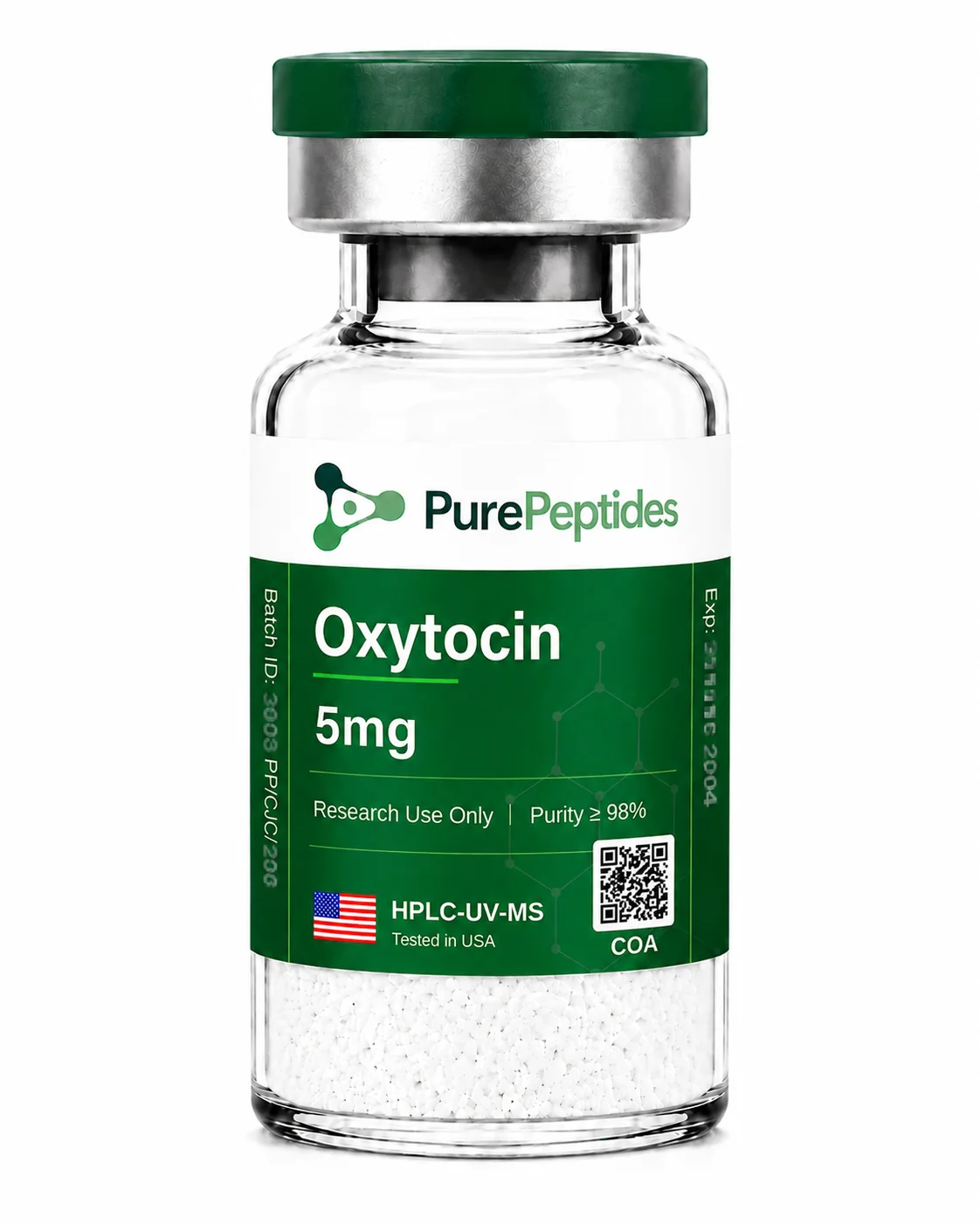
Oxytocin
$57.00
Supplied as a lyophilised powder and independently verified to ≥98% purity by HPLC and MS-UPLC analysis.
1000 in stock
🔥 Exclusive Crypto Offer
Get an INSTANT 15% DISCOUNT when you pay with Bitcoin, Ethereum, Dogecoin, Bitcoin Cash, XRP, Solana, or USDT.
⚡ Don't have crypto? Buy it here in 5 minutes with easy guidance.
💡 Pro Tip: You can also pay with cryptocurrency using your verified Cash App or PayPal account for a fast and secure checkout!
What is Oxytocin?
Oxytocin is a natural nine-amino-acid brain hormone made in the hypothalamus. It acts on oxytocin receptors throughout the brain and body and is studied in animal research as a tool for social-behavior and hormone-signaling research.
- A nine-amino-acid brain peptide with an internal loop (disulfide bridge)
- Acts on oxytocin receptors in the brain and body
- Studied in animal research on social behavior, bonding and hormone signaling
- Used in receptor research to map oxytocin signaling
For research use only. Not approved for human therapeutic use.
Oxytocin (CAS 50-56-6) is a synthetic cyclic nonapeptide neurohormone with the molecular formula C43H66N12O12S2 and a molecular weight of 1007.19 g/mol. Defined by the amino acid sequence Cys-Tyr-Ile-Gln-Asn-Cys-Pro-Leu-Gly-NH2, Oxytocin features a characteristic intramolecular disulfide bridge between Cys1 and Cys6 that forms a 20-membered tocin ring, a structural motif shared with the structurally related neurohormone vasopressin. Produced via solid-phase peptide synthesis, Oxytocin signals through the Oxytocin receptor (OTR), a class I G protein-coupled receptor, and is one of the most extensively studied neuropeptides in biomedical research.
Oxytocin has been extensively investigated in preclinical neuroscience, reproductive endocrinology, and behavioural pharmacology as one of the most widely studied signalling peptides across these disciplines. Its receptor, OTR, has been documented in published studies as expressed throughout the central nervous system, uterine myometrium, mammary tissue, and multiple peripheral organ systems. In vitro studies in human myometrial cell preparations have characterised OTR-mediated Gq/11-coupled phospholipase C activation and intracellular calcium mobilisation, documenting phosphoinositide hydrolysis as a primary downstream readout of OTR signalling and characterising the pertussis toxin-insensitive G-protein mechanism of PLC engagement in peripheral uterine cell preparations [1]. In vivo rodent studies have investigated central Oxytocin signalling within hypothalamic circuits, documenting activity-dependent neuropeptide release dynamics from the dendritic compartments of hypothalamic oxytocinergic neurons and characterising the role of intracellular calcium stores in regulating neuropeptide release under varied experimental conditions within hypothalamic circuitry [2], making Oxytocin a key reference compound in neuropeptide research examining OTR-mediated signalling across central and peripheral biological systems.
Oxytocin is produced to research-grade standards and independently verified by third-party HPLC and MS-UPLC analysis before dispatch. Vials are vacuum sealed and stored in a temperature controlled, monitored cold storage system. Certificates of Analysis are available on request.
Sold strictly for in vitro research purposes only. Not for human consumption. Intended for use by qualified researchers in laboratory settings only.
References
1Phaneuf S, Europe-Finner GN, Varney M, MacKenzie IZ, Watson SP, López Bernal A. Oxytocin-stimulated phosphoinositide hydrolysis in human myometrial cells: involvement of pertussis toxin-sensitive and -insensitive G-proteins. J Endocrinol. 1993 Mar;136(3):497–509. .PubMed PMID: 83862152Ludwig M, Sabatier N, Bull PM, Landgraf R, Dayanithi G, Leng G. Intracellular calcium stores regulate activity-dependent neuropeptide release from dendrites. Nature. 2002 Jul 4;418(6893):85–9. .PubMed PMID: 12097911
Scientific Review

Dr. Martina Rossi, PhD
Scientific Contributor and Reviewer
Reviewed for scientific accuracy, 14 June 2026
View credentials →
Oxytocin (CAS 50-56-6) is a synthetic cyclic nonapeptide neurohormone with the molecular formula C43H66N12O12S2 and a molecular weight of 1007.19 g/mol. Defined by the amino acid sequence Cys-Tyr-Ile-Gln-Asn-Cys-Pro-Leu-Gly-NH2, Oxytocin features a characteristic intramolecular disulfide bridge between Cys1 and Cys6 that forms a 20-membered tocin ring, a structural motif shared with the structurally related neurohormone vasopressin. Produced via solid-phase peptide synthesis, Oxytocin signals through the Oxytocin receptor (OTR), a class I G protein-coupled receptor, and is one of the most extensively studied neuropeptides in biomedical research.
Oxytocin has been extensively investigated in preclinical neuroscience, reproductive endocrinology, and behavioural pharmacology as one of the most widely studied signalling peptides across these disciplines. Its receptor, OTR, has been documented in published studies as expressed throughout the central nervous system, uterine myometrium, mammary tissue, and multiple peripheral organ systems. In vitro studies in human myometrial cell preparations have characterised OTR-mediated Gq/11-coupled phospholipase C activation and intracellular calcium mobilisation, documenting phosphoinositide hydrolysis as a primary downstream readout of OTR signalling and characterising the pertussis toxin-insensitive G-protein mechanism of PLC engagement in peripheral uterine cell preparations [1]. In vivo rodent studies have investigated central Oxytocin signalling within hypothalamic circuits, documenting activity-dependent neuropeptide release dynamics from the dendritic compartments of hypothalamic oxytocinergic neurons and characterising the role of intracellular calcium stores in regulating neuropeptide release under varied experimental conditions within hypothalamic circuitry [2], making Oxytocin a key reference compound in neuropeptide research examining OTR-mediated signalling across central and peripheral biological systems.
Oxytocin is produced to research-grade standards and independently verified by third-party HPLC and MS-UPLC analysis before dispatch. Vials are vacuum sealed and stored in a temperature controlled, monitored cold storage system. Certificates of Analysis are available on request.
Sold strictly for in vitro research purposes only. Not for human consumption. Intended for use by qualified researchers in laboratory settings only.
References
1Phaneuf S, Europe-Finner GN, Varney M, MacKenzie IZ, Watson SP, López Bernal A. Oxytocin-stimulated phosphoinositide hydrolysis in human myometrial cells: involvement of pertussis toxin-sensitive and -insensitive G-proteins. J Endocrinol. 1993 Mar;136(3):497–509. .PubMed PMID: 83862152Ludwig M, Sabatier N, Bull PM, Landgraf R, Dayanithi G, Leng G. Intracellular calcium stores regulate activity-dependent neuropeptide release from dendrites. Nature. 2002 Jul 4;418(6893):85–9. .PubMed PMID: 12097911
Scientific Review
Dr. Martina Rossi, PhD
Scientific Contributor and Reviewer
Reviewed for scientific accuracy, 14 June 2026
View credentials →CAS Number50-56-6Molecular Weight1,007.19 g/molPurity≥98%Physical FormLyophilised PowderManufacturingManufactured in an ISO9001 Certified LaboratoryTestingHPLC + MS-UPLCSKUOXT
Lyophilised powder: store at -20 °C or below, away from light and moisture. Once reconstituted in an appropriate laboratory diluent (e.g. sterile water, PBS, or assay buffer), store at 2–8 °C and use within the validated period for your protocol. Do not refreeze.
Oxytocin (CAS 50-56-6) is a synthetic cyclic nonapeptide neurohormone with the molecular formula C43H66N12O12S2 and a molecular weight of 1007.19 g/mol. Defined by the amino acid sequence Cys-Tyr-Ile-Gln-Asn-Cys-Pro-Leu-Gly-NH2, Oxytocin features a characteristic intramolecular disulfide bridge between Cys1 and Cys6 that forms a 20-membered tocin ring, a structural motif shared with the structurally related neurohormone vasopressin. Produced via solid-phase peptide synthesis, Oxytocin signals through the Oxytocin receptor (OTR), a class I G protein-coupled receptor, and is one of the most extensively studied neuropeptides in biomedical research.
Oxytocin has been extensively investigated in preclinical neuroscience, reproductive endocrinology, and behavioural pharmacology as one of the most widely studied signalling peptides across these disciplines. Its receptor, OTR, has been documented in published studies as expressed throughout the central nervous system, uterine myometrium, mammary tissue, and multiple peripheral organ systems. In vitro studies in human myometrial cell preparations have characterised OTR-mediated Gq/11-coupled phospholipase C activation and intracellular calcium mobilisation, documenting phosphoinositide hydrolysis as a primary downstream readout of OTR signalling and characterising the pertussis toxin-insensitive G-protein mechanism of PLC engagement in peripheral uterine cell preparations [1]. In vivo rodent studies have investigated central Oxytocin signalling within hypothalamic circuits, documenting activity-dependent neuropeptide release dynamics from the dendritic compartments of hypothalamic oxytocinergic neurons and characterising the role of intracellular calcium stores in regulating neuropeptide release under varied experimental conditions within hypothalamic circuitry [2], making Oxytocin a key reference compound in neuropeptide research examining OTR-mediated signalling across central and peripheral biological systems.
Oxytocin is produced to research-grade standards and independently verified by third-party HPLC and MS-UPLC analysis before dispatch. Vials are vacuum sealed and stored in a temperature controlled, monitored cold storage system. Certificates of Analysis are available on request.
Sold strictly for in vitro research purposes only. Not for human consumption. Intended for use by qualified researchers in laboratory settings only.
References
1Phaneuf S, Europe-Finner GN, Varney M, MacKenzie IZ, Watson SP, López Bernal A. Oxytocin-stimulated phosphoinositide hydrolysis in human myometrial cells: involvement of pertussis toxin-sensitive and -insensitive G-proteins. J Endocrinol. 1993 Mar;136(3):497–509. .PubMed PMID: 83862152Ludwig M, Sabatier N, Bull PM, Landgraf R, Dayanithi G, Leng G. Intracellular calcium stores regulate activity-dependent neuropeptide release from dendrites. Nature. 2002 Jul 4;418(6893):85–9. .PubMed PMID: 12097911
Scientific Review
Dr. Martina Rossi, PhD
Scientific Contributor and Reviewer
Reviewed for scientific accuracy, 14 June 2026
View credentials →CAS Number50-56-6Molecular Weight1,007.19 g/molPurity≥98%Physical FormLyophilised PowderManufacturingManufactured in an ISO9001 Certified LaboratoryTestingHPLC + MS-UPLCSKUOXT
Lyophilised powder: store at -20 °C or below, away from light and moisture. Once reconstituted in an appropriate laboratory diluent (e.g. sterile water, PBS, or assay buffer), store at 2–8 °C and use within the validated period for your protocol. Do not refreeze.
Related products

Regeneration Research
Regeneration Research
Regeneration Research
Regeneration Research
Regeneration Research

Regeneration Research
Regeneration Research
Regeneration Research